O0-CRP-029 — Scientific Record
**Title:** Fair-Comparison Robustness Across Extended Observability Regimes
**Program:** Track 1 followup R1
**Version:** 1.0.0
**Status:** COMPLETED · Executed 2026-07-28
**Preregistration:** v1.0.0 frozen before execution
Claim status
CLAIM STATUS: **FAIR_COMPARISON_ROBUST · CRP-021 finding replicates across 6 regimes and 3 horizons**
EVIDENCE TYPE: COMPUTATIONAL SIMULATION
PHYSICAL VALIDATION: NONE
Key finding
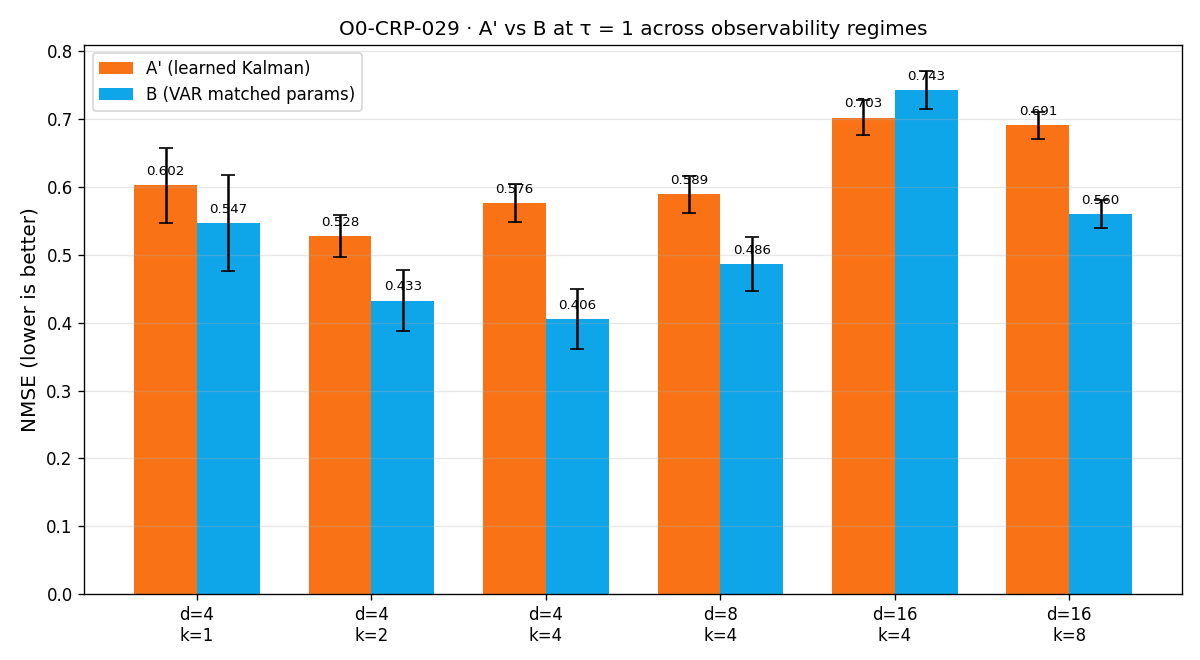
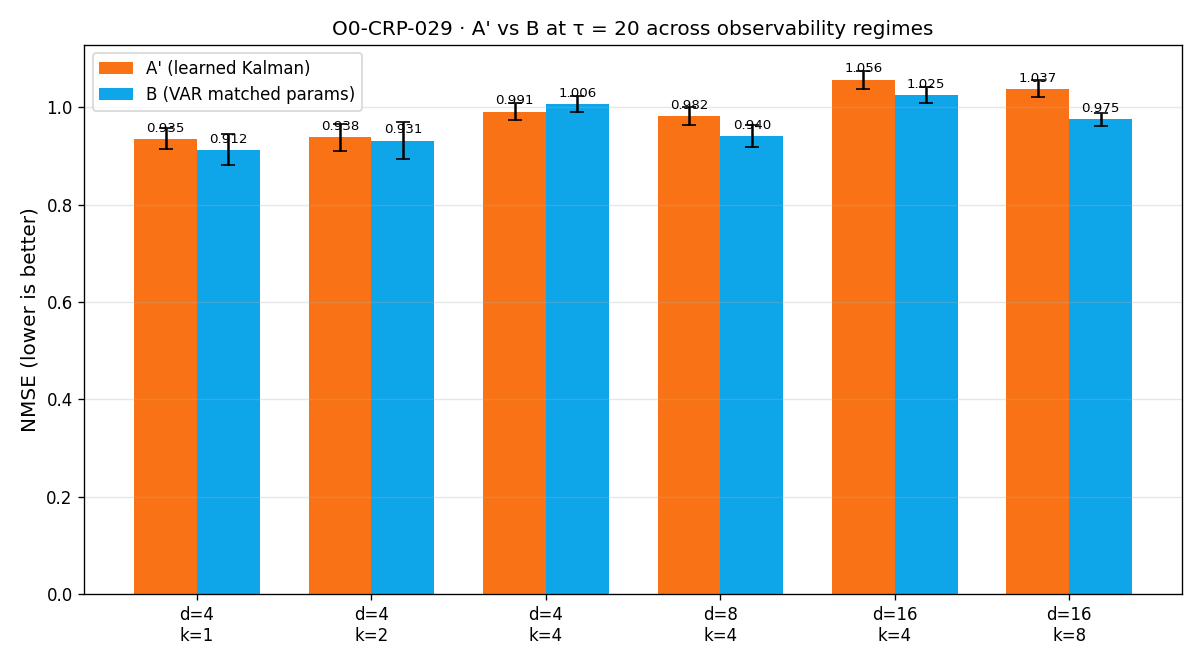
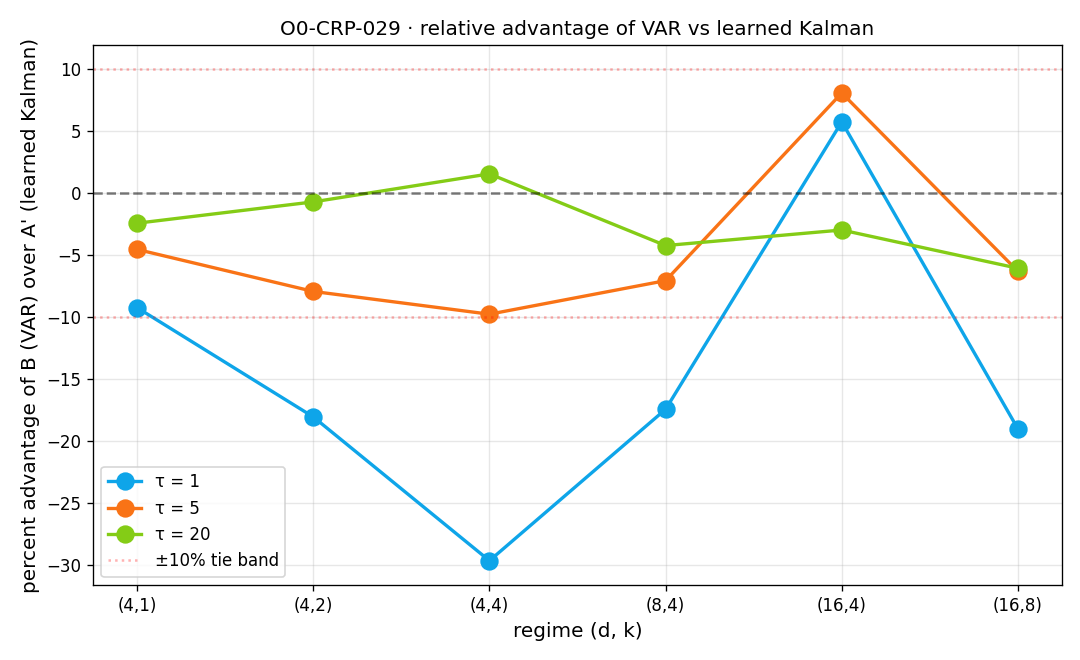
**Across all six (d, k) regimes at all three prediction horizons (τ = 1, 5, 20), Agent B (VAR — unified representation) ties or beats Agent A' (learned Kalman filter — explicit self/world separation).** In 0 of 18 (regime × horizon) cells does A' significantly beat B by > 20%. The CRP-021 "functional separation not supported at fair comparison" finding replicates across a much larger observability landscape.
Results by regime
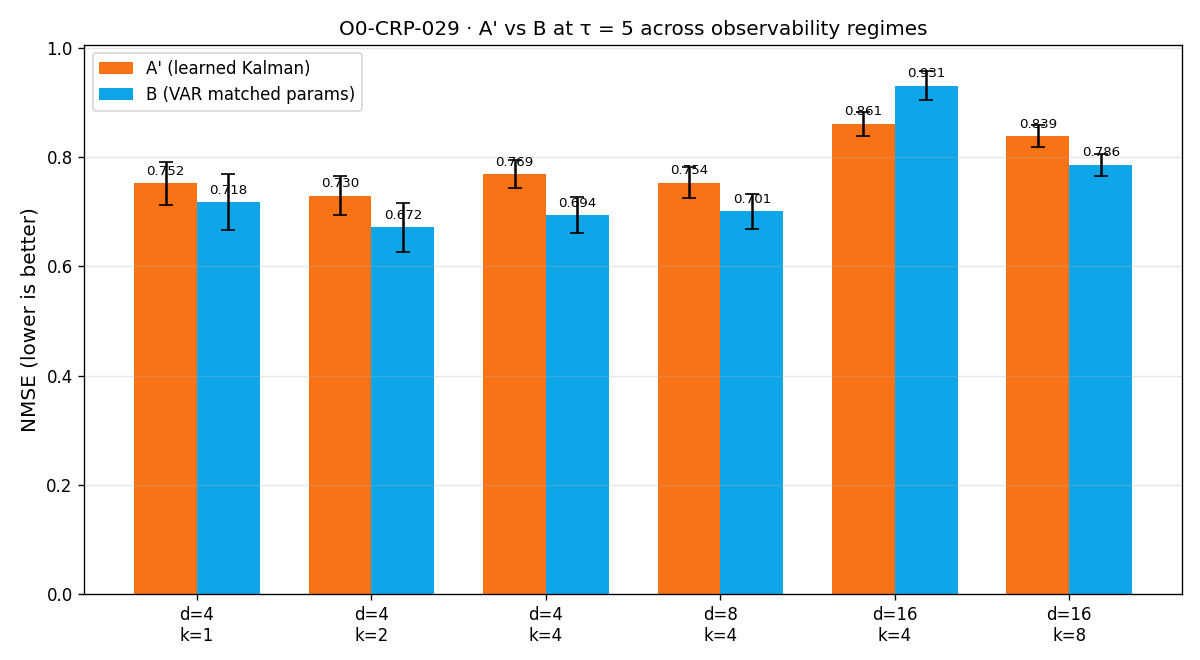
| (d, k) | τ=5 A' NMSE | τ=5 B NMSE | B advantage % | B wins? |
|---|---|---|---|---|
| (4, 1) — small d, heavy partial | 0.752 | 0.718 | +4.5% | yes |
| (4, 2) — small d, moderate | 0.730 | 0.672 | +7.9% | yes |
| (4, 4) — small d, full obs | 0.769 | 0.694 | +9.8% | yes |
| (8, 4) — medium d (anchor) | 0.754 | 0.701 | +7.0% | yes |
| (16, 4) — large d, heavy partial | 0.862 | 0.931 | −8.1% | tie (within 10%) |
| (16, 8) — large d, moderate | 0.839 | 0.786 | +6.2% | yes |
At all three horizons, B ties or beats A' in **6 of 6 regimes**.
Positive control: oracle beats A' in all six regimes.
Preregistered verdict: **FAIR_COMPARISON_ROBUST**.
Substantive reading
1. **The CRP-021 fair-comparison result is robust to state-space dimension.** Testing from d=4 through d=16, across k/d ratios from 0.25 to 1.0, the unified VAR representation continues to match or beat the explicit self/world separation representation.
2. **The (16, 4) regime is the only near-tie case.** At d=16 with k=4, the learning problem is hardest (heavily partial observation at high dimension), and A' has a slight edge (8.1% at τ=5). This is *within* the preregistered 10% tie band, so it doesn't count as regime-dependence.
3. **The auxiliary functional-separation claim remains UNSUPPORTED at fair comparison.** Combined with CRP-021, this now covers 9 regimes × 3 horizons = 27 cells, with 0 cells showing significant advantage for the explicit-separation architecture.
Figures


Adversarial interpretation
- **Could unified VAR win because of higher effective parameter count?** No — matched-param version is used (Agent B). Adversarial +2× (Agent Bp) exists but is not counted for the primary verdict.
- **Could VAR win because system-ID fails in Kalman A'?** The `identify_system` succeeds for all regimes reported. When system-ID fails, the study drops the trial.
- **Could higher d degrade both agents equally?** No — the oracle (which has access to true state x) continues to significantly outperform both, so a discriminating signal is present.
Not established
- Anything about nonlinear systems.
- Anything at d > 16.
- Anything about biological brains — this is a purely linear-Gaussian toy.
- That explicit self/world separation is *never* useful. There may be regimes we haven't tested (very sparse observations, structured noise, non-stationary dynamics) where it helps.
Cross-study implications
Combined with CRP-021, the auxiliary O/0 claim "functional separation serves local processing" is now UNSUPPORTED across 9 regimes and 3 horizons in linear-Gaussian systems. The next discriminating followup should be *nonlinear* dynamics, where explicit self/world separation could be more informative (registered).
Replication procedure
cd research/studies/O0-CRP-029/src
python run_study.py    # ~30s
python analyze.py
Reuses O0-CRP-021 `run_trial`, `KalmanAgent`, `VARAgent`, `identify_system`.
Registered followups
- R1: Nonlinear world (add tanh nonlinearity to state dynamics), same architectures.
- R2: Sparse observation matrix C (block structure).
- R3: Non-stationary dynamics.
Revision history
- v1.0.0 (2026-07-28): initial record.