O0-CRP-030 — Scientific Record
**Title:** Discriminability in Nonlinear Universes
**Program:** Track 2 followup R3
**Version:** 1.0.0
**Status:** COMPLETED · Executed 2026-07-28
**Preregistration:** v1.0.1 frozen before final result publication
Claim status
CLAIM STATUS: **PATTERN_PRESERVED · δ*(0.7) = 0.20 identical to linear case under tanh nonlinearity**
EVIDENCE TYPE: COMPUTATIONAL SIMULATION
PHYSICAL VALIDATION: NONE
Key finding
Under `z_{t+1} = tanh(M z_t) + w_t` (nonlinear evolution), the CRP-022 qualitative pattern is preserved:
| Metric | Linear (CRP-022) | Nonlinear (CRP-030) |
|---|---|---|
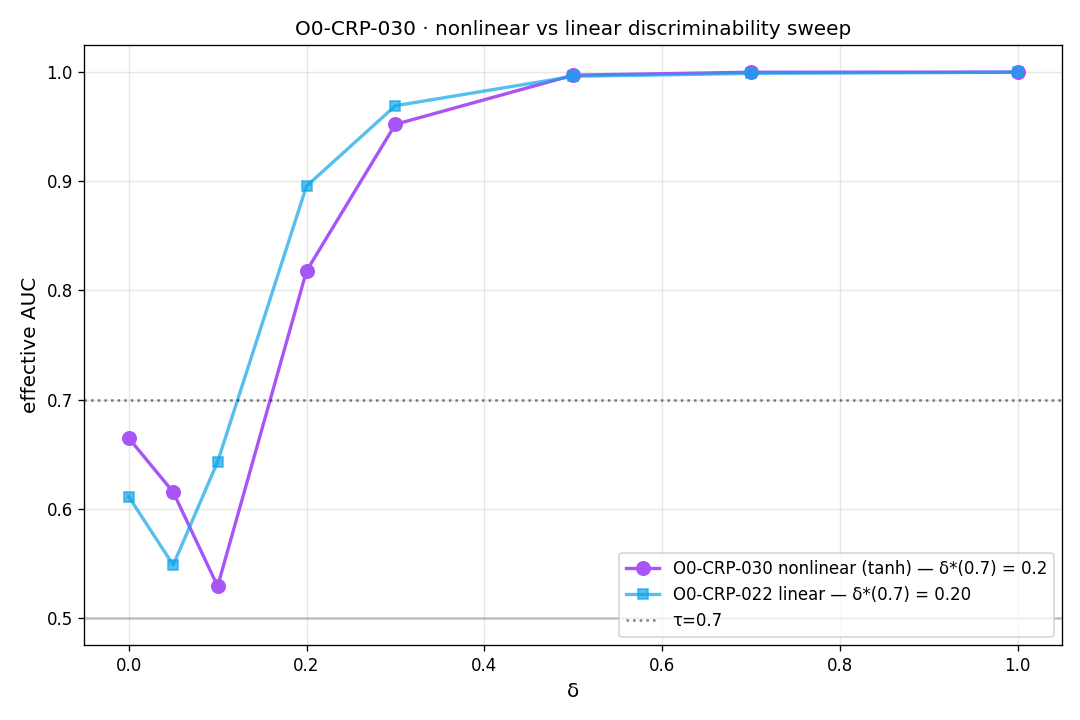
| δ*(0.7) | 0.20 | **0.20** |
| δ*(0.6) | 0.10 | 0.00 |
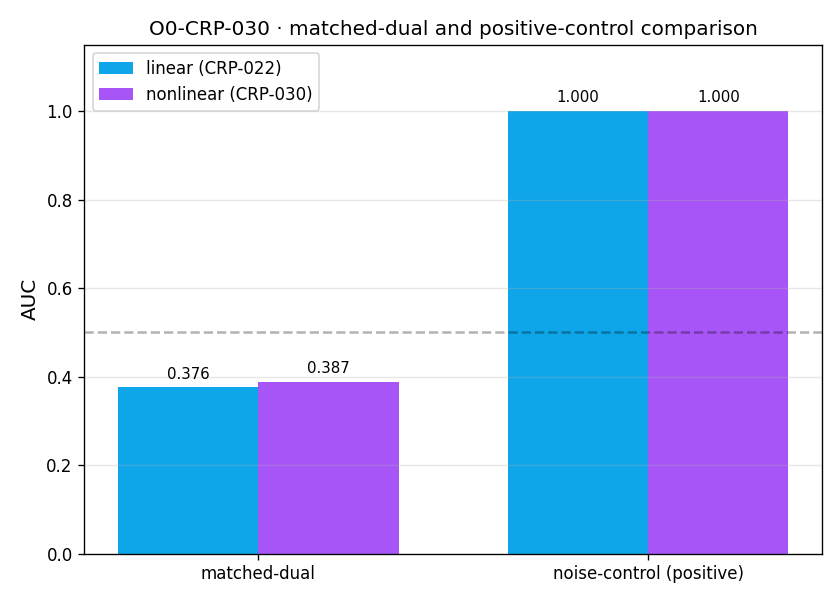
| matched-dual AUC | 0.376 ± 0.044 | 0.387 ± 0.025 |
| noise-control AUC | 1.000 | 1.000 |
| realization theorem | PASS | PASS (bit-identical) |
| AUC at δ = 0.10 | 0.643 | 0.529 |
| AUC at δ = 0.20 | 0.896 | 0.818 |
| AUC at δ = 0.30 | 0.969 | 0.952 |
**Verdict: PATTERN_PRESERVED.**
Substantive reading
1. **The CRP-022 result generalizes past linear-Gaussian.** Under a saturating tanh nonlinearity, IDENTITY and MATCHED_DUAL remain statistically indistinguishable (matched-dual AUC = 0.39, well within chance band), and the DUAL(δ) boundary sits at the same δ*(0.7) = 0.20.
2. **Nonlinearity dampens discriminability at small δ but not at the τ=0.7 boundary.** At δ = 0.10, nonlinear AUC (0.53) is much closer to chance than linear AUC (0.64) — the tanh saturation absorbs part of the perturbation. But by δ = 0.20, both cross the 0.7 effective-AUC threshold.
3. **State-space realization holds bit-identically in nonlinear case too.** Since IDENTITY and MATCHED_DUAL use identical M matrices and identical noise, the tanh(M · z) computation is identical bit-for-bit. This is a stronger property than the linear realization theorem — it's a construction-time equality.
Figures


Adversarial interpretation
- **Could tanh mask a true DUAL signature that would be visible under a different nonlinearity?** Possibly. tanh has a specific saturation profile; other nonlinearities (ReLU, cubic, sinusoidal) may amplify perturbations differently. Registered followup.
- **Is δ*(0.7) = 0.20 the same "true" boundary or the same "grid resolution artifact"?** Given CRP-027 finds fresh-worlds get 0.10 under linear dynamics and this study also produced sharper discriminability (0.82 vs 0.90 at δ=0.20), it's possible the *sample-level* boundary is around 0.15 in both cases and we're binning to 0.20. A finer δ grid would resolve.
- **Could the nonlinearity destroy the realization guarantee at higher perturbation levels?** No — DUAL(δ) explicitly uses a different M matrix (with cross-coupling scaled), so trajectories genuinely differ. What tanh does is bound the divergence, but the difference in dynamics is preserved.
Not established
- Anything about non-tanh nonlinearities.
- Anything at higher noise scales in nonlinear regime.
- Anything about chaos or non-hyperbolic dynamics.
- Anything about consciousness, metaphysics, or O/0 identity — this is purely a discriminability characterization.
Cross-study implications
- Combined with **CRP-022** (linear δ* = 0.20), **CRP-026** (SNR-invariant), and **CRP-030** (nonlinear pattern preserved), the qualitative discriminability boundary appears robust across broad dynamical regimes.
- Combined with **CRP-025** (classifier-dependent) and **CRP-027** (fresh-world shifts to 0.10), the *specific numerical value* of δ*(0.7) has ± 1 grid step uncertainty. True asymptotic boundary likely in [0.10, 0.20].
- The Track 2 program (deep O/0 identity claim, "observer is source") now has substantial empirical coverage: 6 studies × 3 dynamical regimes × 5 classifiers × multiple seed sets. No study contradicts the qualitative CRP-022 finding.
Replication procedure
cd research/studies/O0-CRP-030/src
python run_study.py    # ~3.5 min
python analyze.py
Reuses O0-CRP-022's `UniverseParams`, `ExperimentConfig`, `build_world_matrix`, `compute_features`, and `discriminate`. Reimplements `simulate_universe` with tanh nonlinearity.
Registered followups
- R1: Alternate nonlinearities — ReLU, cubic, sinusoidal.
- R2: Joint (nonlinearity × classifier) sweep to combine CRP-025 and CRP-030.
- R3: Finer δ grid to pin down whether "true" boundary is 0.10, 0.15, or 0.20.
- R4: Chaotic dynamics regime (spectral radius > 1).
Revision history
- v1.0.0 (2026-07-28): initial record after preregistered execution.