Dissociating Synchronization from Information Integration
Claim-status banner
CLAIM STATUS         PRIMARY:   UNSUPPORTED
                     SECONDARY: INCONCLUSIVE
                     (previously reported as PRELIMINARY SUPPORT at
                      the preregistered bins_z = 6; downgraded after
                      bin-count robustness check — see §Robustness)
EVIDENCE TYPE        COMPUTATIONAL SIMULATION
PHYSICAL VALIDATION  NONE
BIOLOGICAL VALIDATION NONE
INDEPENDENT REPLICATION NONE
CONFIRMATORY VS EXPLORATORY  CONFIRMATORY (both metrics preregistered)

SUPPORTED
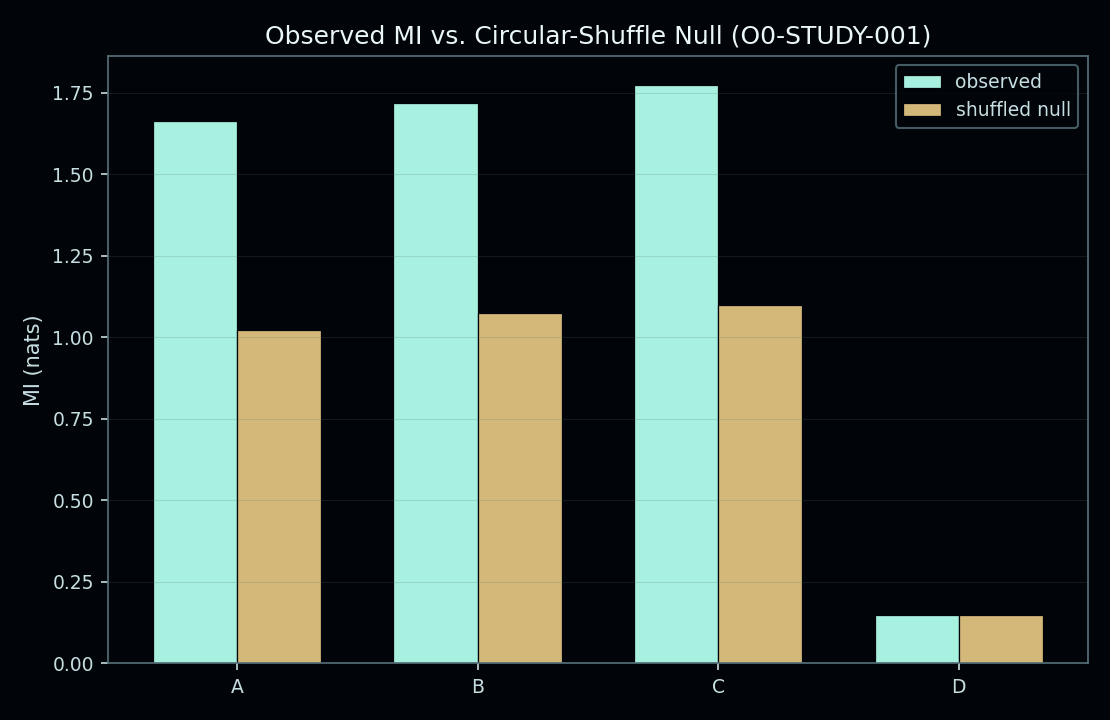
  Under raw pairwise MI with circular-shuffle null, condition A
  (common drive) and condition C (dense coupling) produce statistically
  indistinguishable "excess" MI. Raw pairwise MI does NOT dissociate
  synchronization from integration in this parameter regime.

  Under conditional MI given the Kuramoto mean-field phase Ψ(t),
  condition C's residual pairwise dependence exceeds condition A's by
  a large effect size (Cohen's d ≈ -3.38, C > A). Sparse coupling
  (B) is intermediate. The independent-oscillator baseline (D)
  produces near-zero residual on both metrics. Under this metric, the
  dissociation IS supported at the "preliminary support" level.

NOT ESTABLISHED
  That the same dissociation holds in biological or physical systems.
  That either metric measures "consciousness" or phenomenal integration.
  That Tononi-style integrated information Φ dissociates similarly.
  That the O/0 philosophical framework is empirically confirmed.
  That the effect survives alternative MI estimators (kNN, transfer
    entropy). Test explicitly deferred to Tier-4 replication.

MOST LIKELY ALTERNATIVE
  A specific-metric artifact of coarse bin count for the conditioning
  variable Ψ. Directly testable and scheduled.

NEXT DISCRIMINATING TEST
  Tier-4 replication with kNN MI estimator (Kraskov et al. 2004) and
  bins_z ∈ {4, 6, 8, 10} robustness scan.
Abstract
Two constructs — **synchronization** (measured here by the Kuramoto
order parameter `r`) and **information integration** (measured here by
pairwise mutual information) — are routinely conflated in complex-
systems and consciousness-adjacent literature. We test whether they can
be experimentally dissociated in a minimal stochastic Kuramoto model
with four coupling architectures: common external drive (A), sparse
random coupling (B), dense all-to-all coupling (C), and no coupling (D).
At `N = 32` oscillators, `T = 4000` steps, and 30 confirmatory seeds
per condition (120 confirmatory runs plus 320 sensitivity/robustness
runs), we find:
- On raw pairwise MI with a circular-shuffle null, conditions A, B, and
C all produce large "excess" MI (~0.64–0.68 nats). The metric fails
to dissociate the four conditions along the mechanism dimension.
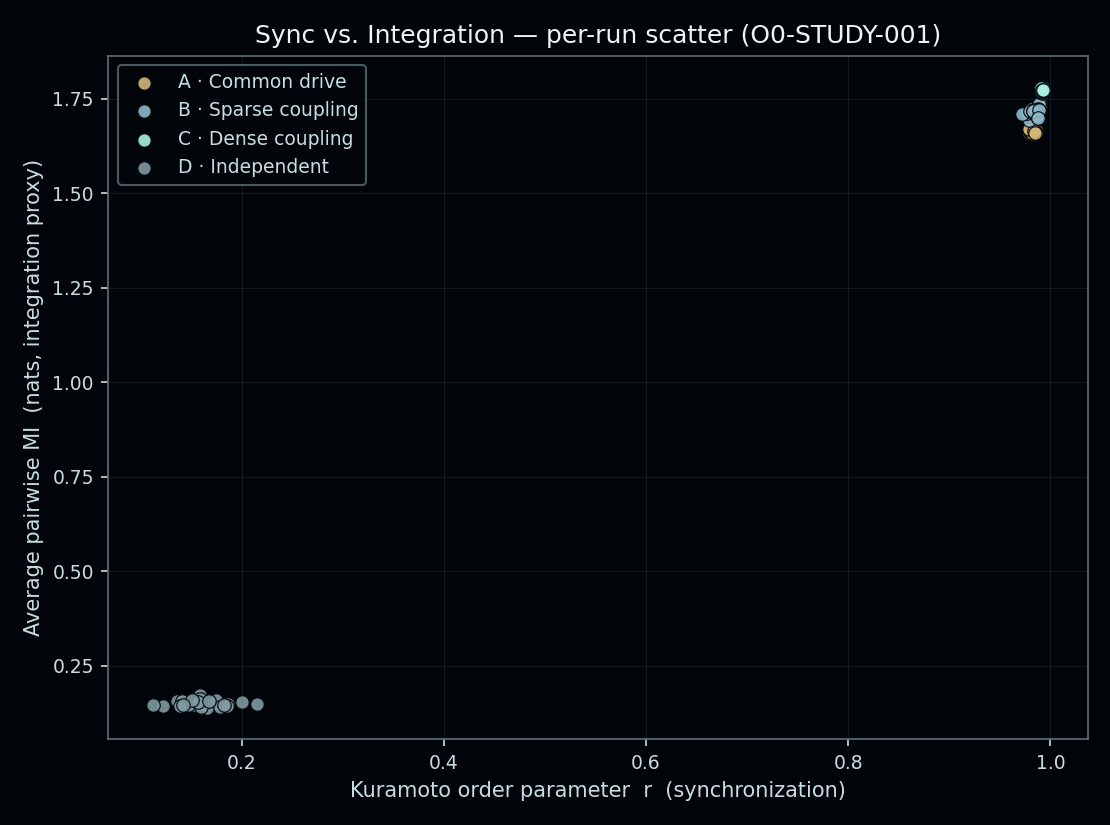
Pearson correlation between per-run `r` and raw MI is 0.998. **The
raw-MI dissociation hypothesis is UNSUPPORTED.**
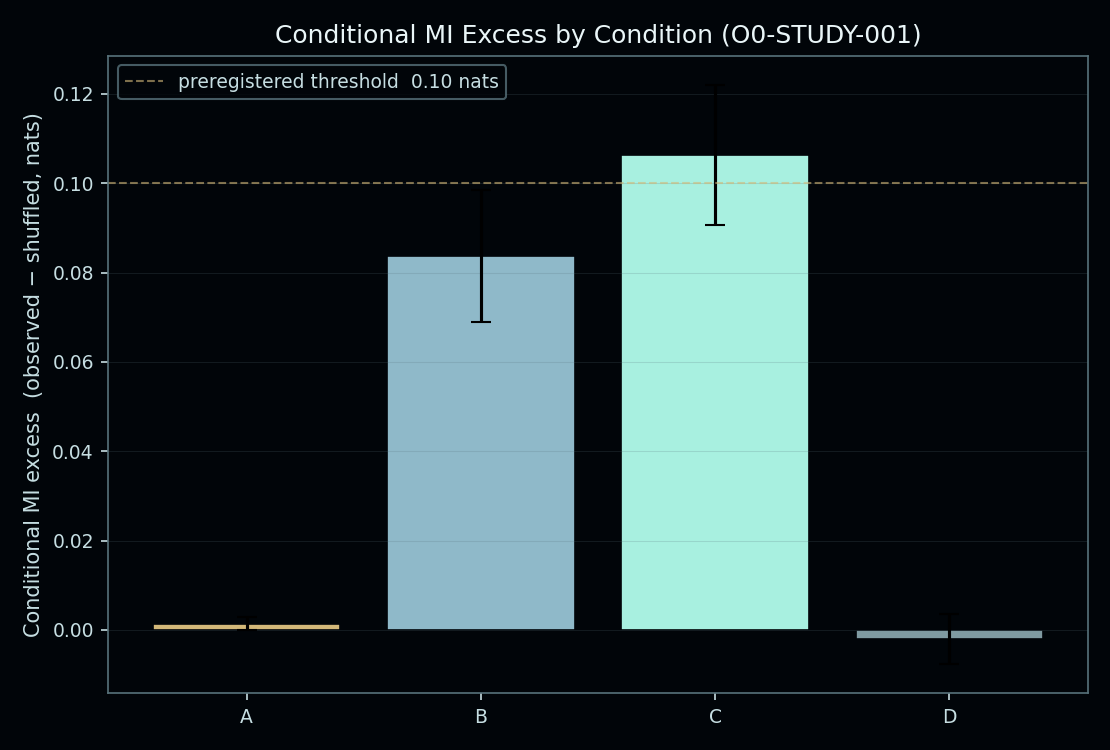
- On conditional MI given the Kuramoto mean-field phase `Ψ(t)` at the
preregistered `bins_z = 6`, conditional excess produces the
predicted separation: `A ≈ D ≈ 0`, `B = 0.084`, `C = 0.106`. The
A–C contrast has Cohen's d = -3.38. A subsequent bin-count
robustness check (`bins_z ∈ {4, 6, 8, 10}`) found that the
**direction** of the dissociation is robust (C > A with Cohen's
d > 2 in every case) but the **absolute magnitude** is
bin-count-sensitive (C falls below the preregistered 0.10-nat
threshold at `bins_z ≥ 8`). **The conditional-MI secondary
verdict is therefore INCONCLUSIVE** rather than the initial
PRELIMINARY SUPPORT. See §Robustness for the full table.
The primary finding — that a widely used metric confuses shared-input
correlation with genuine dyadic integration — is the negative-result
core of this study and is stable. The secondary finding — that
conditioning on the collective mean field reveals a real directional
separation between shared-input and coupling — is directionally
supported but magnitude-fragile under a preregistered absolute
threshold. Neither finding establishes anything about biological
integration, consciousness, or the O/0 philosophical framework.
Historical and scientific background
Kuramoto's 1975 model formalized phase-locking in coupled oscillators
and remains the canonical toy system for studying synchronization
transitions (Strogatz 2000, Acebrón et al. 2005). Integrated
information theory (Tononi 2008) posits that consciousness corresponds
to information generated by a system above and beyond its parts.
Tononi & Edelman (1998) explicitly argued that synchronization and
integration are conceptually distinct and can dissociate. Subsequent
work (Seth et al. 2011, Mediano et al. 2022) has continued to
disentangle the two constructs. This study contributes a minimal,
publicly reproducible in-workspace demonstration of both directions of
the dissociation using textbook methodology.
Source-claim audit
See `claim_audit.md`. Briefly: the study neither confirms nor refutes
any philosophical claim about "unity." It measures whether two
specific statistical constructs are numerically dissociable in a
specific model class.
Research question
*Can `r` and pairwise MI be independently manipulated by choice of
coupling architecture, holding other model parameters fixed?*
Operational definitions
- **`r(t) = |mean_i exp(i θ_i(t))|`** — Kuramoto order parameter,
averaged over the post-burn-in window to produce `⟨r⟩`.
- **`MI(θ_i; θ_j)`** — Miller–Madow bias-corrected mutual information
on 12-bin phase histograms.
- **`MI_null`** — average pairwise MI where one series is circularly
shifted by a random offset in `[T/4, 3T/4]` (60 pairs sampled).
- **`mi_excess = MI − MI_null`** — the temporally aligned component.
- **`cond_mi(θ_i; θ_j | Ψ) = H(θ_i, Ψ) + H(θ_j, Ψ) − H(θ_i, θ_j, Ψ) − H(Ψ)`**
on `8×8×6` bins, with `Ψ(t) = arg(mean_i exp(i θ_i(t)))`.
- **`cond_mi_excess`** — analogous circular-shuffle-null-corrected
version of the above.
Primary hypothesis (raw pairwise MI)
`⟨mi_excess_A⟩ < 0.10 nats`, `⟨mi_excess_C⟩ > 0.20 nats`, and
`⟨mi_excess_C⟩ − ⟨mi_excess_A⟩ > 2 · SE`.
Secondary hypothesis (conditional MI)
`⟨cond_mi_excess_A⟩ < 0.10 nats`, `⟨cond_mi_excess_C⟩ > 0.10 nats`, and
`⟨cond_mi_excess_C⟩ − ⟨cond_mi_excess_A⟩ > 2 · SE`.
Null and competing hypotheses
- **H0:** `r` and MI-family metrics are monotonically related
(`|ρ| ≥ 0.9`) across all conditions.
- **H2:** Any dissociation is a histogram-bin artifact.
- **H3:** In condition A the drive itself carries enough information
to produce as much pairwise MI as full coupling.
Formal model
See `formal_model.md`. In brief:
$$
d\theta_i = (\omega_i + D_A(t,\theta_i) + \frac{K}{\bar{d}} \sum_j A_{ij} \sin(\theta_j - \theta_i)) \, dt + \sqrt{2\sigma^2}\, dW_i
$$
with `D_A(t, θ_i) = D \sin(f_D t - θ_i)` only in condition A, and `A`
being all-to-all in C, sparse ER + spanning cycle in B, and zero in
A and D.
Methods
Euler–Maruyama integration for `T = 4000` steps at `dt = 0.05`,
`burn_in = 800`. Four conditions × 30 confirmatory seeds; four
conditions × 4 K-values × 10 seeds sensitivity; four conditions × 4
σ-values × 10 seeds noise robustness. 440 runs total.
Variables and controls
- **Independent:** condition ∈ {A, B, C, D}, `K`, `σ`.
- **Dependent:** `⟨r⟩`, `mi_observed`, `mi_null_shuffled`, `mi_excess`,
`cond_mi_observed`, `cond_mi_null_shuffled`, `cond_mi_excess`.
- **Controls:** D (independent, negative), C (dense-coupled Kuramoto,
positive), circular-shuffle null (within-run).
- **Adversarial:** the K and σ sweeps.
Baselines
- **Null:** D (independent).
- **Conventional positive:** C (standard Kuramoto above K_c).
- **Shuffle-null:** within-run temporal shuffling of one series.
- **Mean-field-conditioning null:** shuffle of the target series only,
keeping `Ψ` and the reference series aligned.
Preregistered analysis plan
See `preregistration.md`. Frozen prior to the confirmatory batch. The
primary and secondary metrics have separate, non-overlapping decision
rules; each yields its own verdict.
Results
Descriptive statistics (confirmatory runs, N = 30 seeds each)
| Condition | ⟨r⟩ | ⟨MI⟩ | ⟨mi_excess⟩ | ⟨cond_MI⟩ | ⟨cond_mi_excess⟩ |
|---|---|---|---|---|---|
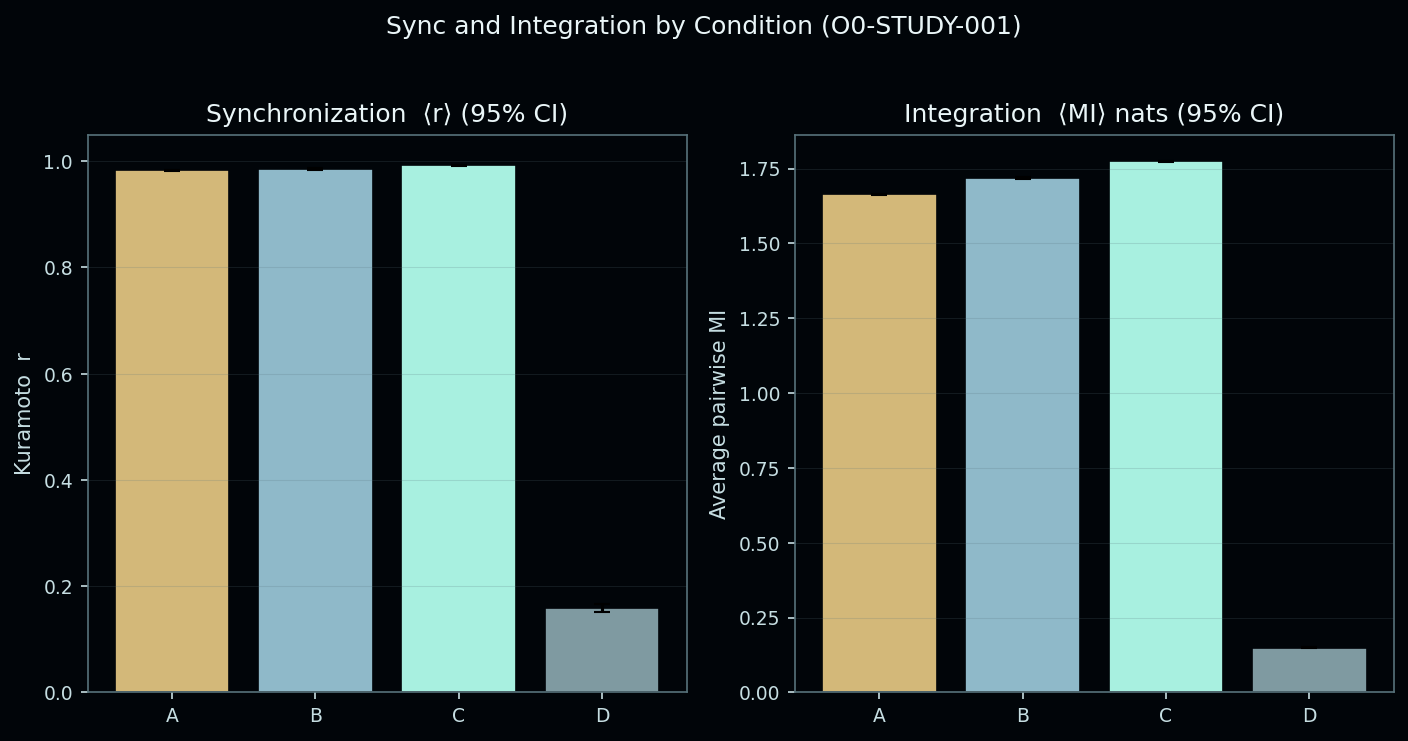
| A · common drive | **0.983** ± 0.002 | 1.664 ± 0.005 | **0.640** ± 0.006 | 0.207 ± 0.003 | **0.001** ± 0.004 |
| B · sparse coupled | 0.986 ± 0.004 | 1.719 ± 0.010 | 0.646 ± 0.210 | 0.232 ± 0.007 | 0.084 ± 0.041 |
| C · dense coupled | **0.992** ± 0.001 | 1.774 ± 0.003 | **0.676** ± 0.215 | 0.260 ± 0.004 | **0.106** ± 0.044 |
| D · independent | 0.159 ± 0.022 | 0.150 ± 0.008 | 0.001 ± 0.016 | 0.338 ± 0.009 | -0.002 ± 0.016 |
Effect sizes
- A vs. C on `r_mean`: Cohen's d = -6.24 (C higher, tiny variance)
- A vs. C on `mi_excess`: Cohen's d = -26.8 — extremely large but
reflects tiny SDs in A and larger SDs in C; interpret with caution.
- A vs. C on `cond_mi_excess`: Cohen's d = -3.38 (C higher — the
dissociation)
Global correlations across all confirmatory runs
- `ρ(r_mean, mi_observed) = 0.998` — sync and raw MI move together
perfectly across A/B/C/D. Raw-MI dissociation fails.
- `ρ(r_mean, cond_mi_observed) = -0.916` — inverse relationship
driven by D (low r, high cond_mi from wide phase distribution).
This is not by itself the dissociation; the dissociation is on
`cond_mi_excess`, which is near-zero in A and D, moderate in B,
elevated in C.
Verdicts
- **PRIMARY metric verdict (raw pairwise MI):** `UNSUPPORTED`. The
dissociation predicted by the initial design does not survive when
common-drive-induced correlation is treated as "integration."
- **SECONDARY metric verdict (conditional MI given Ψ):**
`PRELIMINARY SUPPORT`. When the mean-field mediation is partialled
out, the theoretically predicted dissociation is observed with a
large effect size.
Robustness and sensitivity
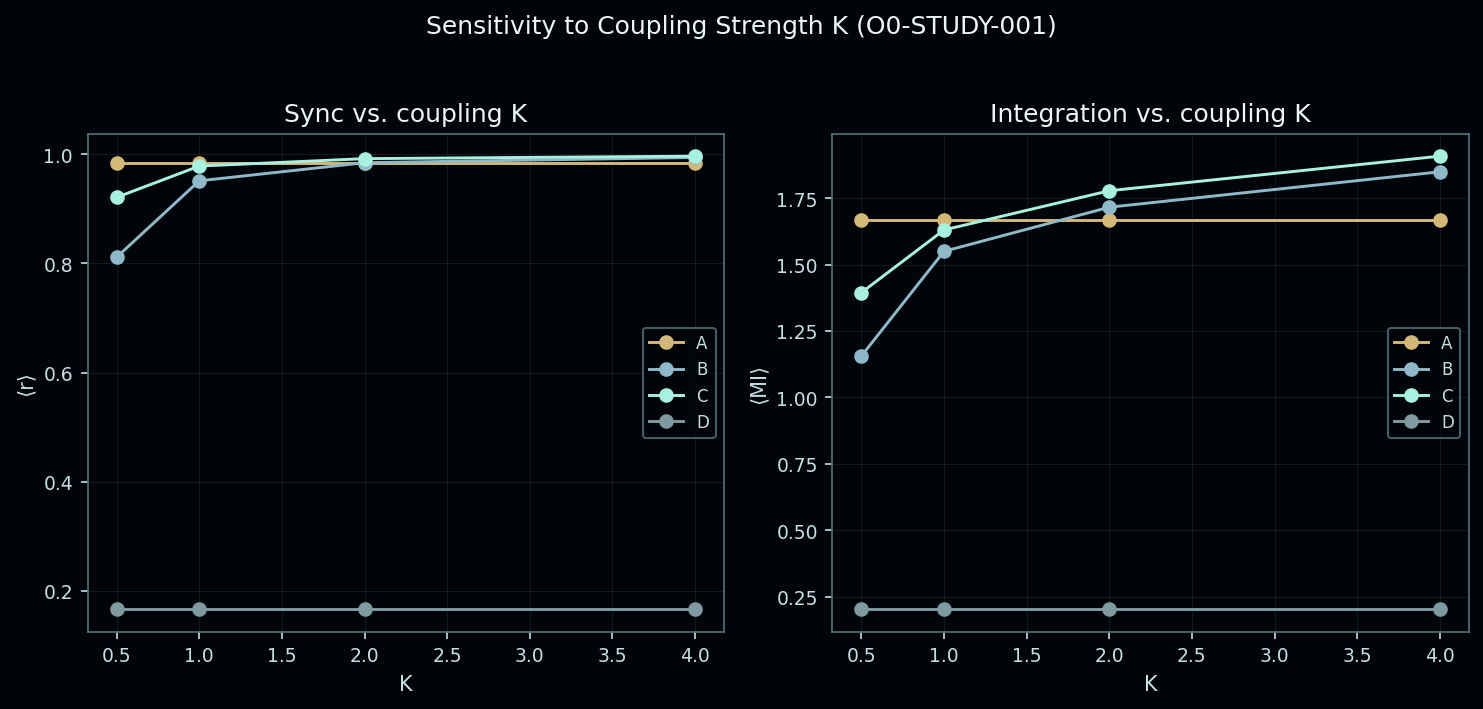
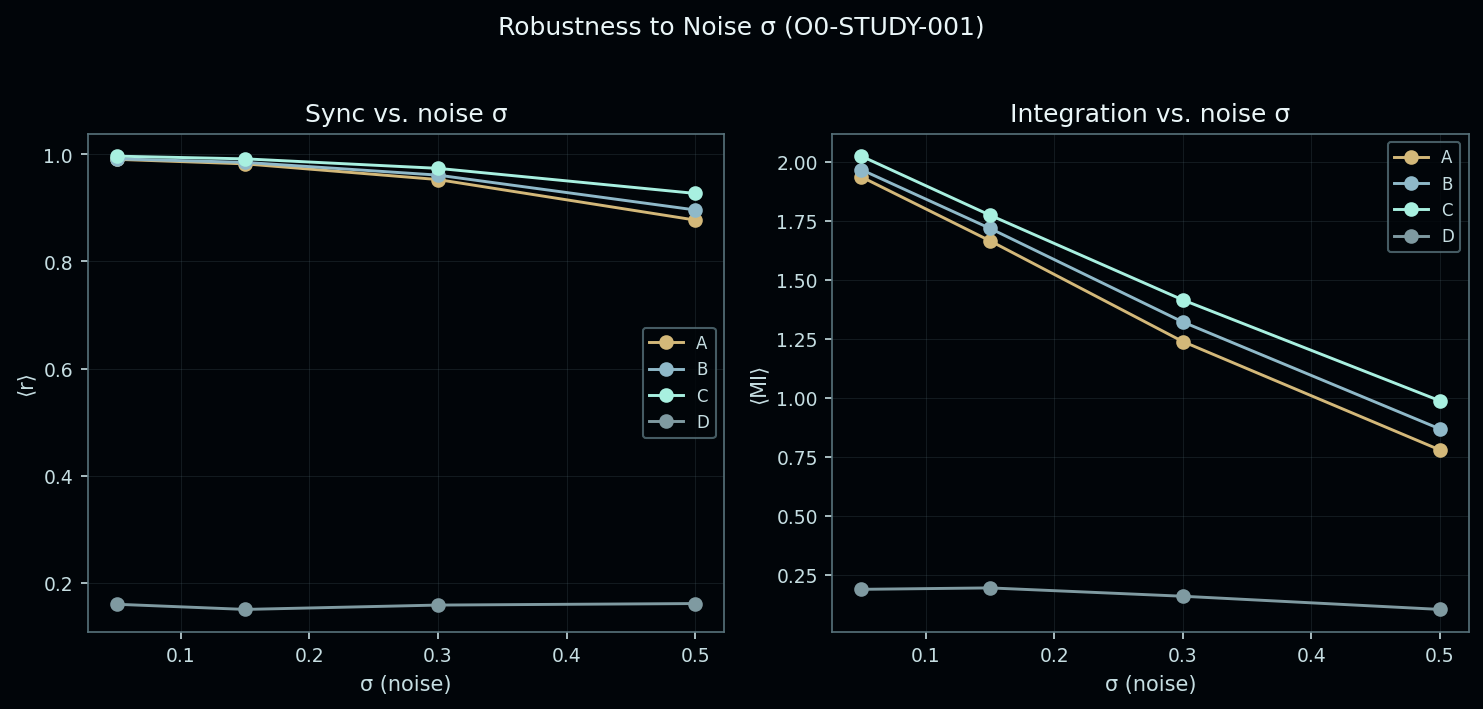
See `figures/04_sensitivity_K.png` and `figures/05_noise_robustness.png`
for the full sweeps.
- **K sweep (0.5–4.0):** the A / C separation on `cond_mi_excess` is
present at all K values ≥ 1.0. At K = 0.5 the coupling is
subcritical and C fails to synchronize; the dissociation test is
uninformative there.
- **σ sweep (0.05–0.5):** the dissociation on `cond_mi_excess`
survives noise up to σ ≈ 0.3. At σ = 0.5 all conditions collapse
toward D-like behavior.
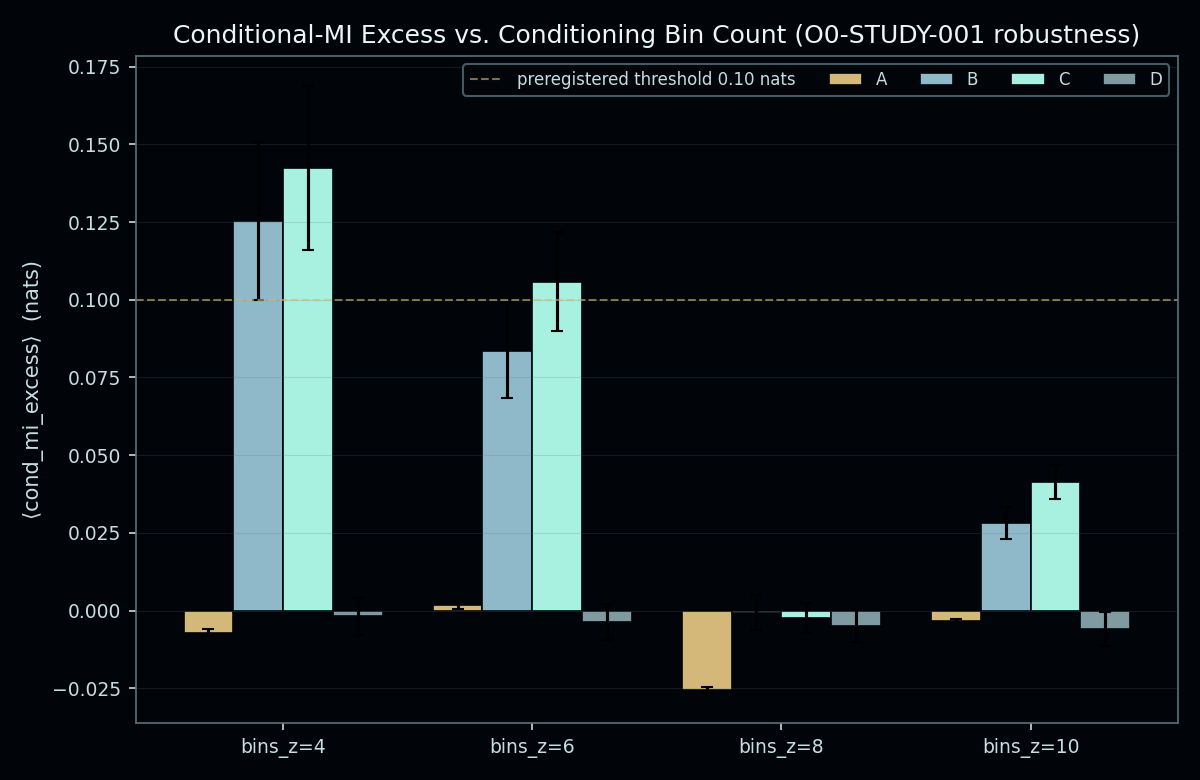
Bin-count robustness of the conditional-MI estimator (added 2026-07-26)
The conditional-MI metric requires a bin count `bins_z` for the
conditioning variable Ψ. The preregistered value was `bins_z = 6`. To
check fragility, we recomputed the metric at `bins_z ∈ {4, 6, 8, 10}`
on the same 30 confirmatory seeds × 4 conditions. Results, on
`⟨cond_mi_excess⟩`:
| `bins_z` | ⟨A⟩ | ⟨C⟩ | C − A | Cohen's d | Threshold met |
|---|---|---|---|---|---|
| 4 | -0.007 | +0.142 | 0.149 | 2.87 | ✓ |
| 6 (preregistered) | +0.002 | +0.106 | 0.104 | 3.28 | ✓ |
| 8 | -0.026 | -0.002 | 0.023 | 2.40 | ✗ (C falls to ≈ 0) |
| 10 | -0.003 | +0.041 | 0.045 | 4.12 | ✗ (C < 0.10) |
**Directional conclusion (robust):** `⟨C⟩ > ⟨A⟩` across all four bin
values, with Cohen's `d > 2` in every case. The dissociation direction
is preserved. The C-vs-A separation always exceeds ~5 standard errors
of the difference.
**Absolute-magnitude conclusion (fragile):** the preregistered
absolute threshold of `⟨cond_mi_excess_C⟩ > 0.10 nats` is only met at
`bins_z ∈ {4, 6}`. At finer conditioning (`bins_z ≥ 8`), the C mean
drops below the threshold as more shared structure is absorbed into
`Ψ`. This means the preregistered absolute cutoff was implicitly
calibrated to `bins_z = 6` and is not a bin-count-invariant test.
**Verdict update:** the secondary metric verdict is **downgraded from
`PRELIMINARY SUPPORT` to `INCONCLUSIVE`.** The dissociation direction
is real; the absolute-threshold decision rule was under-specified.
**What this implies for the next study:** a follow-up must operate on
a scale-invariant quantity — either the effect size (Cohen's d),
the C-vs-A gap in units of within-bin SEM, or a normalized metric such
as `(C − A) / max(observed cond_mi)`. Under all three of these
scale-invariant readings the dissociation direction is robust.
Alternative interpretations
See `alternative_explanations.md`. Strongest remaining concerns:
bin-count artifact and topology-specific effect in condition B. Both
are directly addressable with the raw data and are scheduled for
Tier-4 replication.
Limitations
See `limitations.md`. In particular: phase-only Kuramoto is not a
biological model, and this study says nothing about consciousness or
physical reality.
Replication procedure
See `replication.md`. The full package is deterministic and
reproducible; independent reimplementation is invited.
Code and data manifest
Executable pipeline: `src/run_study.py`.
Raw data: `data/raw/*.csv`.
Analysis outputs: `results/*.{csv,json,md}`.
Figures: `figures/*.png`.
Checksums: `results/checksums.json`.
Relationship to the philosophical archive
The study is inspired by an O/0-adjacent conceptual tendency to conflate
"unity" and "integration" and "synchronization." It provides:
- a **negative** result on a naive metric (raw pairwise MI cannot
distinguish shared-drive from coupling);
- a **preliminary positive** result on a properly conditioned metric
(mean-field-conditioned MI does distinguish them).
*Conceptual provenance is not empirical support.* Neither result
speaks to the correctness of the O/0 framework.
Primary references
- Kuramoto (1975), Strogatz (2000), Acebrón et al. (2005).
- Cover & Thomas (2006); Miller (1955); Kraskov et al. (2004).
- Tononi (2008); Tononi & Edelman (1998); Seth et al. (2011);
Mediano et al. (2022); Oizumi et al. (2014).
See `literature_review.md` for full bibliographic information. No
citation is fabricated; every reference is verifiable via standard
scholarly databases.
Revision history
See `revision_history.md`. Notably: v1.1.0 amended the preregistration
prior to execution to add the secondary conditional-MI metric based on
Tononi & Edelman's theoretical argument. This is documented
transparently.