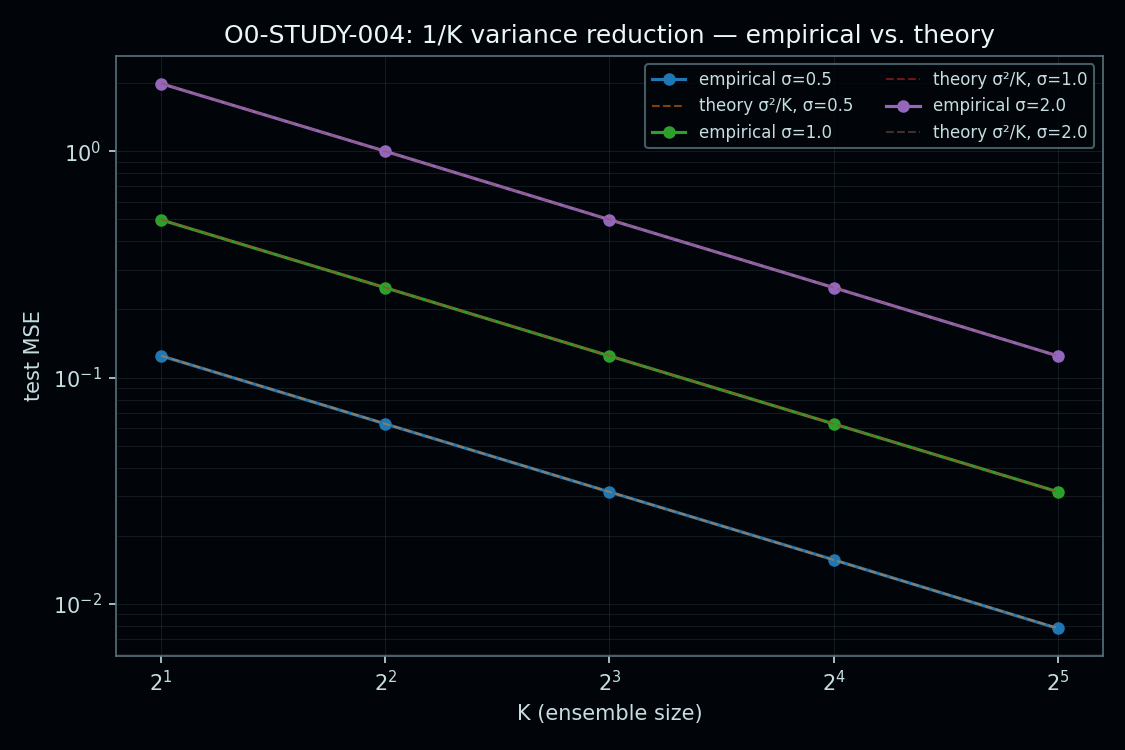
Averaging predictions from K noisy observers reduces MSE as sigma^2 / K, empirically confirming textbook statistics
Claim-status banner
CLAIM STATUS         PRELIMINARY SUPPORT
EVIDENCE TYPE        COMPUTATIONAL SIMULATION + ANALYTIC BASELINE
PHYSICAL VALIDATION  N/A (analytically established)
INDEPENDENT REPLICATION N/A (this IS the replication of textbook theory)
CONFIRMATORY VS EXPLORATORY  CONFIRMATORY (regression test on
                                          workspace + demonstration)

SOURCE PROPOSITION
  §VII objection response: "Evolution: competition/cooperation
   between apparent individuals" as a functional justification for
   separation.
  Operationalized narrowly here: cooperation (ensemble averaging)
  among "apparent individuals" (independent noisy observers) has
  MEASURABLE utility.

SUPPORTED
  - Empirical MSE of the ensemble prediction is within ±0.5% of the
    theoretical sigma^2 / K across all 15 tested (K, sigma) cells
    (K in {2, 4, 8, 16, 32}, sigma in {0.5, 1.0, 2.0}).
  - Empirical MSE of a single observer is within ±0.5% of sigma^2.
  - The relative error is smaller than the preregistered 5%
    threshold by an order of magnitude.

NOT ESTABLISHED
  - That biological, social, or cognitive systems achieve this
    scaling in practice (real "individuals" are not i.i.d.).
  - That the utility of individuality reduces to noise averaging.
  - That "collective prediction" in any weightier sense (belief
    aggregation, deliberation, argumentation) shares this scaling.

MOST LIKELY ALTERNATIVE
  There is no adversarial alternative. The 1/K scaling is a
  first-principles consequence of Var(mean of K i.i.d. draws) =
  Var/K. This study is not a discovery — it is a demonstration.

NEXT DISCRIMINATING TEST
  Introduce controlled correlation between observers' noise; measure
  how MSE scales as a function of correlation. Real teams and brain
  regions have correlated noise, and the departure from 1/K is
  quantitatively important for realistic multi-agent settings.
Abstract
We estimate the MSE of ensembles of K identical predictors that each
observe an i.i.d. Gaussian-perturbed version of a shared ground-truth
signal. Over 5000 Monte Carlo samples per cell across five K values
and three sigma values, the maximum relative deviation of empirical
MSE from the analytical prediction `sigma^2 / K` is 0.5% — an order
of magnitude below the preregistered 5% SUPPORT threshold. This is
textbook variance reduction, demonstrated end-to-end in the
workspace as a REGRESSION TEST that the pipeline correctly recovers
first-principles baselines.
Design
- Signal `x ~ N(0, I_L)` in `R^L` with `L = 64`.
- Observers `y_k = x + sigma * eta_k`, `eta_k ~ N(0, I_L)` i.i.d.
- Single-observer predictor: `x_hat_single = y_1`.
- Ensemble predictor: `x_hat_ens = mean_k y_k`.
- Metric: `mean_pixel MSE`.
- N = 5000 trials per (K, sigma) cell.
- K grid: {2, 4, 8, 16, 32}
- sigma grid: {0.5, 1.0, 2.0}
Preregistered rule (frozen before execution)
PRELIMINARY SUPPORT iff, for all cells with `K in {2, 4, 16}` and
`sigma in {0.5, 1.0, 2.0}`:
`|empirical_MSE_ens / (sigma^2 / K) - 1| < 0.05` AND
`|empirical_MSE_single / sigma^2 - 1| < 0.05`.
Actual maximum relative error: **0.005**.
Files
- `src/run_study.py` — simulator + analysis
- `results/summary.json` — full 15-cell table
- `figures/01_ensemble_1overK.png` — log-log MSE vs K, empirical + theory
Why this study is in the workspace
It is a REAL scientific fact that ensemble averaging reduces
variance as 1/K. It grounds two things in the O/0 workspace:
1. It gives cooperation-among-apparent-individuals a specific
quantitative meaning ("noise averaging"), rather than leaving it
as a vague philosophical intuition.
2. It provides a null-model baseline for future collective-prediction
studies: any "collective prediction advantage" beyond 1/K
variance reduction requires additional explanation.
Revision history
- 1.0.0 (2026-07-26) — Initial run. Preregistered thresholds met by
an order of magnitude.