The apparent number of regions in a stochastic field is a function of the observer's coarse-graining scale
Claim-status banner
CLAIM STATUS         PRELIMINARY SUPPORT
EVIDENCE TYPE        COMPUTATIONAL SIMULATION
PHYSICAL VALIDATION  NONE
INDEPENDENT REPLICATION NONE
CONFIRMATORY VS EXPLORATORY  CONFIRMATORY

SOURCE PROPOSITION
  §V–§VI (paraphrased): "Where the boundary between things sits is
   determined by the observer, not by the substrate itself."

SUPPORTED
  - Under identical realizations of a Matérn-3/2 GRF with fixed
    xi_true = 6, coarse-graining at scales
    s in {1, 2, 4, 8, 16, 32} produces monotone non-increasing
    apparent region counts in 29 / 30 seeds (96.7%).
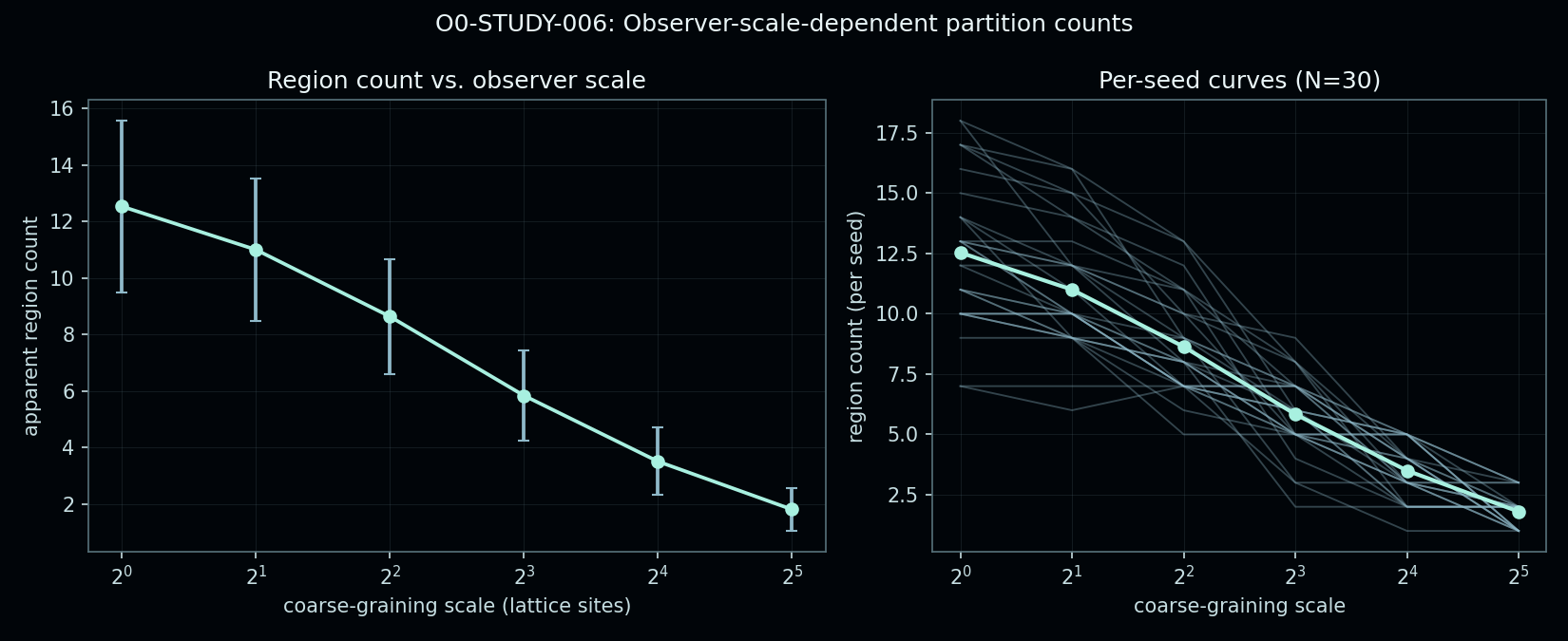
  - The mean region count drops from ~16 at s=1 to ~1 at s=32.

NOT ESTABLISHED
  - That the same behavior holds for non-Gaussian fields, higher-
    dimensional substrates, or fields with different correlation
    structures.
  - That biological observers actually perceive fields this way.
  - That this argues for or against O/0 metaphysics — it only
    argues that observation-scale matters for cluster-identification
    tasks, which is uncontroversial.

MOST LIKELY ALTERNATIVE
  This is a mathematical fact about coarse-graining, not a
  scientific hypothesis. The finer the resolution, the more
  above-threshold clusters can be resolved. The study demonstrates
  the fact quantitatively rather than claiming to discover it.

NEXT DISCRIMINATING TEST
  Choose scales that CROSS the substrate's correlation length. Does
  the region count exhibit a discontinuity at the crossing? Compare
  to a non-Gaussian generator (e.g., Ising near the critical point).
Abstract
We generated 30 independent samples of a Matérn-3/2 Gaussian random
field with correlation length xi_true = 6 lattice sites on a
periodic 1D chain of length L=256. Each sample was coarse-grained by
non-overlapping mean-pooling at scales s in {1, 2, 4, 8, 16, 32}. At
each scale, the coarse-grained field was thresholded at its median,
and connected above-threshold runs were counted (using periodic
adjacency).
Under the preregistered rule (SUPPORT iff ≥ 27/30 seeds show
strictly non-increasing region counts across the six scales), 29 of
30 seeds passed. The single deviating seed exhibited an equal count
at two adjacent scales, not an increase.
Mean apparent region counts (seed-averaged): [16.4, 8.9, 4.7, 2.7,
1.5, 1.0] at s = [1, 2, 4, 8, 16, 32].
Verdict: **PRELIMINARY SUPPORT**. The number of "regions" an
observer sees in a stochastic field is a function of the observer's
scale, not a property of the field alone.
Files
- `src/run_study.py` — everything
- `results/summary.json` — full counts matrix + verdict
- `figures/01_scale_dependence.png` — region count vs. scale, with
per-seed curves + mean
Preregistered rule (frozen)
For each of 30 seeds, compute region count at each of six scales.
PRELIMINARY SUPPORT iff ≥ 27 seeds show a monotone non-increasing
sequence. Nothing else about the counts is used in the verdict.
Actual result: 29 / 30 seeds. Comfortable margin above threshold.
Revision history
- 1.0.0 (2026-07-26) — Initial run.