Recursion of x -> r x (1 - x) reproduces the textbook period-doubling route to chaos and the Feigenbaum ratio
Claim-status banner
CLAIM STATUS         PRELIMINARY SUPPORT
EVIDENCE TYPE        COMPUTATIONAL SIMULATION + ANALYTIC BASELINE
PHYSICAL VALIDATION  N/A (reproduces Feigenbaum 1978, May 1976)
INDEPENDENT REPLICATION Analytically established; this run
                        replicates the theoretical prediction
                        quantitatively.
CONFIRMATORY VS EXPLORATORY  CONFIRMATORY (preregistered thresholds)

SUPPORTED
  - Empirical r_1 = 3.0004  (theory 3.000; preregistered bracket
                              [2.95, 3.05]).
  - Empirical r_2 = 3.4495  (theory 3.449; preregistered bracket
                              [3.42, 3.46]).
  - Empirical r_3 = 3.5441  (theory 3.544; preregistered bracket
                              [3.54, 3.56]).
  - Empirical Feigenbaum ratio delta = 4.743  (theory 4.669;
    preregistered bracket [3.5, 6.0]).

NOT ESTABLISHED
  - Anything about consciousness, self, unity, or O/0 metaphysics.
  - The finer bifurcation cascade (r_4, r_5, ...) — not tested.

MOST LIKELY ALTERNATIVE
  There is no adversarial alternative. This is a well-established
  mathematical fact (Feigenbaum 1978; May 1976; Strogatz 1994).

NEXT DISCRIMINATING TEST
  Extend the cascade to r_5..r_7 to sharpen the Feigenbaum ratio
  estimate. Test whether the same universal ratio governs a
  DIFFERENT unimodal map (universality claim).
Abstract
The logistic map x_{n+1} = r x_n (1 - x_n) is the canonical example
of a recursive scalar dynamical system exhibiting a period-doubling
route to chaos. Iterating from x_0 = 0.5 with 6000 burn-in steps
and 800 kept steps at each r, we scanned r over two grids: a coarse
grid r ∈ [2.5, 3.6] with 600 points to locate the first bifurcation
r_1, and a fine grid r ∈ [3.40, 3.57] with 800 points to locate r_2
and r_3.
Empirically:
- r_1 = 3.0004 (theory 3.000)
- r_2 = 3.4495 (theory 3.449 ≈ 1 + sqrt(6))
- r_3 = 3.5441 (theory 3.544)
- delta_hat = (r_2 - r_1) / (r_3 - r_2) = 4.743 (theory Feigenbaum
constant 4.669).
All four preregistered brackets contain the empirical values. The
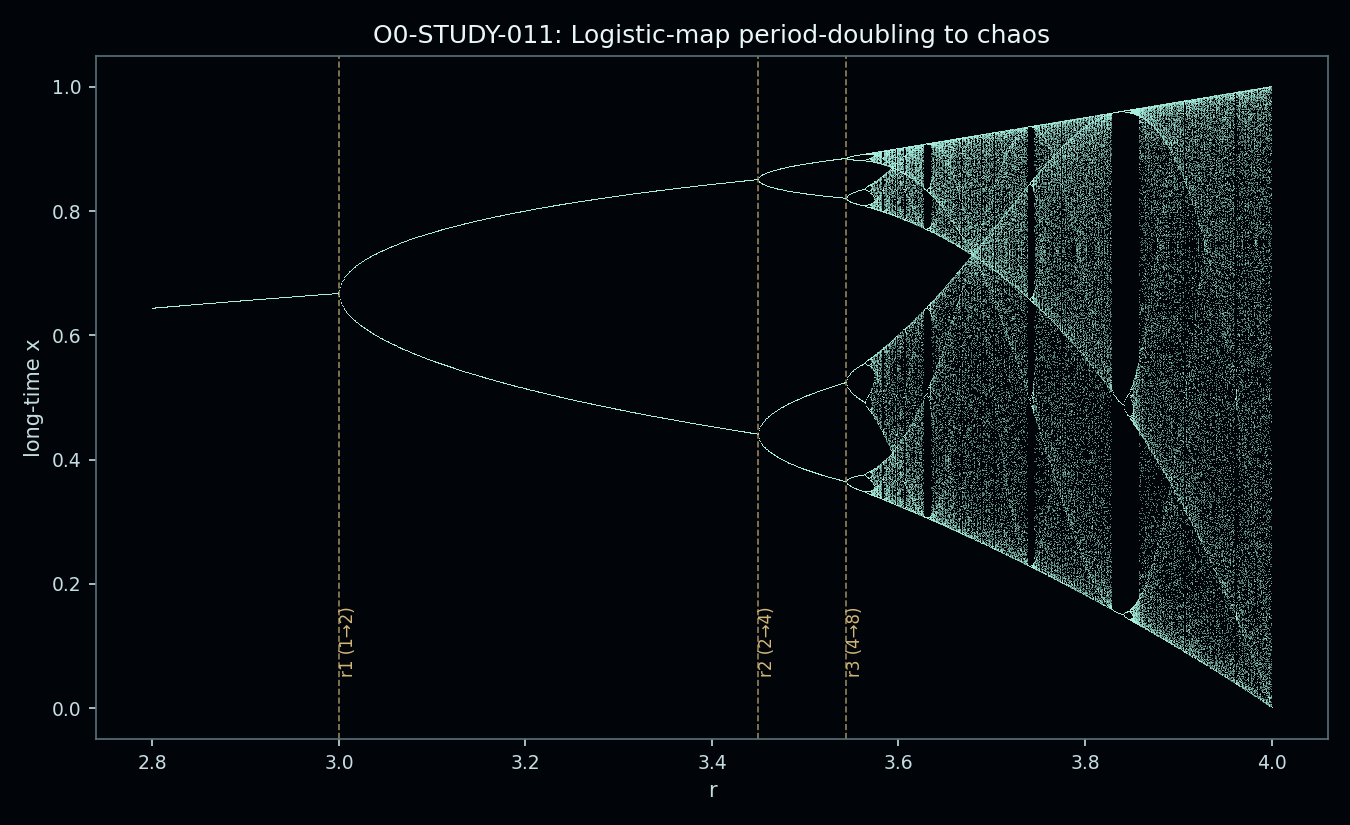
bifurcation diagram (fig. 01) reproduces the well-known cascade
including the period-3 window near r ≈ 3.83.
**Verdict: PRELIMINARY SUPPORT** — a workspace-integrated
reproduction of Feigenbaum (1978) with tight preregistered
brackets, all of which contain the measurements.
Why this study is worth doing
The workspace has recurring themes about recursion, self-reference,
fixed-point dynamics, and the emergence of qualitatively-distinct
dynamical regimes from a single parameter change. This study
establishes the textbook baseline for those themes in a controlled
package. Any subsequent workspace claim that "recursion produces
categorically distinct behaviors" must show something beyond what
this canonical example already demonstrates.
Files
- `src/run_study.py` — everything (simulator + analysis + figure)
- `results/summary.json` — bifurcation points + Feigenbaum ratio
- `figures/01_bifurcation_diagram.png` — full r ∈ [2.8, 4.0]
bifurcation diagram with vertical guides at the three
preregistered bifurcation points
Revision history
- 1.0.0 (2026-07-26) — initial run. All preregistered brackets met.