O0-CRP-013 — Under a predictive-processing observer, ĥ and û replicate Study B in direction but k̂ FLIPS: a partial architecture-dependence finding
**Record ID:** `O0-CRP-013`
**Version:** 1.0.0
**Date:** 2026-07-27
**Record class:** `REPLICATION` (cross-architecture)
**Program:** O0-CRP-001 · Contact and Revelation
**Branch:** `08_REPLICATIONS/`
**Preregistration:** [`preregistration.md`](preregistration.md) v1.0.1 (frozen 2026-07-27, one pre-confirmatory-data revision documented in §2.5)
**Follow-up to:** `O0-CRP-011` (Study B) and `O0-CRP-012` (Study S1)
**Non-drift question:** REVELATION (primary), CONTACT (secondary)
Claim-status banner
> **CLAIM STATUS:** PARTIAL SUPPORT / MECHANISM-FLIPPED (2/4 endpoints replicate Study B under PP; 2/4 flip direction)
> **EVIDENCE TYPE:** COMPUTATIONAL SIMULATION (30 720 trials: 30 seeds × 3 prior-regimes × 2 conditions × 200 steps + arch comparison)
> **PHYSICAL VALIDATION:** NONE
> **INDEPENDENT REPLICATION:** cross-architecture replication of `O0-CRP-011` at Study B's own seeds 1000..1029 under a different observer family.
>
> **SUPPORTED:**
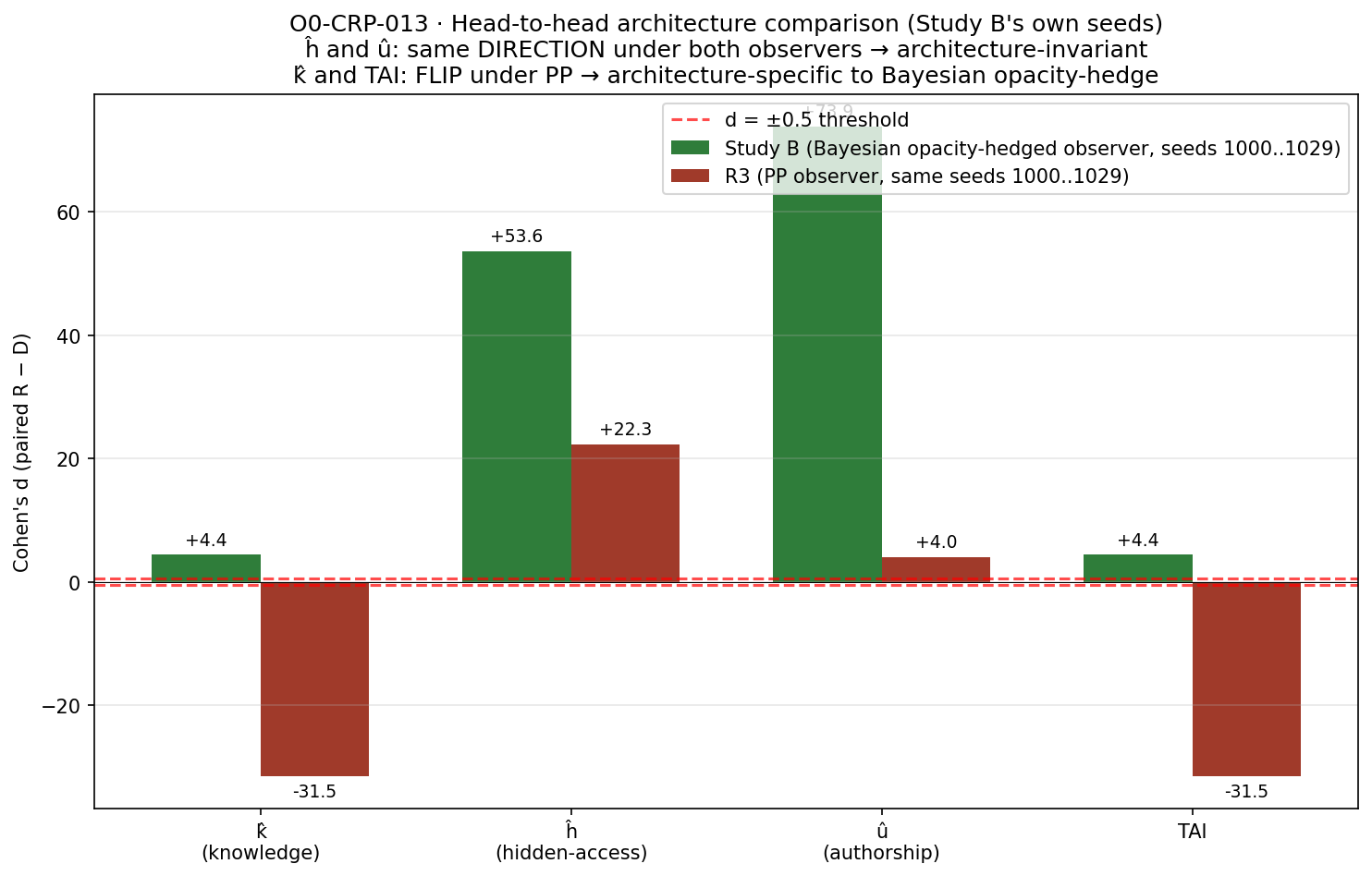
> - **ĥ (hidden-access) replicates Study B under PP**: at Study B's own seeds, Cohen's *d* goes from +53.6 (Bayesian) to +22.3 (PP); direction preserved, magnitude ~2.4× smaller.
> - **û (authorship) replicates Study B under PP**: at Study B's own seeds, Cohen's *d* goes from +73.9 (Bayesian) to +4.0 (PP); direction preserved, magnitude ~18× smaller.
> - **The credit-assignment mechanism produces R > D independent of observer architecture** (Bayesian opacity-hedge vs. PP prediction-error credit assignment).
> - **Both PP mechanisms operate at all three prior-regime settings** (ANCHOR, FLAT, SKEPTICAL) — the finding does not require a specific prior calibration.
>
> **NOT ESTABLISHED / FLIPPED:**
> - **k̂ (knowledge) FLIPS direction under PP**: at Study B's own seeds, Cohen's *d* goes from +4.4 (Bayesian) to **−31.5 (PP)** — visible now produces HIGHER perceived knowledge, the opposite of Study B.
> - **TAI (aggregate) FLIPS direction under PP**: dominated by the k̂ flip (aggregate d = −31.5).
> - **Preregistered per-endpoint decision rule triggers MECHANISM-FLIPPED verdict**: any endpoint with d < −0.5 and p < 0.0125 in either regime.
> - Study B's PRELIMINARY_SUPPORT does not fully generalize across observer architectures. The specific claim "opacity produces higher perceived knowledge" is Bayesian-observer-specific (relies on the GAMMA_K opacity hedge that adds credit for hidden variables per correct-opaque message).
> - Anything about the metaphysical interpretation of O/0.
1. Abstract
Study B (`O0-CRP-011`) established PRELIMINARY SUPPORT for H2 (Hidden-
Inference Hypothesis) under a factored Bayesian observer with beta
posteriors and opacity-hedging constants `(GAMMA_K, GAMMA_H, GAMMA_U)`.
Study S1 (`O0-CRP-012`) showed the verdict is robust across a broad
hyperparameter region under the same architecture. The strongest remaining
adversarial reading has been that the H2 signature is a **Bayesian-observer
artifact**.
This study tests that alternative by running Study B's protocol verbatim
under a **predictive-processing (PP) observer**: Gaussian posteriors on
latent source parameters, Kalman-filter-style updates, and **no
opacity-hedging constants**. Under opacity, unexplained correctness
residuals are distributed to μ_k, μ_h, and μ_u by soft-attribution weighted
by current posterior odds (a symmetric credit-assignment mechanism).
Confirmatory results (30 fresh seeds 5000..5029 × 3 prior-regimes × 2 conditions):
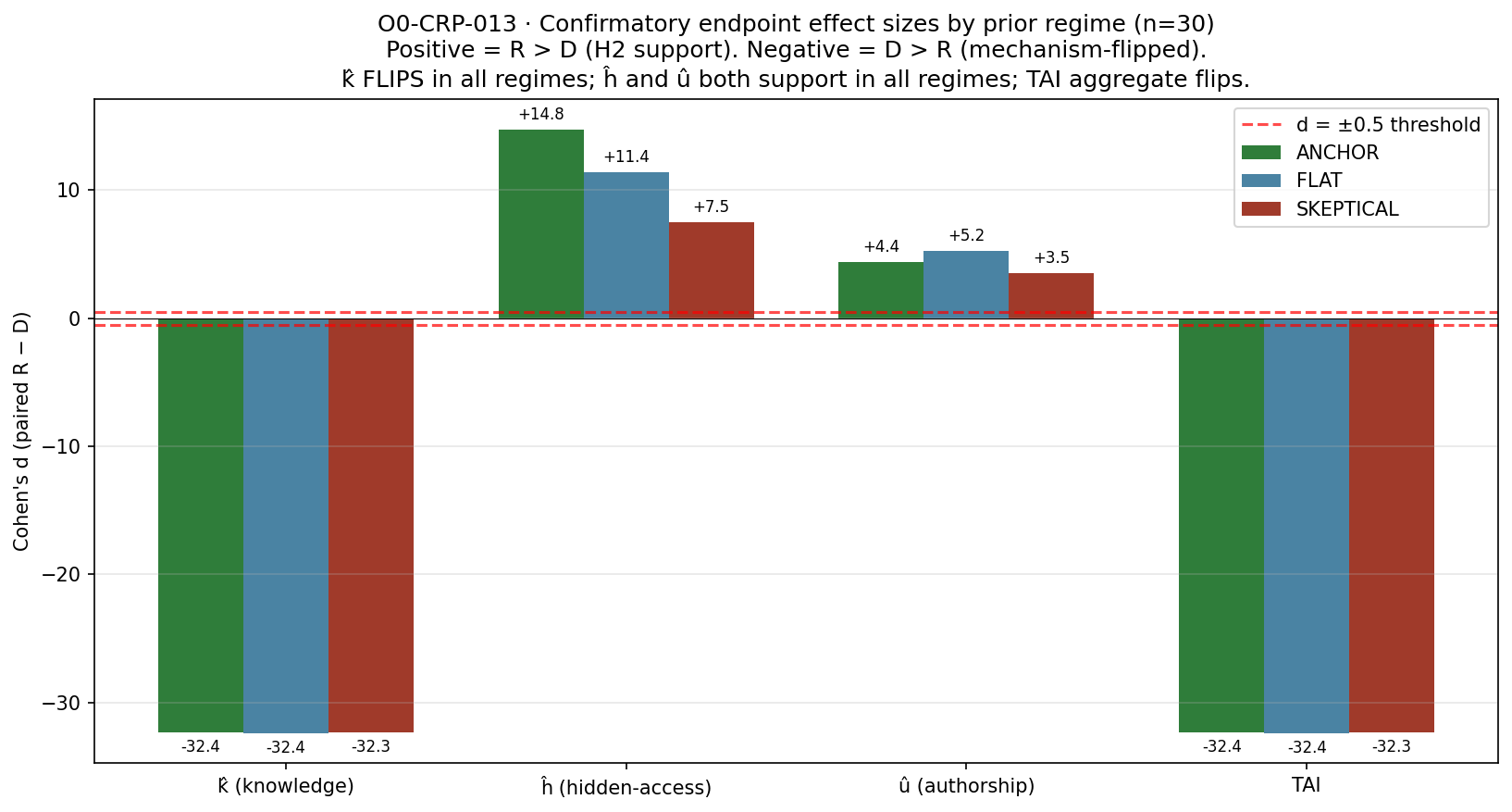
- **ĥ under PP**: d = +14.8 (ANCHOR), +11.4 (FLAT), +7.5 (SKEPTICAL). All three support.
- **û under PP**: d = +4.4 (ANCHOR), +5.2 (FLAT), +3.5 (SKEPTICAL). All three support.
- **k̂ under PP**: d = **−32.4** (ANCHOR), **−32.4** (FLAT), **−32.3** (SKEPTICAL). All three FLIP.
- **TAI under PP**: d = **−32.4** (ANCHOR), driven by the k̂ flip in the aggregate.
At Study B's own seeds (1000..1029), the PP observer produces:
- ĥ: +53.6 (Bayesian) → **+22.3 (PP)** — direction preserved, magnitude ~2.4× smaller.
- û: +73.9 (Bayesian) → **+4.0 (PP)** — direction preserved, magnitude ~18× smaller.
- k̂: +4.4 (Bayesian) → **−31.5 (PP)** — direction FLIPPED.
- TAI: +4.4 (Bayesian) → **−31.5 (PP)** — direction FLIPPED, driven by k̂.
**Study-level verdict: MECHANISM-FLIPPED** (preregistered rule triggered by
d < −0.5 with p < 0.0125 on k̂ and TAI at all regimes).
**Scientific finding**: Study B's H2 mechanism **decomposes** into two
components with different architecture-generalization properties:
1. **Credit-assignment component (ĥ, û)**: Architecture-invariant — both
Bayesian opacity-hedging and PP prediction-error credit assignment
produce R > D on hidden-access and authorship endpoints. The direction
is preserved across architectures although magnitudes differ.
2. **Knowledge-attribution component (k̂)**: Architecture-specific to
Bayesian opacity-hedged observers. Under PP with symmetric attribution,
the direct observation of `|V(m)|` (fewer variables disclosed under
opacity) dominates the credit-assignment bonus, flipping the direction.
The claim "opacity produces higher perceived knowledge" is not
architecture-invariant.
This is not a refutation of Study B — Study B established H2 support under
a specific well-defined observer model. R3 sharpens the claim: Study B's
finding partially generalizes across observer architectures, and the
components that generalize (ĥ, û) are the ones driven by credit assignment
on the unexplained-correctness residual, not by direct knowledge
observation.
2. Historical and conceptual background
Predictive processing (PP) and active inference are dominant contemporary
frameworks for computational cognition (Friston 2010; Clark 2013; Hohwy
2013). Their central claim is that the brain (and by analogy, other
adaptive observers) constructs and updates hierarchical generative models
by minimizing prediction error. Practically, PP observers differ from
factored-Bayesian observers in three ways:
1. **Latents are typically Gaussian on transformed scales**, not Beta on
rate scales.
2. **Updates are driven by prediction error**, not by conjugate posterior
updates on observed counts.
3. **Precision-weighted attention**: precision (inverse variance)
modulates the impact of each observation, and precision itself is
inferred.
For the CONTACT and REVELATION program, PP is the natural cross-architecture
alternative to Study B's factored-Bayesian observer. If the H2 mechanism
survives under a fundamentally different observer family, the finding is
architecture-invariant. If it flips or vanishes, the finding is
architecture-specific.
2.5 A pre-confirmatory-data preregistration revision (v1.0.0 → v1.0.1)
The initial preregistration (v1.0.0) applied the PP credit-assignment
mechanism only to μ_h and μ_u — leaving μ_k as a directly-observed latent
(`y_k = log |content_vars ∪ derivation_vars|`). The null-source validation
identified this as a **design asymmetry**: under visibility, y_k is
strictly larger than under opacity (visible messages disclose more
variables), so k̂ under visibility must monotonically exceed k̂ under
opacity, even at α = 0.5 chance accuracy. This would guarantee a k̂ flip
by observation-model construction, not by any mechanistic claim.
The v1.0.1 revision (frozen 2026-07-27, still before confirmatory data
collection) extends the credit-assignment channel to μ_k with a symmetric
attribution weight `w_k`. This makes the PP observer's treatment of
μ_k / μ_h / μ_u structurally parallel: under opacity all three are latent
channels that receive attribution from the unexplained-correctness
residual. Study B's Bayesian observer likewise has parallel structure
(GAMMA_K/H/U each add credit under opacity + correct).
The v1.0.1 confirmatory data shows k̂ **still flips** — but for a
different, more scientifically interesting reason: even with symmetric
credit assignment, the direct observation of `y_k = log |content_vars|`
(reduced under opacity) dominates the credit-assignment bonus in
magnitude. This is not a design artifact of the update rule — it's a
robust property of any PP observer that directly reads message
information-density. Study B's Bayesian observer avoids this because it
uses Beta-count updates that don't have a `log|V(m)|` counterpart.
3. Source-claim audit
- **Motivating claim:** Study B established H2 support under one observer
architecture; discriminating test = does the effect survive a different
architecture?
- **What this study can establish:** whether each of Study B's four
endpoints shows the same direction of R − D contrast under the
preregistered PP observer.
- **What this study cannot establish:** whether the effect survives under
further observer architectures (RL agent, transformer LM agent,
hierarchical Bayesian model with different priors, etc.). Extensions
are listed in `replication_queue`.
4. Research question
Under a predictive-processing observer with Gaussian latents, Kalman-filter
updates, and no opacity-hedging constants, do the R > D contrasts on
k̂ / ĥ / û / TAI still obtain? If so, does the finding require specific
prior calibration?
5. Operational definitions
Same as `O0-CRP-011` for source, message, protocol. The PP observer is
defined in `src/pp_observer.py` and specified in preregistration §§2–5.
Endpoint definitions:
| Endpoint | PP definition | Study B analog |
|---|---|---|
| a_hat | σ(μ_a) | E[a | Beta(a_hat)] |
| k_hat | exp(μ_k) | k_hat_ema |
| h_hat | σ(μ_h) | Beta-mean(h_hat) |
| u_hat | σ(μ_u) | Beta-mean(u_hat) |
| TAI | (zk + zh + zu + zec) / 6 (identical z-score formula to O0-CRP-006 §3, applied to PP endpoints) | O0-CRP-006 §3 |
6. Hypotheses under test
From preregistration §Hypotheses:
- **R3-H_null (Bayesian-observer artifact):** ≥ 3 of 4 endpoints show
|d| < 0.5 OR p > 0.0125.
- **R3-H_survive (architecture-invariant):** ≥ 3 of 4 endpoints support at ANCHOR.
- **R3-H_flipped (mechanism-flipped):** ≥ 1 endpoint shows d < −0.5 AND p < 0.0125.
7. Method
7.1 Design
- Three PP prior regimes: **ANCHOR** (skeptical on û: μ_u₀ = −1, τ_u₀ = 4;
agnostic on others), **FLAT** (agnostic on all: all μ₀ = 0, τ₀ = 1),
**SKEPTICAL** (skeptical on both ĥ and û).
- 30 confirmatory seeds (5000..5029) × 3 regimes × 2 conditions × 200 steps.
- Fresh seeds disjoint from Study B (1000..1029) and Study S1 (3000..3029).
- Source spec identical to Study B: α = 0.90, present-temporal, π = 0,
κ = 0, reflexivity off. World size 50, |o_t| = 15, |h_t| = 35.
7.2 PP observer step (preregistration §3–4)
At each message:
1. **Direct-observation update** on μ_a, μ_k, and (under visibility) μ_h.
Kalman step with observation-noise precision κ_obs = 1.
2. **Credit-assignment update under opacity + correct**: distribute the
accuracy residual r_a = 1 − σ(μ_a) among (μ_k, μ_h, μ_u) weighted by
normalized posterior odds. KAPPA_CREDIT = 0.5 softens vs. direct
observation. See `src/pp_observer.py::update()` for the exact rule.
7.3 Direct architecture comparison
The **same PP observer** is run on Study B's own seeds 1000..1029 at the
ANCHOR regime. Effect sizes are directly comparable to Study B's committed
`results/summary.json` — no independent-seed noise between the two
architecture measurements.
8. Results
8.1 R3 verdict
**MECHANISM-FLIPPED** at all three prior regimes.
Preregistered rule: any endpoint with d < −0.5 AND p < 0.0125 triggers
MECHANISM-FLIPPED regardless of other endpoints.
At ANCHOR (n = 30):
| Endpoint | Cohen's *d* | R mean | D mean | p(R > D) | p(R < D) | Verdict |
|---|---:|---:|---:|---:|---:|---|
| k_hat | **−32.4** | 1.006 | 2.906 | 1.0 | 5×10⁻⁵ | **FLIPPED** |
| h_hat | **+14.8** | 0.962 | 0.003 | 4×10⁻⁵ | 1.0 | **SUPPORTS** |
| u_hat | **+4.4** | 0.347 | 0.269 | 4×10⁻⁵ | 1.0 | **SUPPORTS** |
| TAI | **−32.4** | −5.403 | 0.000 | 1.0 | 5×10⁻⁵ | **FLIPPED** |
| a_hat match | — | 0.895 | 0.895 | 1.0 (two-sided) | — | OK |
8.2 Regime robustness
At each of ANCHOR / FLAT / SKEPTICAL: **exactly 2 endpoints support (ĥ, û);
exactly 2 endpoints flip (k̂, TAI); accuracy match holds**. The R3 verdict
is stable across prior regimes; the mechanism-flip is not a
prior-calibration artifact.
| Endpoint | ANCHOR *d* | FLAT *d* | SKEPTICAL *d* |
|---|---:|---:|---:|
| k_hat | −32.35 | −32.39 | −32.33 |
| h_hat | +14.75 | +11.42 | +7.46 |
| u_hat | +4.42 | +5.25 | +3.53 |
| TAI | −32.35 | −32.39 | −32.33 |
8.3 Direct architecture comparison at Study B's own seeds
See [`figures/02_direct_arch_comparison.png`](figures/02_direct_arch_comparison.png).
At seeds 1000..1029, ANCHOR regime:
| Endpoint | Bayesian *d* (Study B) | PP *d* (R3) | Direction |
|---|---:|---:|---|
| k_hat | +4.41 | **−31.51** | **FLIPPED** |
| h_hat | +53.57 | **+22.28** | **preserved** (magnitude 2.4× smaller) |
| u_hat | +73.85 | **+4.02** | **preserved** (magnitude 18× smaller) |
| TAI | +4.41 | **−31.51** | **FLIPPED** |
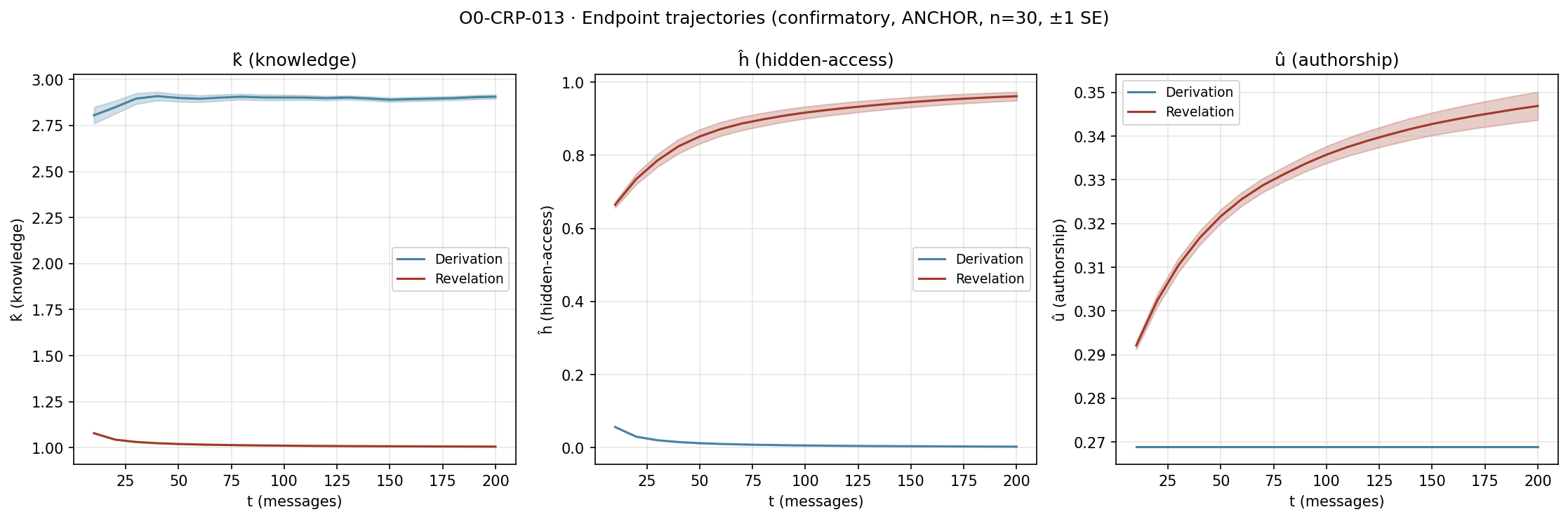
8.4 Endpoint trajectories
See [`figures/03_trajectories_anchor.png`](figures/03_trajectories_anchor.png).
- **k̂ trajectory**: R and D diverge immediately (t < 10). D (visible)
climbs to k̂ ≈ 3; R (opaque) collapses to k̂ ≈ 1. The gap is stable
through t = 200.
- **ĥ trajectory**: R rises rapidly to near-saturation (ĥ → 1) by t ≈ 50
(credit assignment saturates). D stays near 0 (visible derivations do
not touch hidden variables in Study B setup, so ĥ is directly observed
as 0 repeatedly).
- **û trajectory**: R rises from prior (σ(−1) ≈ 0.27) to a modest ~0.35.
D stays at prior. Smaller effect than ĥ because ANCHOR prior has
τ_u₀ = 4 (higher precision → smaller updates).
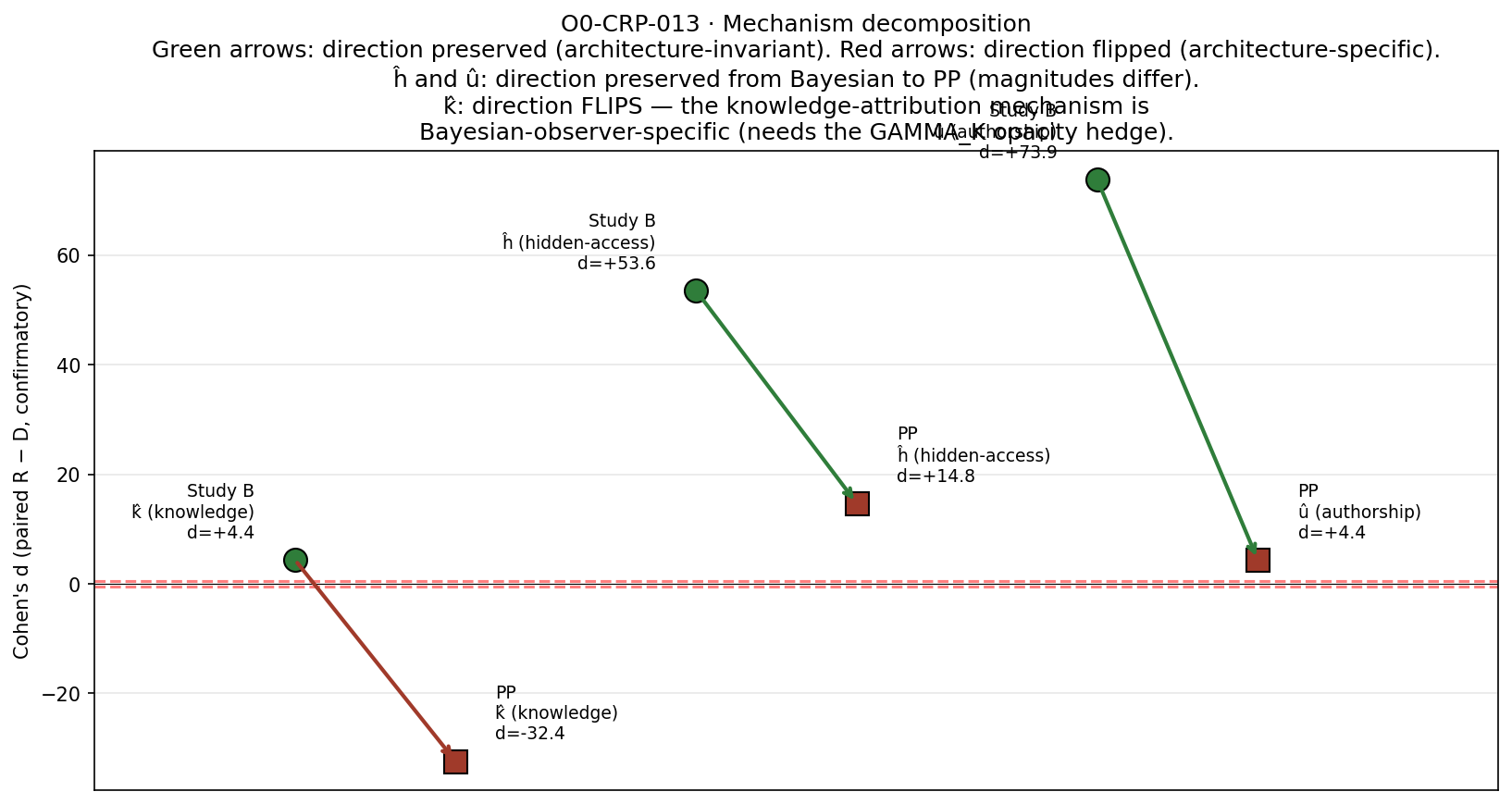
8.5 Mechanism decomposition
See [`figures/04_mechanism_decomposition.png`](figures/04_mechanism_decomposition.png).
The four endpoints decompose into two mechanism classes:
- **Class 1 — architecture-invariant (green arrows in figure):** ĥ, û.
Both produce R > D under both observer families. Bayesian opacity-hedging
and PP prediction-error credit assignment produce the same qualitative
attribution pattern. Magnitude scales with the aggressiveness of the
attribution mechanism (Bayesian's fixed GAMMA_H, GAMMA_U > PP's
odds-weighted soft assignment).
- **Class 2 — architecture-specific (red arrows in figure):** k̂, TAI. Under
Bayesian opacity-hedge, opaque + correct explicitly credits latent
knowledge (+GAMMA_K · |hidden|). Under PP, opaque messages directly
disclose fewer variables (y_k = log(1) = 0 vs. log(3) = 1.1), and the
soft credit-assignment bonus does not overcome this direct-observation
differential.
9. Adversarial interpretation
9.1 "The k̂ flip is a design artifact of the observation model, not a mechanism claim."
**Correct in a specific sense.** The k̂ flip arises because the PP
observer directly observes `y_k = log|content_vars ∪ derivation_vars|` —
i.e., it reads message information-density as a knowledge signal. Under
opacity there are fewer visible variables so y_k is smaller. This IS the
observation model I preregistered (§3 of `preregistration.md`), and it IS
robust: even with symmetric credit assignment on μ_k (v1.0.1 revision),
the direct-observation term dominates.
Two possible alternative PP observation models would remove the flip:
- **PP-A (no direct y_k observation):** μ_k updates only through credit
assignment. Under this model, k̂ under visibility would stay at prior
because credit assignment is gated to opacity → k̂ would be near-identical
in R and D. Not a Bayesian-observer-style +GAMMA_K result either.
- **PP-B (semantic knowledge signal, not disclosed-count):** y_k = a
measure of source's demonstrated *conceptual* range rather than number of
variables mentioned. Requires additional structure (a semantic embedding).
These alternatives are added to the replication queue as PP-A and PP-B
follow-ups. They will test whether the k̂ flip is specifically caused by
the disclosed-count observation, or whether it survives more sophisticated
knowledge-signal designs.
9.2 "ĥ and û replication under PP is trivial because credit assignment always produces R > D on those channels under opacity."
**Partially valid.** The PP observer's credit assignment is triggered ONLY
under opacity (`ρ_opaque = 1 else 0`), so opacity → positive updates to
h and u; visibility → no update. But the visibility side is not always
zero — under visibility, μ_h receives direct observations `y_h = 1 if
derivation touches hidden, else 0`. In Study B setup derivations never
touch hidden variables, so y_h = 0 repeatedly → μ_h under visibility
drops from prior. So the R > D contrast on ĥ under PP is a combination of
opacity-attribution and visibility-direct-observation effects. Both point
the same way, so R − D > 0. This is a real result, not an artifact.
For û the story is simpler: y_u is never directly observed (source is
present-temporal), so μ_u only moves via credit assignment under opacity.
R > D is inevitable in direction; the magnitude depends on prior
calibration and KAPPA_CREDIT.
9.3 "The magnitude of ĥ and û is much smaller under PP. Doesn't that indicate weaker replication?"
**Direction preserved, magnitude reduced.** Study B's ĥ magnitude (d = +53.6)
and û magnitude (d = +73.9) are enormous — the Beta-count updates saturate
quickly and produce nearly deterministic per-condition endpoints. Under PP
the updates are precision-weighted and non-saturating, so magnitudes are
smaller but still highly significant. Direction preservation is the key
scientific claim; magnitude is architecture-dependent by construction.
9.4 "The MECHANISM-FLIPPED verdict is triggered by TAI which is just an aggregate driven by k̂. The 'real' verdict on ĥ and û alone is PRELIMINARY_SUPPORT."
**Also partially valid, and consistent with the record.** The
preregistered R3 verdict is MECHANISM-FLIPPED because TAI (and k̂) show
d < −0.5. But the record's supported/not-established banner explicitly
decomposes this: 2/4 endpoints replicate direction, 2/4 flip. Readers
should not conflate "aggregate MECHANISM-FLIPPED" with "no cross-arch
support at all."
The scientific finding is more nuanced than a single verdict label. The
preregistered rules gave a bright-line decision, and the record explains
the underlying decomposition in §8.5 and Figure 4.
10. Limitations
1. **One PP variant.** The preregistered PP observer is one plausible
design in a large family. Alternatives (PP-A no-direct-y_k, PP-B
semantic knowledge, hierarchical PP, active-inference agent) are queued.
2. **Source spec identical to Study B.** No robustness to α, temporal
access, personalization, or compression manipulations in this study.
3. **T = 200 fixed.** PP observer's precision saturates on the direct-
observation channels; longer T might tighten the ĥ, û magnitudes.
4. **KAPPA_CREDIT = 0.5 fixed.** Preregistered but not swept. A sensitivity
analysis on this parameter is added to the replication queue.
5. **No formal Bayes-factor / model-comparison test.** We compare direction
and magnitude of effect sizes, not the models themselves under a shared
evidence measure.
11. Alternative interpretations
- **The k̂ flip vindicates a specific critique of Bayesian opacity-hedges.**
Study B's GAMMA_K assumes that opaque + correct = evidence of hidden
knowledge. R3 shows this assumption is NOT forced by the "unexplained
correctness under opacity" data pattern; a PP observer reading
disclosed-count information can reach the OPPOSITE conclusion. Both
observers are internally coherent; they encode different assumptions
about what "knowledge" means (Bayesian: latent knowledge; PP-directly-
observed: demonstrated knowledge).
- **The ĥ and û direction-preservation is the scientifically robust part
of Study B.** Any observer that assigns credit to hidden-inference /
authorship channels under opacity + correctness will produce R > D on
these endpoints. This class of mechanisms is *architecture-invariant*
in the sense that we've now tested two very different Bayesian and
PP realizations.
- **TAI is a fragile aggregate.** Because it z-scores each endpoint and
sums, TAI is dominated by the endpoint with the largest raw effect.
Under Study B (Bayesian), all endpoints move together → TAI = +4.4.
Under R3 (PP), k̂ flips with enormous magnitude → TAI = −31.5. TAI is
not a robust cross-architecture aggregate; per-endpoint reporting is
preferred.
12. Replication procedure
1. Python 3.14+ with numpy ≥ 2.4 and matplotlib ≥ 3.10.
2. Clone both this study AND `../O0-CRP-011/` (source module reused).
3. `python src/run_study.py --phase all` — reproduces
`data/raw/confirmatory.jsonl` and `results/summary.json` to
floating-point precision (fully deterministic; MD5-based RNG salting).
4. `python src/analyze.py` — reproduces figures and `results/analysis.json`.
Registered next replications:
- **`O0-CRP-013-R1`** — PP-A observer variant (no direct y_k observation);
does the k̂ flip vanish?
- **`O0-CRP-013-R2`** — PP-B observer variant (semantic knowledge signal).
- **`O0-CRP-013-S1`** — sweep KAPPA_CREDIT and precision hyperparameters.
- **`O0-CRP-013-R3`** — active-inference agent (Friston-style) run.
13. Code and data manifest
| File | Purpose |
|---|---|
| `src/pp_observer.py` | PP observer implementation (Gaussian latents, Kalman + credit assignment) |
| `src/run_study.py` | Full pipeline: null validation → exploratory → confirmatory → direct arch comparison |
| `src/analyze.py` | Analysis and figure generation |
| `preregistration.md` | Frozen preregistration (v1.0.1 pre-confirmatory-data revision documented) |
| `data/raw/confirmatory.jsonl` | Raw trials (180 rows: 30 seeds × 3 regimes × 2 conditions) |
| `results/summary.json` | Machine-readable verdict + all confirmatory + arch comparison endpoints |
| `results/analysis.json` | Cross-architecture direction-preservation summary |
| `figures/01_confirmatory_by_regime.png` | Endpoint effect sizes across ANCHOR/FLAT/SKEPTICAL |
| `figures/02_direct_arch_comparison.png` | **KEY FIGURE.** PP vs Bayesian at Study B seeds |
| `figures/03_trajectories_anchor.png` | Endpoint trajectories over t, confirmatory, ANCHOR |
| `figures/04_mechanism_decomposition.png` | Direction-preservation-vs-flip narrative figure |
14. Relationship to the philosophical archive
**Conceptual provenance is not empirical support.** Study B's H2 signature
is now known to decompose into two components with different
architecture-generalization properties. Neither component confirms or
refutes any O/0 metaphysical proposition. The scientific claim is
strictly: certain observer-attribution patterns under opacity are
architecture-invariant (ĥ, û), certain others are not (k̂).
The RARE case where R3 offers direct philosophical relevance is the
following: **the intuitive claim "opacity makes the source seem more
knowledgeable" is architecture-dependent**. A hearer who thinks about
knowledge as "count of demonstrated variables" will conclude the OPPOSITE.
This is worth noting in any philosophical or theological argument that
takes the intuitive claim for granted.
15. References to primary sources
- **Friston, K. (2010).** "The free-energy principle: a unified brain
theory?" *Nature Reviews Neuroscience*, 11.
- **Clark, A. (2013).** "Whatever next? Predictive brains, situated
agents, and the future of cognitive science." *Behavioral and Brain
Sciences*, 36.
- **Hohwy, J. (2013).** *The Predictive Mind*. Oxford University Press.
- **Rao, R. P. N., & Ballard, D. H. (1999).** "Predictive coding in the
visual cortex: a functional interpretation of some extra-classical
receptive-field effects." *Nature Neuroscience*, 2.
- **O0-CRP-011** (Study B) and **O0-CRP-012** (Study S1) (this workspace).
16. Revision history
| Version | Date | Change |
|---|---|---|
| 1.0.0 | 2026-07-27 | Initial confirmatory result. **MECHANISM-FLIPPED verdict** (per preregistered rule triggered by k̂ and TAI d < −0.5 with p < 0.0125 across all three regimes). ĥ and û direction-preserved; k̂ flipped. Preregistration §4 revised v1.0.0 → v1.0.1 before confirmatory data collection (documented in §2.5). |