Physical nonseparability: a Bell bound, original-data reproduction, and the O/0 inference
Version 1.0.0. Date: 2026-11-11.
Status: REPRODUCED_BELL_VIOLATION. Exact conditional theorem plus retrospective
analysis of previously published physical measurements. The original physical
experiment is by Hensen and colleagues, not the Ozone Archive. This report has
not received independent peer review.
Abstract
We independently parse the public Delft event log, reproduce its fixed trial
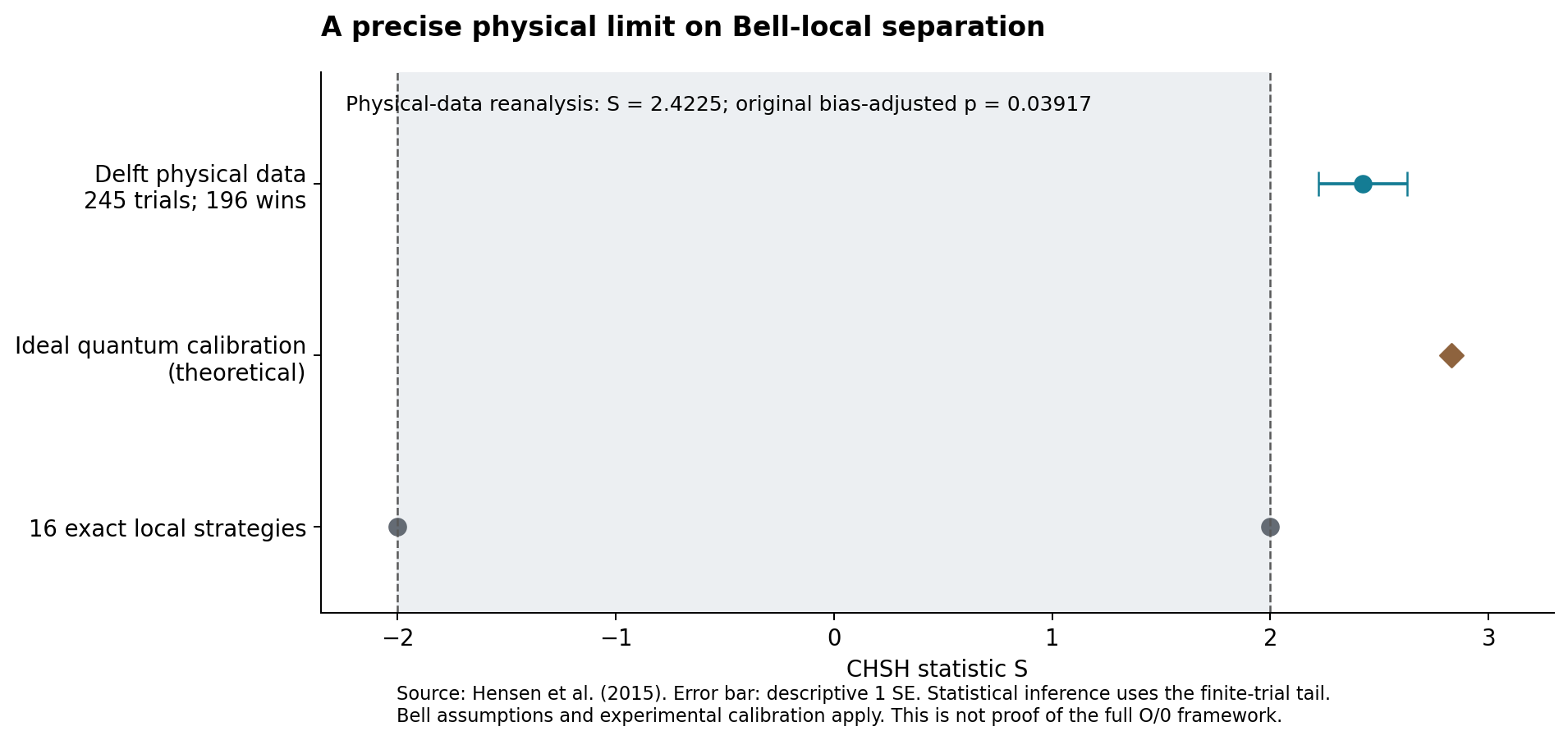
selection, and recover 245 Bell trials with 196 CHSH-game wins. The measured
CHSH statistic is 2.4224998705, above the Bell-local bound of 2. The original
conservative random-setting-bias correction gives a finite-statistics null
tail of 0.0391746436. A separate high-precision calculation agrees with the
numerical library. Exhaustive enumeration verifies the bound for all 16
deterministic local strategies. This provides a reproducible physical benchmark
for a precise limit on Bell-local separation. It does not establish O/0's
universal source, observer-source identity, consciousness, or zero-infinity
claims. The missing link is an O/0-specific quantitative prediction.
1. Research question
Can the framework's interest in separation be connected to a physical claim
with an exact mathematical limit and experimental data? Yes, for the specific
claim that Bell-local factorization describes a particular bipartite
experiment. Whether this result discriminates O/0 from ordinary quantum
mechanics is a separate question, addressed below.
The original published result was known before this analysis. This is a
retrospective reproduction and logical audit, not a new preregistered discovery
or independent laboratory experiment. The new code is written for this report;
the downloaded Python 2 example was inspected for the documented rules and
was not executed.
2. What is proved mathematically
Assume binary settings a,b in {0,1}, binary outcomes A,B in {-1,+1}, and a
possibly shared hidden variable lambda. Bell locality requires:
P(A,B | a,b,lambda) = P(A | a,lambda) P(B | b,lambda).
Measurement independence additionally requires lambda's distribution not to
depend on the freely selected current settings. These are explicit premises;
neither is an assumption that the two sites have no shared history or source.
For a deterministic local assignment A0,A1,B0,B1, define:
S_lambda = A0 B0 + A0 B1 + A1 B0 - A1 B1
         = A0 (B0+B1) + A1 (B0-B1).
Because B0,B1 are each plus or minus one, exactly one parenthesis is zero
and the other is plus or minus two. Therefore S_lambda is exactly plus or
minus two. Random local response rules can be represented by mixing these
deterministic assignments. Taking any convex mixture gives |S| <= 2.
The supplied enumeration checks every one of the 16 assignments.
This is an exact conditional proof for a defined model class. It is not a
proof that every kind of separation, every ontology, or every shared-source
model is impossible. A Bell-local model already permits one shared lambda.
3. Physical data and fixed method
The source is the authors' official 4TU repository for the 2015 Delft
experiment. The downloaded archive is 152,913 bytes; its MD5 matches the
repository metadata. The archive and event-log SHA-256 hashes are preserved
in results/summary.json. The original measurements and their interpretation
belong to Hensen et al., Nature 526, 682-686 (2015).
There are 4,746 deposited candidate-event rows. We apply the documented
herald-window, excitation-click and invalid-marker conditions, keeping the
original timing thresholds and CHSH sign convention. All 245 selected trials
receive outcomes; a missing click in the specified readout window maps to -1,
rather than causing trial deletion. No thresholds, signs, subsets or stopping
rules were selected to maximize the violation here. Exact rules are in
analysis_plan.md and src/analyze.py.
The settings counts for (00,01,10,11) are (53,79,62,51). The complete 4-by-4
setting/outcome count table, selected original row indices, and conditional
correlations are downloadable. Code validates the source checksum before use.
4. Reproduced result
- Trials: 245. CHSH-game wins: 196.
- S = 2.4224998704613703; descriptive standard error = 0.20382659825201987.
- Original conservative RNG-bias correction: tau = 0.0000108,
q = 0.75 + 3*(tau + tau^2).
- Primary tail: P[W >= 196 | n=245, q] = 0.039174643558790086.
- The ideal-uniform-settings tail is reported separately in the summary.
- All 16 deterministic local strategies obey |S| <= 2.
The finite-statistics argument bounds each trial's conditional winning
probability under the local model, given the appropriate setting assumptions;
it does not require device outcomes to be independent and identically
distributed. We adopt the original investigators' RNG calibration and
experimental conditions. This computation does not independently validate
the apparatus timing, spatial separation, random-bit calibration or laboratory
procedures. The standard error is descriptive, not the basis of the primary
memory-robust null calculation.
A p-value bounds an outcome frequency under the specified null. It is not
the probability that the null is true, the probability that O/0 is true,
or a logical proof from finite observations.
5. Calibration and negative control
An explicit two-qubit Bell state with Pauli measurement operators gives
S = 2*sqrt(2). Its global density matrix is pure, while each local reduced
state has purity 1/2. This theoretical known-answer calculation checks the
algebra and illustrates information in the joint state absent from its
individual marginals. It is labeled theoretical; it adds no physical trials.
As a descriptive negative control, 2,000 seeded permutations rearrange Bob's
outcomes within his own setting strata. This preserves his local setting-
dependent frequencies while breaking the paired correlation with Alice.
Every permutation score and its central 95% range are provided. This control
is not substituted for the primary Bell-test null tail.
The SciPy survival probability is checked against an independent, 80-digit
standard-library binomial sum. All analysis sources and derived artifacts
carry SHA-256 checksums.
6. What this establishes for the O/0 project
There is real, previously peer-reviewed physical evidence against the stated
Bell-local model class under its experimental assumptions. In ordinary quantum
theory, a separable mixture of local states with local measurements obeys the
Bell bound, so its violation is evidence of entanglement. This is a precise
physical sense in which an independent-local-state account is insufficient.
It is not evidence specific to O/0. Ordinary quantum mechanics already predicts
Bell violations. A shared classical source alone does not evade the bound.
The experiment does not measure subjective awareness or demonstrate that two
observers are numerically one entity. It does not establish a controllable
faster-than-light channel. Bell's theorem cannot be used as a substitute for
those missing tests.
The original O/0 source's discussion of entanglement motivates this bridge.
Conceptual provenance is not empirical support for the entire framework.
7. The remaining proof obligation
Consider three candidate accounts:
- Bell-local factorization with measurement independence: predicts |S| <= 2.
- Standard quantum mechanics: permits larger values and explains this result.
- The present O/0 source: supplies no distinct distribution P(A,B|a,b).
For O/0 to become a competing scientific theory, it must supply the missing
quantitative rule. If an O/0 model predicts exactly the same probabilities
as quantum mechanics for every measured outcome, then on those data:
Likelihood(data | O/0) / Likelihood(data | quantum mechanics) = 1.
No analysis of those outcomes can distinguish the two models under that
condition. This is an identifiability statement, not an assertion that one
interpretation is false. Calling an existing quantum result proof of a
particular ontology would leave this gap unresolved.
A genuinely discriminating next experiment requires an O/0-derived numerical
prediction for a specified preparation and measurement, a different predicted
distribution under the comparator, fixed calibration and exclusion rules,
adequate statistical precision, and independent replication. Any proposed
departure from quantum theory must be stated as an additional hypothesis;
it cannot simply be inferred from the word "oneness."
8. External replication context and novelty
Other laboratories and platforms have reported loophole-free Bell violations.
For example, Storz et al. (2023) report S=2.0747 +/- 0.0033 from more than one
million superconducting-circuit trials. That result is cited from the original
paper and is not reanalyzed here.
Bell nonlocality is an established discovery. This record contributes a
reproducible archive benchmark and an explicit inference audit. It does not
claim a new discovery of nonlocality or a new physical confirmation of O/0.
The underlying papers have peer review; this archive reanalysis does not yet.
9. Data, code and reproduction
The downloadable package includes the analysis plan, independent Python 3
implementation, exact-local-strategy table, aggregate counts, selected row
indices, permutation controls, provenance, figure and checksums. The original
archive is fetched directly from its official repository and is not
redistributed here under an assumed license. README.md gives one-command
reproduction, including checksum validation. No downloaded analysis code is
executed.
References
- Hensen et al., original experiment: https://doi.org/10.1038/nature15759
- Hensen et al., open preprint: https://arxiv.org/abs/1508.05949
- Original data: https://doi.org/10.4121/uuid:6e19e9b2-4a2d-40b5-8dd3-a660bf3c0a31
- Repository metadata: https://data.4tu.nl/v2/articles/12703235
- Elkouss and Wehner, finite-statistics methods: https://doi.org/10.1038/npjqi.2016.26
- Storz et al., independent physical platform: https://doi.org/10.1038/s41586-023-05885-0