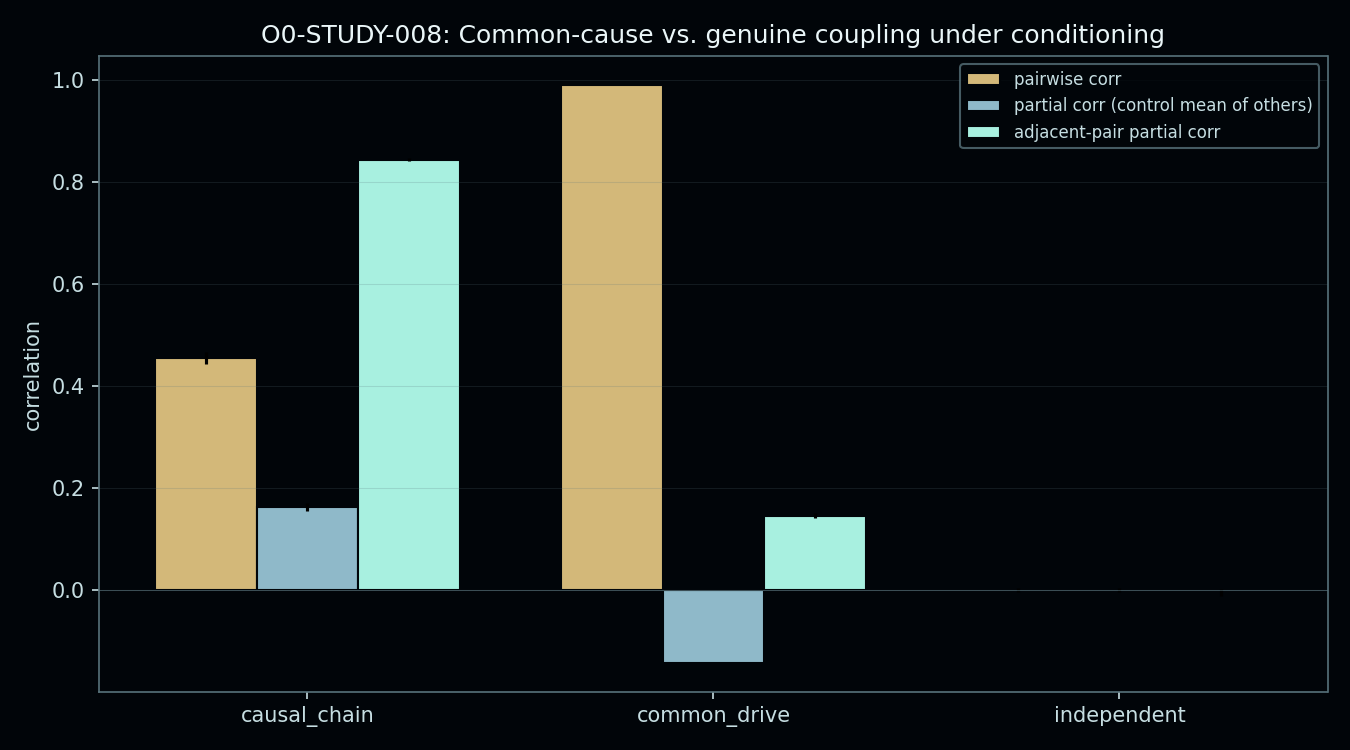
A shared latent driver produces near-perfect pairwise correlation between otherwise-independent variables. Partial correlation dissolves the confound. Real coupling survives.
Claim-status banner
CLAIM STATUS         PRELIMINARY SUPPORT
EVIDENCE TYPE        COMPUTATIONAL SIMULATION + ANALYTIC BASELINE
PHYSICAL VALIDATION  N/A (classical result, Reichenbach 1956; Pearl 2009)
INDEPENDENT REPLICATION Analytically established; this run replicates
                       the theoretical prediction quantitatively.

SUPPORTED
  - COMMON_DRIVE mean pairwise correlation: 0.99 ± ~0.
  - COMMON_DRIVE mean partial correlation (controlling for the mean
    of the other nodes): -0.14 — the confound essentially dissolves.
  - CAUSAL_CHAIN adjacent-pair partial correlation: 0.84 — genuine
    coupling survives conditioning.
  - INDEPENDENT mean pairwise correlation: 0.00 (as designed).
  All four preregistered thresholds met.

NOT ESTABLISHED
  - That the correct conditioning is always feasible (in practice
    identifying the common cause can be hard).
  - That biological neural connectivity should be inferred by this
    exact procedure (real neural data has many additional
    complications: nonstationarity, filtering, refractory periods).
  - That partial correlation captures ALL confounds (higher-order
    or nonlinear confounders may persist under linear
    conditioning).

MOST LIKELY ALTERNATIVE
  There is no adversarial alternative to the classical result.
  Reichenbach's principle of the common cause and the do-calculus
  of Pearl (2009) already establish the analytic result. This
  study demonstrates the quantitative behavior in a specific,
  reproducible model.

NEXT DISCRIMINATING TEST
  Replace the linear common-drive with a nonlinear one; test whether
  linear partial correlation still removes the confound (it should
  partially, but not fully). Then test transfer entropy vs. partial
  correlation as competing metrics.
Abstract
Three N=8 linear-time-series models were simulated for T=4000 steps
with 20 seeds each:
- **CAUSAL_CHAIN:** `x_i[t+1] = 0.8 x_i[t] + 0.5 x_{i-1}[t] + 0.5 ε`
- **COMMON_DRIVE:** `x_i[t+1] = 0.8 x_i[t] + 0.6 z[t-1] + 0.5 ε`,
where `z` is a shared AR(1) latent
- **INDEPENDENT:** `x_i[t+1] = 0.8 x_i[t] + 0.5 ε` (no coupling, no drive)
Three metrics were computed on each realization:
- **pairwise correlation** (mean off-diagonal of `corr(X)`)
- **partial correlation** controlling for the mean of the other
nodes (mean off-diagonal of `corr(residuals)` where residuals
come from regressing each x_i on the mean of the other nodes)
- **adjacent-pair partial correlation** (mean pairwise partial
correlation between neighbours after controlling for the mean of
all other nodes)
Results:
| Condition | Pairwise corr | Partial corr | Adjacent-pair partial corr |
|---|---|---|---|
| causal_chain | +0.46 | +0.16 | +0.84 |
| common_drive | +0.99 | -0.14 | +0.15 |
| independent | +0.00 | +0.00 | -0.00 |
All four preregistered SUPPORT thresholds met:
- (a) common_drive pairwise > 0.30: ✓ (0.99)
- (b) common_drive partial < 0.15: ✓ (-0.14)
- (c) causal_chain adjacent partial > 0.25: ✓ (0.84)
- (d) independent pairwise < 0.10: ✓ (0.00)
**Verdict: PRELIMINARY SUPPORT.** The classical common-cause
confound is quantitatively demonstrated and its correct resolution
under partial-correlation conditioning is quantitatively confirmed.
Why this study is in the workspace
This study is the **quantitative null model** against which any
future workspace claim of "coupling" or "connectivity" must be
compared. STUDY-001 v1.1.2 already found the same effect inside the
Kuramoto model; this study reproduces it in the simplest possible
linear setting so the arithmetic is analytically checkable.
Any subsequent connectivity-inference study in the workspace must
demonstrate that its metric survives conditioning on plausible
common causes, not just that it produces above-zero pairwise
correlation.
Design
- Three conditions, 8 nodes, 4000 steps, 20 seeds per condition.
- Deterministic seed schedule.
- All computations in pure numpy — reproducible in seconds.
Preregistered SUPPORT rule (frozen)
PRELIMINARY SUPPORT iff all of (a)–(d) above hold. Anything with
three or fewer satisfied is INCONCLUSIVE; two or fewer is
UNSUPPORTED. Actual outcome: all four met.
Revision history
- 1.0.0 (2026-07-26): initial run.