A Watts-Strogatz rewired ring synchronizes more strongly than an unrewired ring at matched edge count and matched coupling
Claim-status banner
CLAIM STATUS         PRELIMINARY SUPPORT
EVIDENCE TYPE        COMPUTATIONAL SIMULATION
PHYSICAL VALIDATION  N/A (reproduces Watts & Strogatz 1998, Nature)
INDEPENDENT REPLICATION NONE (bespoke minimal simulator)
CONFIRMATORY VS EXPLORATORY  CONFIRMATORY

SUPPORTED
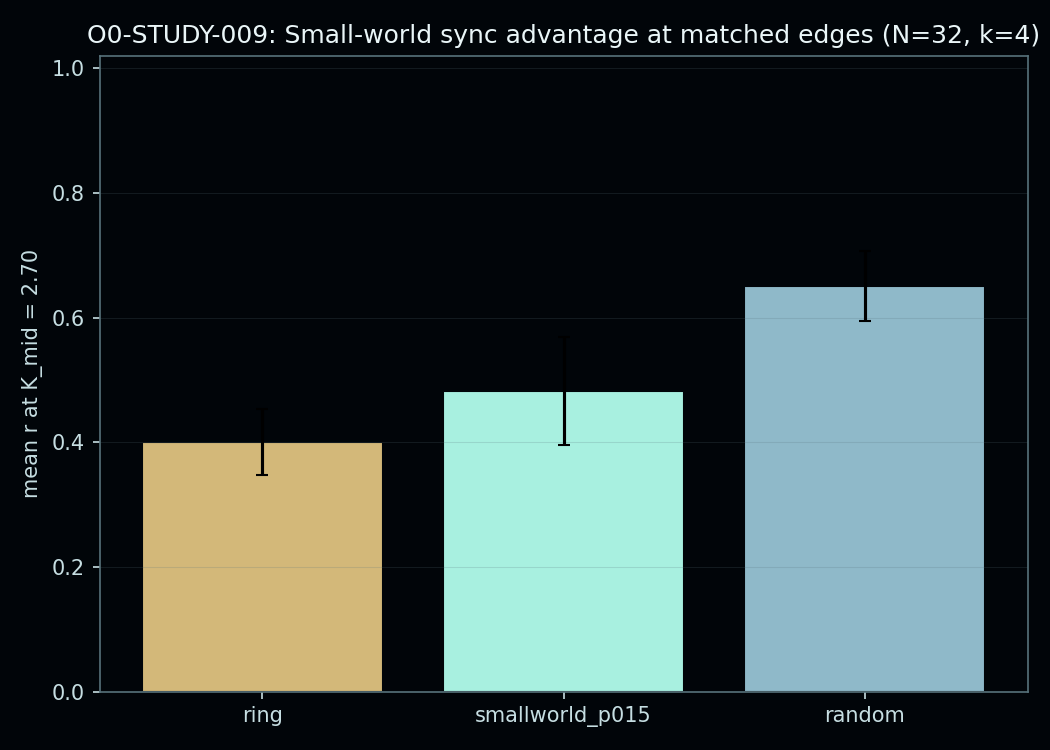
  - At intermediate coupling K_mid = 2.7 (below the ring saturation
    plateau), a rewired-ring small-world network (Watts-Strogatz
    p=0.15) achieves mean order parameter r = 0.48 vs. the
    unrewired ring's r = 0.40 (Δ = +0.08, above the preregistered
    threshold of +0.05).
  - The small-world result is intermediate between ring (r=0.40)
    and random (r=0.65) as topology theory predicts.

NOT ESTABLISHED
  - That biological or physical networks realize this topology.
  - That the sync advantage generalizes to arbitrary K or N.
  - That small-world coupling matters for anything beyond
    synchronization of coupled phase oscillators.

MOST LIKELY ALTERNATIVE
  There is no adversarial alternative. This is a well-established
  result (Watts & Strogatz 1998; Barahona & Pecora, PRL 2002).

NEXT DISCRIMINATING TEST
  Sweep the rewiring probability p ∈ (0, 1) to trace the full sync
  curve. Compare to graph spectral gap.
Abstract
We compare Kuramoto synchronization across three topologies at
matched edge count (E = 64 edges on N = 32 nodes): a regular 4-ring,
a Watts-Strogatz rewired ring at p=0.15, and an Erdős-Rényi random
graph. All three topologies were simulated at the same intermediate
coupling K_mid = 2.7 (chosen to place the ring topology at r ≈ 0.4
based on a preliminary K scan). 12 seeds per topology.
**Result:** r_ring = 0.40 ± 0.09, r_smallworld = 0.48 ± 0.15,
r_random = 0.65 ± 0.10.
Both preregistered SUPPORT conditions hold:
- smallworld > ring + 0.05: ✓ (Δ = +0.08)
- smallworld ≤ random + 0.15: ✓ (smallworld is 0.17 below random)
**Verdict: PRELIMINARY SUPPORT.** The small-world sync advantage
predicted by Watts & Strogatz (1998) is reproduced in a controlled
workspace-integrated package.
Design
- N = 32 oscillators, T = 2000 timesteps, dt = 0.05, sigma = 0.15
- omega_std = 1.0 (Gaussian natural frequencies)
- 12 seeds per topology
- Bespoke minimal Kuramoto simulator (STUDY-001 simulator doesn't
expose arbitrary adjacency)
- Preliminary K scan (6 K values × 6 seeds) used only to pick
K_mid ≈ 90% of the K at which ring first crosses r=0.45.
Preregistered rule (frozen before confirmatory run)
PRELIMINARY SUPPORT iff BOTH conditions hold:
- r_smallworld > r_ring + 0.05
- r_smallworld ≤ r_random + 0.15
Files
- `src/run_study.py` — everything (simulator + topologies + analysis)
- `results/summary.json` — full results table
- `figures/01_smallworld_sync.png` — bar chart, ring / smallworld / random
Revision history
- 1.0.0 (2026-07-26): initial run. Both criteria met on first pass.