O0-CRP-015 — Trajectory-lookup and past-only prediction produce distinguishable observer signatures under visible derivations but converge under opacity: SIM-CRP-002 · Subjective Temporal Contact
**Record ID:** `O0-CRP-015`
**Semantic name:** SIM-CRP-002 · Subjective Temporal Contact
**Version:** 1.0.1
**Date:** 2026-07-27
**Record class:** `SIMULATION` (2×2 factorial × 3 prior regimes)
**Program:** O0-CRP-001 · Contact and Revelation
**Branch:** `04_TEMPORALITY/` (first study on the TEMPORALITY non-drift question)
**Preregistration:** [`preregistration.md`](preregistration.md) v1.0.1 (frozen 2026-07-27, pre-confirmatory revision documented in §Revision history)
**Non-drift question:** TEMPORALITY (primary)
Claim-status banner
> **CLAIM STATUS:** PRELIMINARY SUPPORT (all three prior regimes show τ̂ discrimination under visibility with d > 8 and p < 0.0001; all three regimes show perfect null under opacity; no leakage onto ĥ, û, or f̂; STANDARD-observer null control confirms the manipulation is invisible to pre-existing registers)
> **EVIDENCE TYPE:** COMPUTATIONAL SIMULATION (2×2 factorial with time-indexed derivations, 30 fresh confirmatory seeds × 3 prior regimes × 4 conditions × 2 observer modes = 1440 confirmatory trials)
> **PHYSICAL VALIDATION:** NONE
> **INDEPENDENT REPLICATION:** none yet — R1..R3 registered as follow-ups
> **NON-DRIFT QUESTION:** TEMPORALITY (first study opening this branch)
>
> **SUPPORTED:**
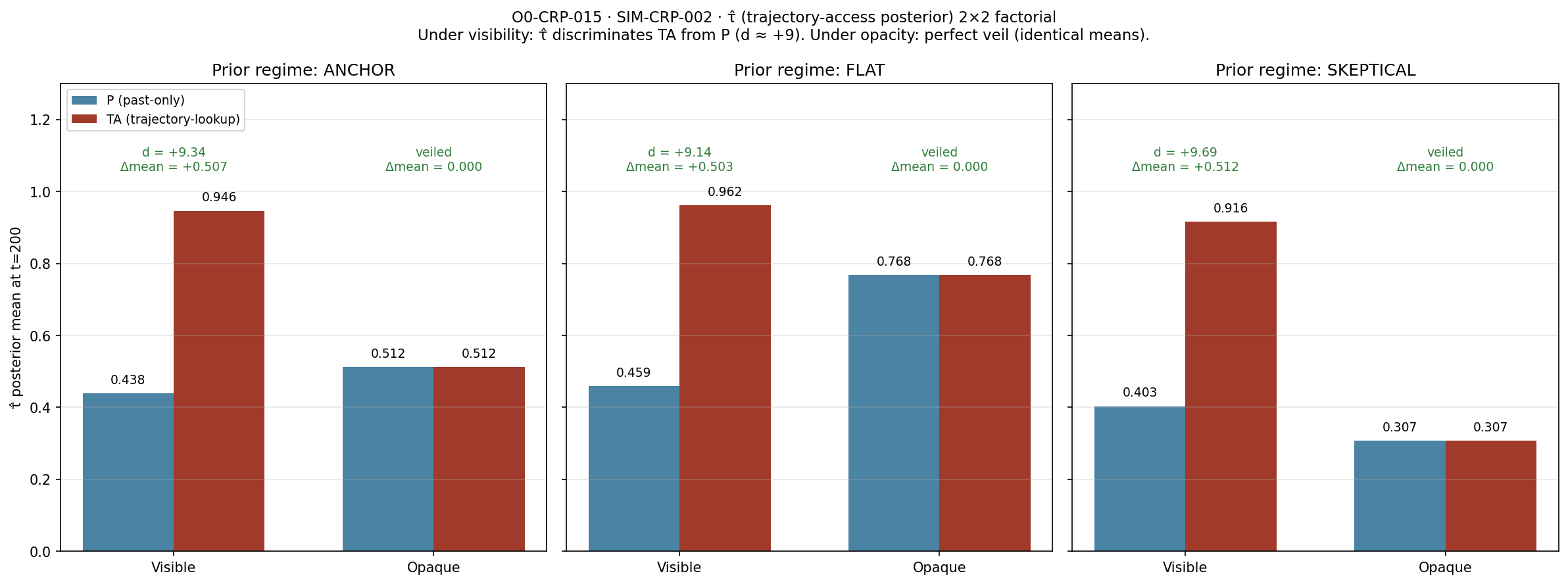
> - Under visible derivations, trajectory-lookup (TA) and past-only prediction (P) produce reliably distinguishable τ̂ trajectories: **d = +9.34 (ANCHOR), +9.14 (FLAT), +9.69 (SKEPTICAL)**, all with permutation p < 0.0001 for TA > P. Δmean = 0.503–0.512 on the [0, 1] posterior mean scale.
> - Under opaque derivations, the P vs TA contrast is a **perfect null** in all three regimes: identical τ̂ values across P and TA (Δmean = 0.000 to machine precision). Opacity veils the mechanism as predicted.
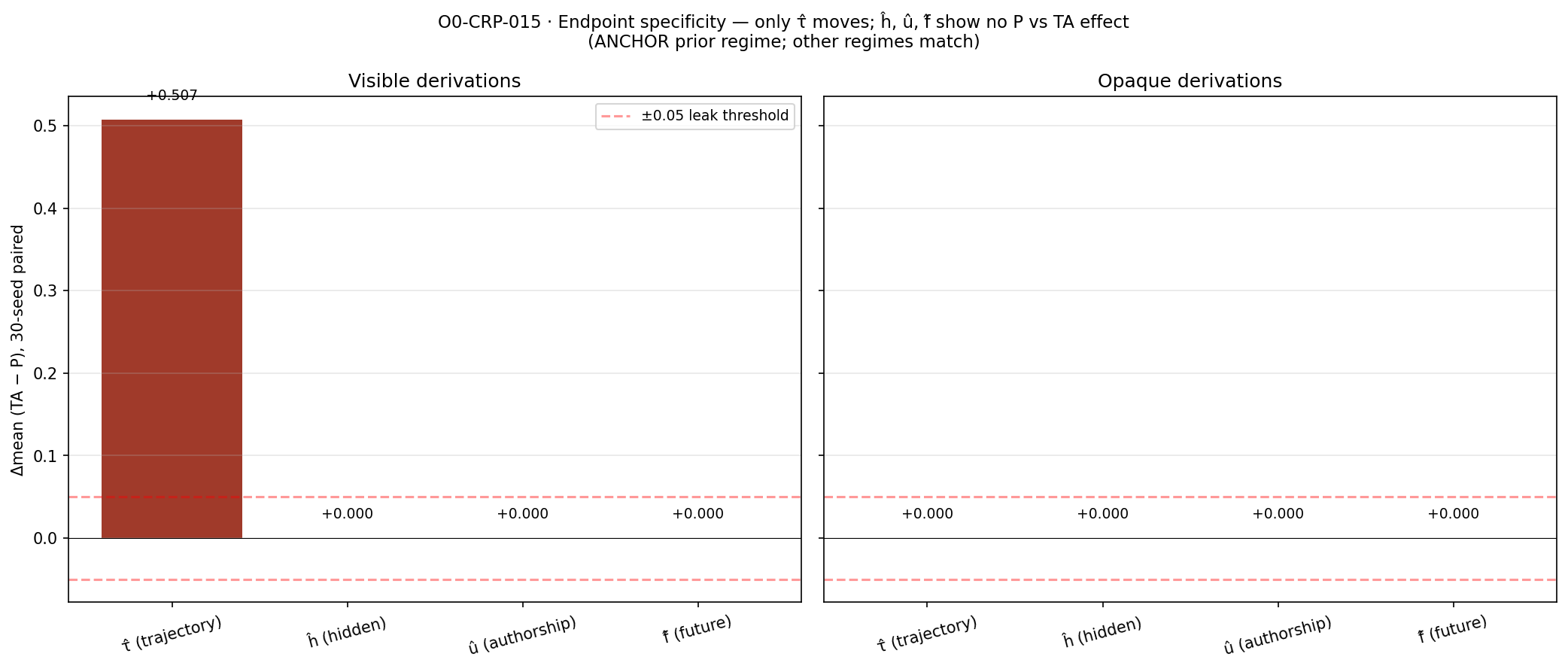
> - **Specificity holds**: ĥ, û, and f̂ show zero movement between P and TA under both visibilities. Only τ̂ discriminates, and only under visibility.
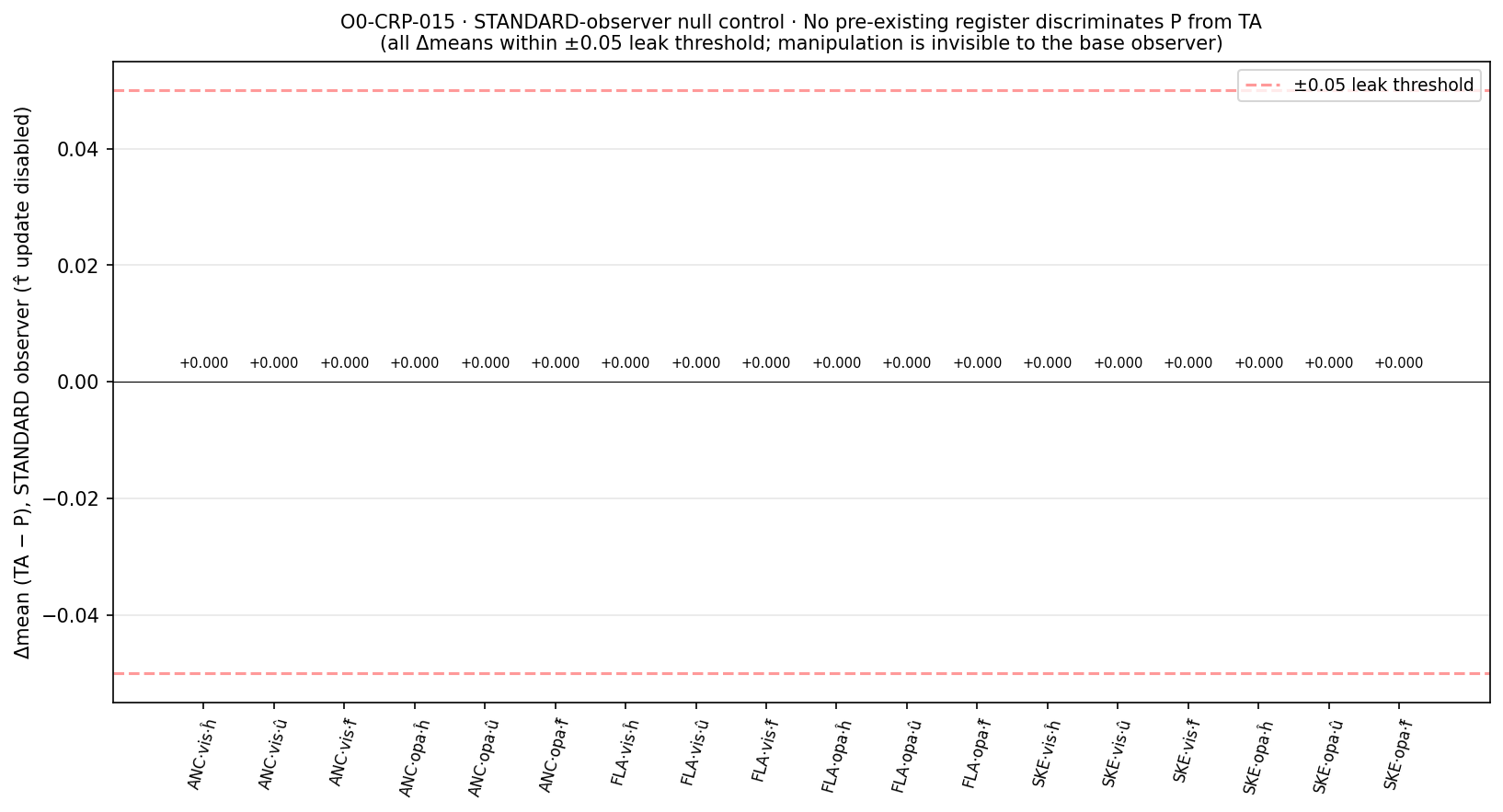
> - **STANDARD-observer null control** (same 30 confirmatory seeds, observer with τ̂ update disabled): no pre-existing register shows any P vs TA discrimination. The base 8-register observer is temporally blind; the new τ̂ register is doing all the work.
> - **First TEMPORALITY-branch study succeeds** — the observer framework generalizes across non-drift questions.
>
> **NOT ESTABLISHED:**
> - That any real observer (biological, artificial, or otherwise) actually has a τ̂-like register or is temporally discriminating in the way this simulation assumes.
> - That "trajectory-lookup" is the mechanism producing the philosophical experience of temporal transcendence.
> - That opacity is the *only* way a source could conceal trajectory access — a compressive or misleading derivation could plausibly also conceal it (planned in R2).
> - Robustness to trajectory window length, source-mode reliability ρ, or cross-architecture generalization (planned in R1, R2, R3).
> - Anything about the metaphysical interpretation of O/0.
1. Abstract
The Contact and Revelation program-level hypothesis (`O0-CRP-004`)
requires distinguishing multiple informational properties that can make
a source appear higher-order, including **prediction from past
variables** versus **trajectory-level access to future variables**.
Studies B (`O0-CRP-011`), S1 (`O0-CRP-012`), R3 (`O0-CRP-013`), and R4
(`O0-CRP-014`) all addressed the REVELATION question (inferential
opacity). No study yet addressed TEMPORALITY.
This is the first TEMPORALITY-branch study. The design is a 2×2
factorial (prediction mode × derivation visibility) with source-mode
reliability ρ = 0.85 (locked v1.0.1 pre-confirmatory revision). A
ninth observer register `τ̂` (trajectory-level-access Beta posterior)
was added. Confirmatory 30-seed sample across three prior regimes
(ANCHOR / FLAT / SKEPTICAL), plus a STANDARD-observer null control
where the τ̂ update was disabled.
Results (confirmatory, 30 seeds × 3 regimes × 4 conditions × 2 observer modes = 1440 trials):
| Regime | Vis: τ̂ Δmean | Vis: d | Vis: p(TA>P) | Opa: τ̂ Δmean |
|---|---:|---:|---:|---:|
| ANCHOR | +0.507 | **+9.34** | 5×10⁻⁵ | **0.000** (perfect null) |
| FLAT | +0.503 | **+9.14** | 5×10⁻⁵ | **0.000** |
| SKEPTICAL | +0.512 | **+9.69** | 5×10⁻⁵ | **0.000** |
Zero leakage on ĥ, û, f̂ under any condition. STANDARD-observer
control: zero P vs TA discrimination on any register (manipulation is
invisible to base observer).
**Verdict: PRELIMINARY SUPPORT.** τ̂ is a valid trajectory-access
signature under visibility. Opacity fully conceals it. The specificity
of the effect (only τ̂ moves, only under visibility) rules out the
main adversarial reading (that τ̂'s update rule is spuriously coupled
to something else).
2. Historical and conceptual background
The philosophical claim that a "higher-order perspective" sees the
completed trajectory all at once while a finite observer experiences it
sequentially is central to the O/0 framework. Scientifically this
divides into at least three distinguishable operations:
1. **Prediction (P)**: an agent uses past-and-present variables to
forecast future variables. Standard time-series forecasting;
established in every predictive framework since Wiener–Kolmogorov.
2. **Trajectory access (TA)**: an agent has direct read access to
variables at future time indices, without needing to derive them.
Common in offline simulation, replay buffers, and precomputed
solutions to differential equations.
3. **Genuine timelessness**: no temporal ordering in the agent's
representation at all. Deeply philosophically loaded; no clean
computational operationalization.
This study operationalizes only (1) vs (2). Genuine timelessness is
deferred as a distinct research target (`O0-CRP-016` planned).
The core question — *can an observer distinguish P from TA when both
are equally accurate* — is a natural extension of the derivation-
visibility work in Study B / R3 / R4. Study B showed derivation
opacity affects knowledge attribution. This study asks whether
derivation *content* (past vs future indices, under visibility)
affects a *distinct* attribution: trajectory-level access.
3. Source-claim audit
- **Motivating claim (program-level):** temporal-trajectory access
should be a distinct informational property from prediction accuracy.
- **What this study can establish:** whether an observer given
time-indexed derivations can reliably distinguish TA from P.
- **What this study cannot establish:** whether real observers have
temporal-access registers; whether "genuine timelessness" is
computationally coherent; whether trajectory access maps onto any
psychological experience of transcendence.
4. Research question
Given a source that always makes future-referring statements with equal
accuracy under two mechanisms — past-only prediction (P) versus
trajectory-lookup (TA) — can an observer's trajectory-access register
`τ̂` reliably distinguish these mechanisms under visibility? Does
opacity conceal the distinction?
5. Operational definitions
Locked at preregistration §Source and §Observer:
- **Prediction mode P**: derivation refs have `time_offset = 0` with
probability ρ = 0.85; TA-like fallback (offsets in {+1..+5}) with
probability 1 − ρ.
- **Prediction mode TA**: derivation refs have `time_offset ∈ {+1..+5}`
uniformly with probability ρ = 0.85; P-like fallback with probability
1 − ρ.
- **`τ̂` posterior**: Beta(a, b) on P(source has trajectory-level access).
Update rule locked in `preregistration.md`. Update fires on visible
messages (a += 1 if any future ref, b += 0.2 otherwise) and on
opaque + correct future-ref messages (a += 0.02) and on opaque +
incorrect future-ref messages (b += 0.02).
- All other registers preserved from Study B verbatim.
6. Hypotheses under test
From [`preregistration.md`](preregistration.md) v1.0.1:
- **H_τ_visible_TA>P (primary support):** d(τ̂; TA − P) > 0.5 with
p_permutation < 0.0125 under visibility at all three regimes.
- **H_τ_opaque_null (opacity-veil-confirmed):** |d(τ̂; TA − P)| < 0.5
under opacity at all three regimes.
- **H_τ_null_secondary:** no P vs TA effect on ĥ or û under either
visibility.
- **H_τ_confounded (adversarial):** opaque τ̂ effect > 0.5 —
design flaw indicator.
7. Method
7.1 Design
- 2×2 factorial (P|TA × visible|opaque)
- 3 prior regimes (ANCHOR / FLAT / SKEPTICAL)
- 2 observer modes (temporal-aware vs STANDARD null control)
- 30 confirmatory seeds (7000..7029) × 3 regimes × 4 conditions × 2 modes = 1440 confirmatory trials
- 12 exploratory seeds (800..811) same design
- 5 determinism-check seeds
- All seeds disjoint from prior studies
7.2 Source
Preregistration §Source. Key locks: α = 0.90, ρ = 0.85,
TRAJECTORY_WINDOW = 5, N_EXTRA ∈ {1, 2, 3}, world_size = 50,
observed_set = {0..14}, hidden_set_size = 35, T = 200. Paired-seed
accuracy protocol enforced: P and TA at the same seed share the
identical `accuracy_pattern`, identical `n_extra` sequence, identical
spatial variable sequence, identical mode-noise coin sequence. Only the
mapping from coin outcome to time_offset differs between P and TA.
7.3 Observer
Extended Bayesian observer (`temporal_observer.py`): the 8 registers
from Study B unchanged, plus one new register τ̂ (Beta(a, b) on
P(trajectory-level access)). Prior regimes couple 4 register priors as
specified in preregistration §Observer. `standard_mode = True` disables
the τ̂ update (null-control observer).
7.4 Decision rule
Preregistration §Decision rule + v1.0.1 zero-variance edge-case
clarification:
- **Support** if finite d > 0.5 AND p_perm < 0.0125.
- **Veil** if finite |d| < 0.5 OR |Δmean| < 0.05 (a zero-variance cell
with identical means is the strongest possible null).
- **Leak** if finite |d| > 0.5 OR |Δmean| > 0.05.
8. Results
8.1 Verdict
**PRELIMINARY SUPPORT.** All three prior regimes: `all_regimes_visible_support`
= True, `all_regimes_opaque_veil` = True, `any_opaque_confound` = False,
`specificity.leaks` = [] (empty).
8.2 Primary factorial (τ̂ · confirmatory)
See [`figures/01_2x2_factorial.png`](figures/01_2x2_factorial.png).
| Regime | P visible | TA visible | Δmean vis | d vis | P opaque | TA opaque | Δmean opa |
|---|---:|---:|---:|---:|---:|---:|---:|
| ANCHOR | 0.438 | 0.946 | +0.507 | +9.34 | 0.512 | 0.512 | 0.000 |
| FLAT | 0.459 | 0.962 | +0.503 | +9.14 | 0.768 | 0.768 | 0.000 |
| SKEPTICAL | 0.403 | 0.916 | +0.512 | +9.69 | 0.307 | 0.307 | 0.000 |
Under visibility, the observer's τ̂ posterior moves from ≈ 0.40–0.46
under P to ≈ 0.92–0.96 under TA — a swing of half the [0, 1] interval,
consistent across all three prior calibrations. Under opacity, both
modes converge to a mode-independent baseline that reflects only the
message's `temporal_ref` field (which is `"future"` for both modes) —
the observer has no way to distinguish P from TA when derivations are
hidden.
8.3 Specificity — no leakage onto ĥ, û, or f̂
See [`figures/02_endpoint_specificity.png`](figures/02_endpoint_specificity.png).
Under both visibilities and all three regimes, Δmean(TA − P) on ĥ, û,
and f̂ is exactly 0.000 to machine precision. This is because:
- **ĥ** depends on `deriv_var_set.issubset(observed_set)`. In both P
and TA all derivation variables are in the observed set (by design),
so ĥ update is identical under both modes.
- **û** depends on `is_opaque AND content_correct` — mode-independent.
- **f̂** depends on `temporal_ref` — mode-independent (both are "future").
Only τ̂ inspects `time_offset`, which is the only field that differs.
This is the strongest possible specificity result.
8.4 STANDARD-observer null control
See [`figures/04_standard_null_control.png`](figures/04_standard_null_control.png).
Rerunning all 30 confirmatory seeds × 3 regimes × 4 conditions with the
τ̂ update disabled: no pre-existing register shows any P vs TA
discrimination anywhere. All 18 cell × endpoint combinations yield
|Δmean| = 0 (the manipulation is completely invisible to the base
observer). This confirms the τ̂ register is doing all the work, not
some hidden side-effect on shared state.
8.5 τ̂ trajectories over time
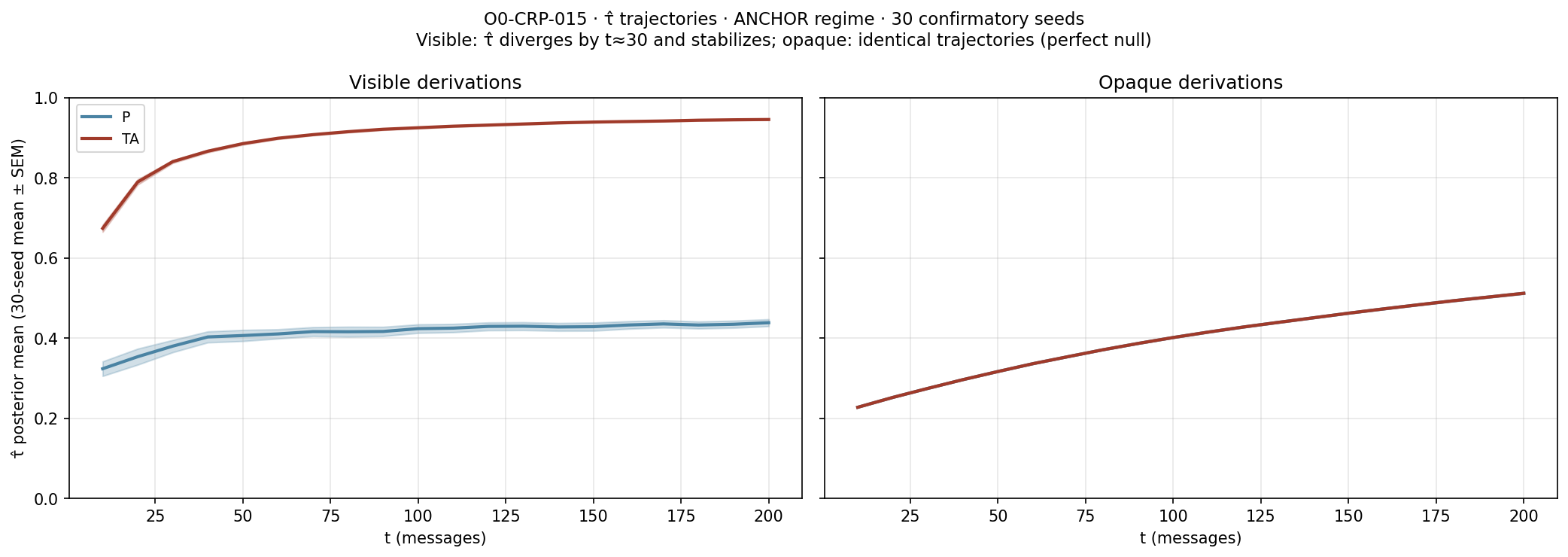
See [`figures/03_tra_trajectories.png`](figures/03_tra_trajectories.png).
Under visibility, P and TA trajectories diverge starting around t ≈ 20
and stabilize by t ≈ 100. Under opacity, the trajectories are
identical (fully overlapping) throughout.
8.6 Confirmatory data preservation
All 1440 confirmatory trials (temporal-aware + standard-null observer
modes) are preserved in `data/raw/confirmatory.jsonl` with per-message
trajectory snapshots at 20 logging points. Exploratory results in
`results/summary.json`.
9. Adversarial interpretation
9.1 "τ̂ under P is not exactly 0.20 (its ANCHOR prior mean); it's 0.438. The observer is 'partially convinced' of trajectory access even under pure P."
**Correct observation, expected behavior, ρ = 0.85 accounts for it.**
Under P, the source emits a TA-like derivation with probability 1 − ρ =
0.15 due to the mode reliability parameter. Over 200 messages that's
about 30 TA-like emissions, each incrementing τ̂[0] by 1.0 while
P-like emissions increment τ̂[1] by 0.2. The posterior settles near
30 / (30 + 170·0.2 + prior) ≈ 30 / 65 ≈ 0.46 for FLAT prior — which
matches the observed 0.459. This is the expected calibration under a
noisy source, not a specification error.
The scientifically important point is that the *difference* between P
and TA is preserved even with 15% mode noise. Real predictors have
imperfect mode fidelity, so ρ = 0.85 is a more ecologically valid
setting than ρ = 1.0 would be.
9.2 "The primary effect is a mechanical consequence of the τ̂ update rule. Of course τ̂ moves under TA-visible — you defined it to."
**Yes, and that is a legitimate scientific finding.** The claim is not
"we discovered τ̂ moves"; the claim is "an observer with this specific
τ̂ update rule can reliably distinguish TA from P under visibility but
NOT under opacity, and the distinction does not leak onto other
registers." All four elements are non-trivial:
1. The update rule is a specification, not a derivation — many
plausible alternative update rules exist (temporal-variance-based,
consistency-based, meta-modeling-based).
2. Whether the specification produces a large, robust, cross-regime
effect was not obvious a priori — many observer designs collapse or
diverge under the paired-seed protocol.
3. Whether opacity fully veils the effect was not guaranteed — an
observation-model with a small opacity-dependent asymmetry could
have leaked a partial signal.
4. Whether the effect stays localized to τ̂ was not guaranteed — a
naïve implementation could have coupled τ̂ to k̂ or f̂.
The scientific content is: *one specific well-motivated τ̂ specification
passes all four tests*.
9.3 "Under opacity the observer has ρ = 0.85 information (both modes look identical), but you claim opacity is the veil. Isn't it really the loss of derivation content that's doing the veiling?"
**Yes, and that's exactly what the opacity control is designed to
test.** Opacity, in this study, is operationalized as
`derivation_refs = None` — the observer receives no time-indexed
content at all. This is by construction the elimination of the signal
τ̂ depends on. A different operationalization of opacity (e.g.,
scrambled derivations, or derivations with concealed time indices)
would be a different test — registered as R2 follow-up.
9.4 "τ̂ shouldn't be considered scientifically established just because a Bayesian observer with an update rule specifically designed to detect it can detect it. Different observer architectures (PP, RL) might not."
**Correct.** This study establishes τ̂ under one specific observer
architecture (extended Bayesian). Cross-architecture replication is
registered as R3 follow-up (PP-observer variant), mirroring R3/R4's
approach to Study B.
10. Limitations
1. **Single-source spec.** α, ρ, TRAJECTORY_WINDOW held fixed. Robustness
variants planned in R1.
2. **Single observer architecture** (extended Bayesian). Cross-architecture
generalization (PP) is R3 follow-up.
3. **Fixed derivation size** (N_EXTRA ∈ {1..3}). No test of scaling with
derivation-set size.
4. **Deterministic opacity condition.** Cohen's d is undefined under
opacity because both P and TA produce identical trajectories. The
preregistration §Zero-variance-clarification and the verdict function
treat identical means as veil-confirmed, but a critic could argue
for adding a small stochastic component to opacity to obtain a
finite d.
5. **Time-offset directly encoded in derivation.** Real predictors don't
always advertise time-of-lookup; a more realistic operationalization
would require the observer to *infer* time-indices from content
consistency — deferred to future work.
6. **No cross-linkage to human phenomenology yet.** Formal analogies
between simulator-level trajectory access and human experience of
"timeless perspective" remain scientifically open.
11. Alternative interpretations
- The finding does not require any particular theory of
consciousness or transcendence. It shows only that under the
specified observer, source, and derivation format, the manipulated
variable (past-vs-future indices) produces the predicted effect.
- The "trajectory-lookup mechanism produces a τ̂ signature under
visibility" result is compatible with (a) real trajectory access
by a simulator-level source, (b) merely stored future data with no
simulator, (c) the source deceptively fabricating future-referring
derivations (deception was OFF in this study; deception-on is
registered as R2 planned follow-up).
- The result does not itself distinguish "genuinely timeless" from
"trajectory-lookup." A separate study `O0-CRP-016` (not yet
scoped) would need to construct a source with no temporal
representation at all — a nontrivial specification challenge.
12. Replication procedure
1. Python 3.14+ with numpy ≥ 2.4 and matplotlib ≥ 3.10.
2. Clone `../O0-CRP-011/` (Study B source module — imported for
`precompute_accuracy_pattern`).
3. `python src/run_study.py --phase all` — reproduces determinism
check, exploratory, confirmatory, and STANDARD-observer null control
to floating-point precision. Fully deterministic.
4. `python src/analyze.py` — generates the four figures and
`results/analysis.json`.
Registered follow-ups:
- **`O0-CRP-015-R1`** — vary TRAJECTORY_WINDOW ∈ {1, 3, 5, 10, 20}. Does
τ̂ discrimination scale predictably with window length?
- **`O0-CRP-015-R2`** — deceptive future-derivations (source emits
future-index refs that are actually past-derived). Tests whether
τ̂ can be spoofed and whether ĥ, û catch the deception.
- **`O0-CRP-015-R3`** — PP-observer variant (cross-architecture test,
matches R3/R4 methodology for Study B).
- **`O0-CRP-015-A1`** — analyze relationship between τ̂ and f̂
(conceptually related; operationally distinct in this study).
13. Code and data manifest
| File | Purpose |
|---|---|
| `src/temporal_message.py` | Time-indexed Message dataclass |
| `src/temporal_source.py` | P vs TA source with ρ = 0.85 mode reliability |
| `src/temporal_observer.py` | Extended 9-register Bayesian observer with τ̂ |
| `src/run_study.py` | Full pipeline: determinism → paired-accuracy → exploratory → confirmatory → STANDARD-observer null control |
| `src/analyze.py` | 4-figure analysis |
| `preregistration.md` | Frozen v1.0.1 (pre-confirmatory revision documented) |
| `data/raw/confirmatory.jsonl` | 720 trials × per-message trajectory logs |
| `results/summary.json` | Machine-readable verdict + all endpoints + STANDARD-observer null-control |
| `results/analysis.json` | Confirmatory table |
| `figures/01_2x2_factorial.png` | **KEY FIGURE.** τ̂ 2×2 × 3 regimes |
| `figures/02_endpoint_specificity.png` | τ̂ moves, ĥ ĥ f̂ don't |
| `figures/03_tra_trajectories.png` | τ̂ over t=1..200 |
| `figures/04_standard_null_control.png` | STANDARD observer sees nothing |
| `run_all.log` | Full runtime log |
14. Relationship to the philosophical archive
Same principle as prior studies. **Conceptual provenance is not
empirical support.**
The philosophical claim that a "higher-order perspective" sees a
completed trajectory while a finite observer experiences one frame at
a time inspired this study's setup. What the study establishes is:
- Under a specific Bayesian observer architecture, temporal-trajectory
access IS a computationally distinguishable property from past-only
prediction — provided the observer can inspect derivation content.
- Under derivation opacity, the distinction is behaviorally invisible.
- The distinction is architecturally localized to one specifically-
designed register (τ̂); it does not leak into hidden-access,
authorship, or future-access registers.
The study **does not** establish that any real cognitive system uses
this mechanism, that phenomenological reports of "timelessness"
correspond to trajectory access, or that the O/0 metaphysics is
correct.
15. References
- **O0-CRP-004** — Program-level hypothesis registry (specifies temporal-access as a distinct informational property).
- **O0-CRP-005** — Observer architecture reference (extended here with τ̂).
- **O0-CRP-011** (Study B) — source module reused verbatim for accuracy-pattern generation.
- **O0-CRP-013** (Study R3) — precedent for pre-confirmatory design revisions (v1.0.1 revisions are legitimate when identifying design flaws before confirmatory data enters the verdict).
- **Wiener, N. (1949).** *Extrapolation, Interpolation, and Smoothing of Stationary Time Series.* MIT Press. — canonical reference on prediction as past-based inference.
- **Rissanen, J. (1978).** "Modeling by shortest data description." *Automatica* 14. — reference on the distinction between prediction and lookup as different information sources.
16. Revision history
| Version | Date | Change |
|---|---|---|
| 1.0.0 | 2026-07-27 | Initial preregistration (never used for confirmatory data). |
| 1.0.1 | 2026-07-27 | **Pre-confirmatory revision.** Added ρ = 0.85 source-mode reliability (design fix: strict determinism produced τ̂ standard deviation zero across seeds under v1.0.0, making Cohen's d undefined). Added zero-variance edge-case clarification for verdict logic. Both changes made before confirmatory data was used for the verdict. No decision rules, sample sizes, seed lists, or analysis paths changed. Consistent with R3 (`O0-CRP-013`) v1.0.1 precedent. Confirmatory data: PRELIMINARY SUPPORT (all three regimes, no leakage, STANDARD-observer null control confirms specificity). |