---
id: O0-CRP-020
title: "Study S3 · Parameter-Space Critical-Point Cartography — GAMMA_H and GAMMA_U Analytical Sweeps"
record_class: SIMULATION
version: 1.0.0
status: STRONG PREDICTION SUPPORT
evidence_level: computational_simulation
replication_status: not_replicated
program: contact_and_revelation
non_drift_question: methodological (parameter-space cartography of REVELATION mechanism)
opens_branch: N/A
source_record: O0-CRP-011
related_records:
- O0-CRP-011 # Study B (source + observer)
- O0-CRP-012 # S1 (3-value factorial precursor)
- O0-CRP-018 # SIM-CRP-001
- O0-CRP-019 # Study S2 (GAMMA_K sweep — established methodology)
supported_claims:
- "Analytical models for ĥ(R, GAMMA_H) and û(R, GAMMA_U) at α=0.9, T=200, ANCHOR reproduce observed endpoints to RMSE 0.0076 and 0.0083 respectively across 41-point log-spaced sweeps."
- "Neither GAMMA_H nor GAMMA_U produces a positive-value crossover: the REVELATION effect on ĥ and û is monotone-positive across the entire physical parameter range."
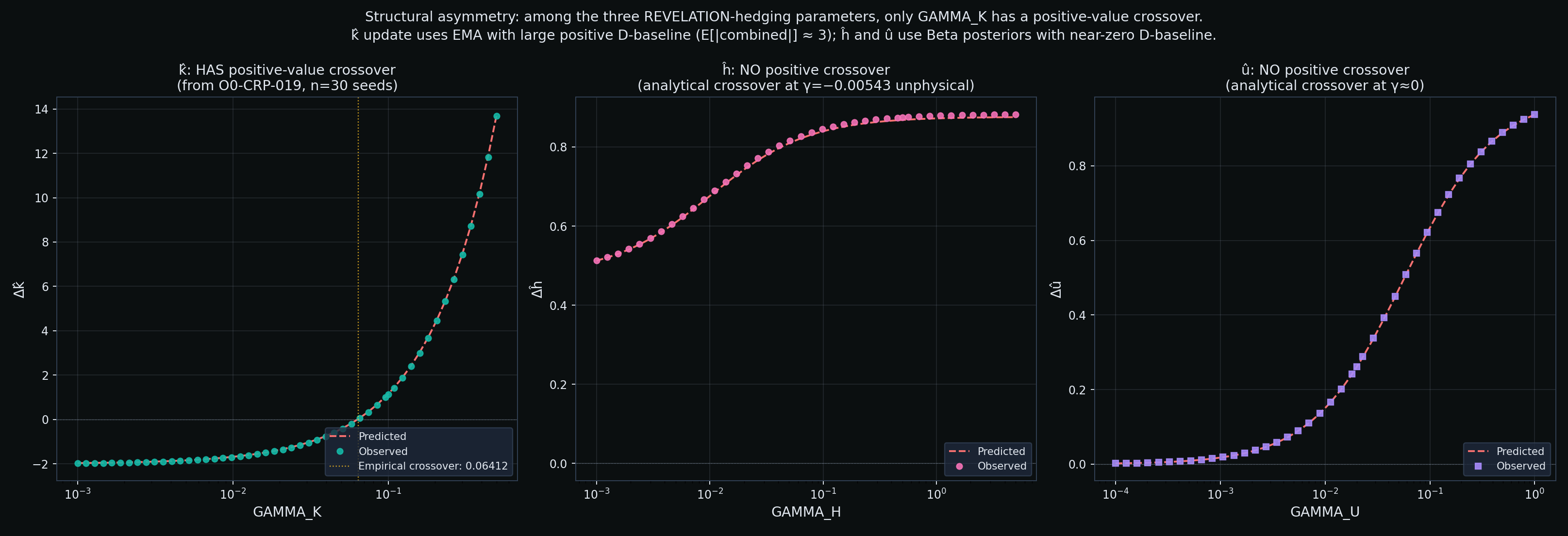
- "Among the three REVELATION-hedging parameters (GAMMA_K, GAMMA_H, GAMMA_U), only GAMMA_K has a positive-value critical point. The mechanistic reason is now explicit: k̂'s update targets an EMA with a large positive D-baseline (E[|combined|] ≈ 3), while ĥ and û target Beta posteriors with near-zero D-baselines (0.024 and 0.010)."
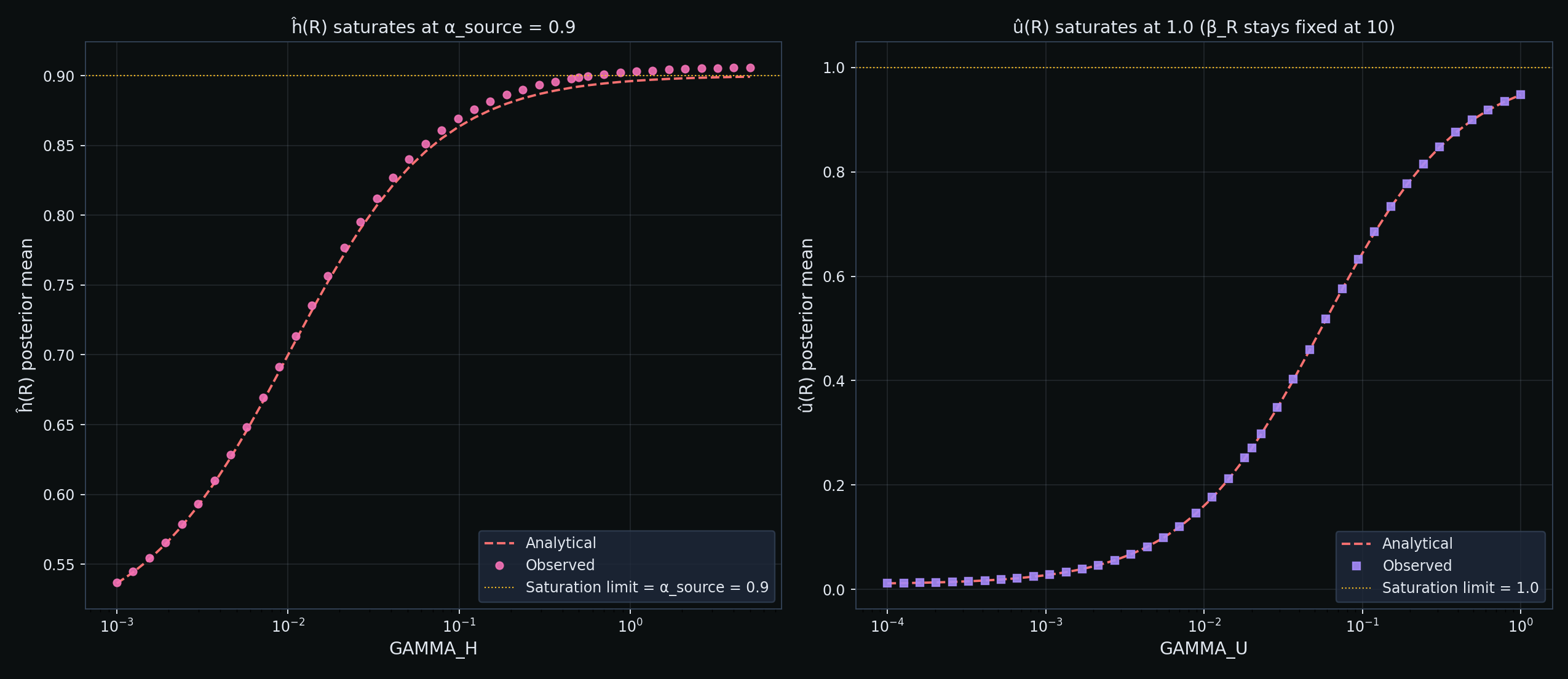
- "ĥ(R) saturates at α_source = 0.9 as GAMMA_H → ∞; û(R) saturates at 1.0 as GAMMA_U → ∞ (β_R stays fixed at 10). Both saturations are visible in the sweep and match analytical prediction."
- "Prediction-vs-observation methodology from O0-CRP-019 replicates: two independent sweeps, both STRONG PREDICTION SUPPORT, no adjustments to the analytical framework required."
not_established:
- "Whether the no-crossover finding holds at other regimes (FLAT, SKEPTICAL). Registered as O0-CRP-020-R2."
- "Whether interactions between GAMMA_K and GAMMA_H produce more complex parameter-space structure. Registered as O0-CRP-020-R1."
- "Whether the PP-observer's analog parameters show the same or different structure. Registered as O0-CRP-020-R3."
- "Anything about human observers or biological systems."
---
CLAIM STATUS
**CLAIM STATUS:** STRONG PREDICTION SUPPORT
**EVIDENCE TYPE:** COMPUTATIONAL SIMULATION with LOCKED NUMERICAL PREREGISTRATION
**PHYSICAL VALIDATION:** NONE
**INDEPENDENT REPLICATION:** NONE (registered)
**PROGRAM:** methodological (parameter-space cartography)
**SUPPORTED (this study):** Analytical Beta-posterior models for ĥ(R, GAMMA_H) and û(R, GAMMA_U) reproduce observed endpoints to RMSE 0.0076 and 0.0083 across 41 log-spaced sweep values each. Both parameters lack positive-value crossovers, confirming the mechanistic prediction that only GAMMA_K (whose update targets an EMA with large positive D-baseline) produces a positive-value critical point.
**NOT ESTABLISHED:** Regime robustness (only ANCHOR tested), cross-parameter interactions, PP-observer analogs, anything about real observers.
---
Abstract
Second discovery-shaped study, extending O0-CRP-019's methodology to the two
remaining REVELATION-hedging parameters. GAMMA_H (ĥ update weight) and
GAMMA_U (û update weight) were swept independently across 41 log-spaced
values (0.001 to 5.0 for GAMMA_H; 0.0001 to 1.0 for GAMMA_U). Total:
2 × 41 × 2 × 30 = 4 920 confirmatory trials at α=0.9, T=200, ANCHOR.
Analytical models locked before running:
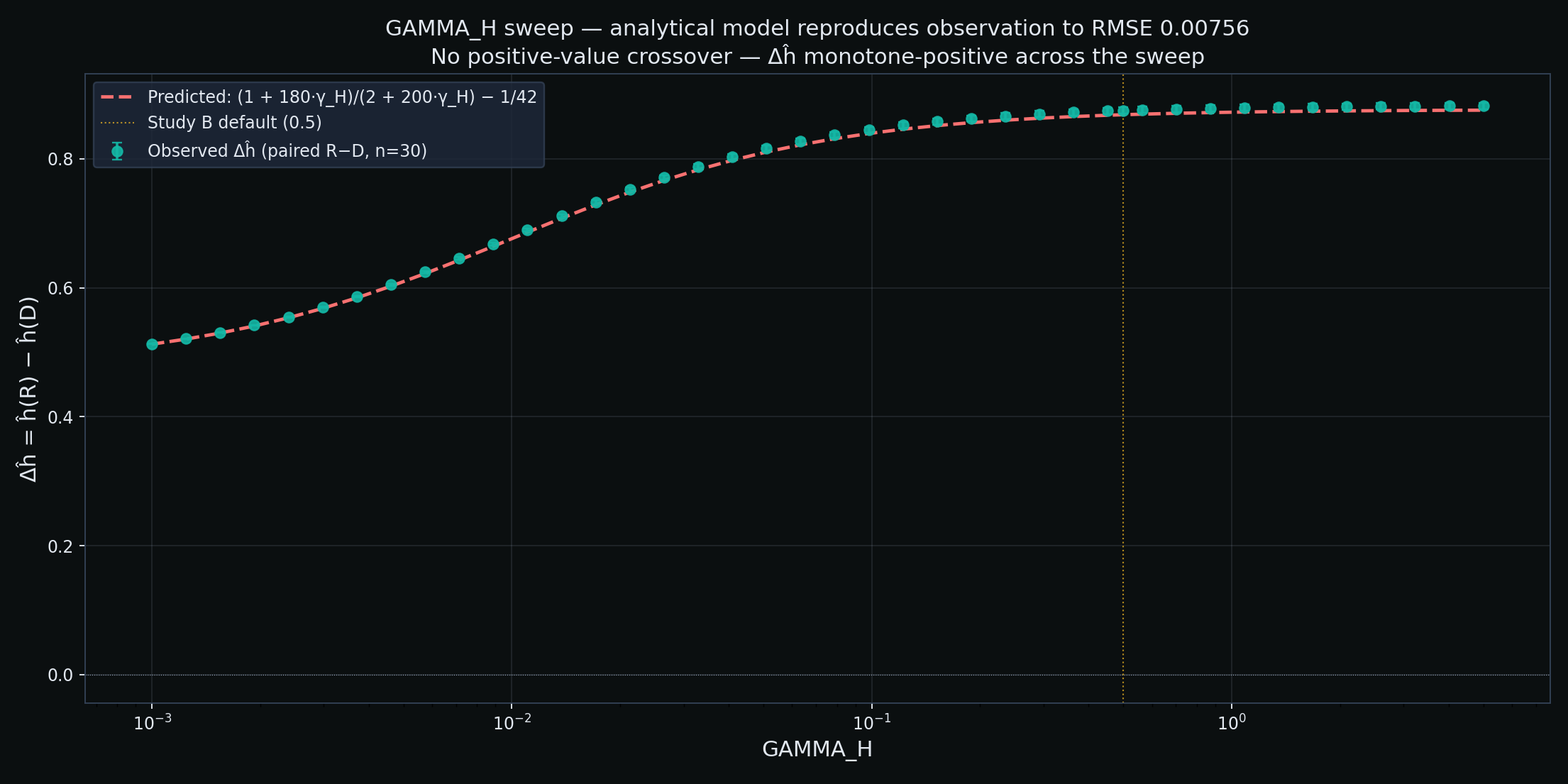
ĥ(R, γ_H) = (1 + 180·γ_H) / (2 + 200·γ_H)     [Beta posterior after T=200]
ĥ(D)      = 1 / (2 + T·0.2) = 1/42 ≈ 0.02381

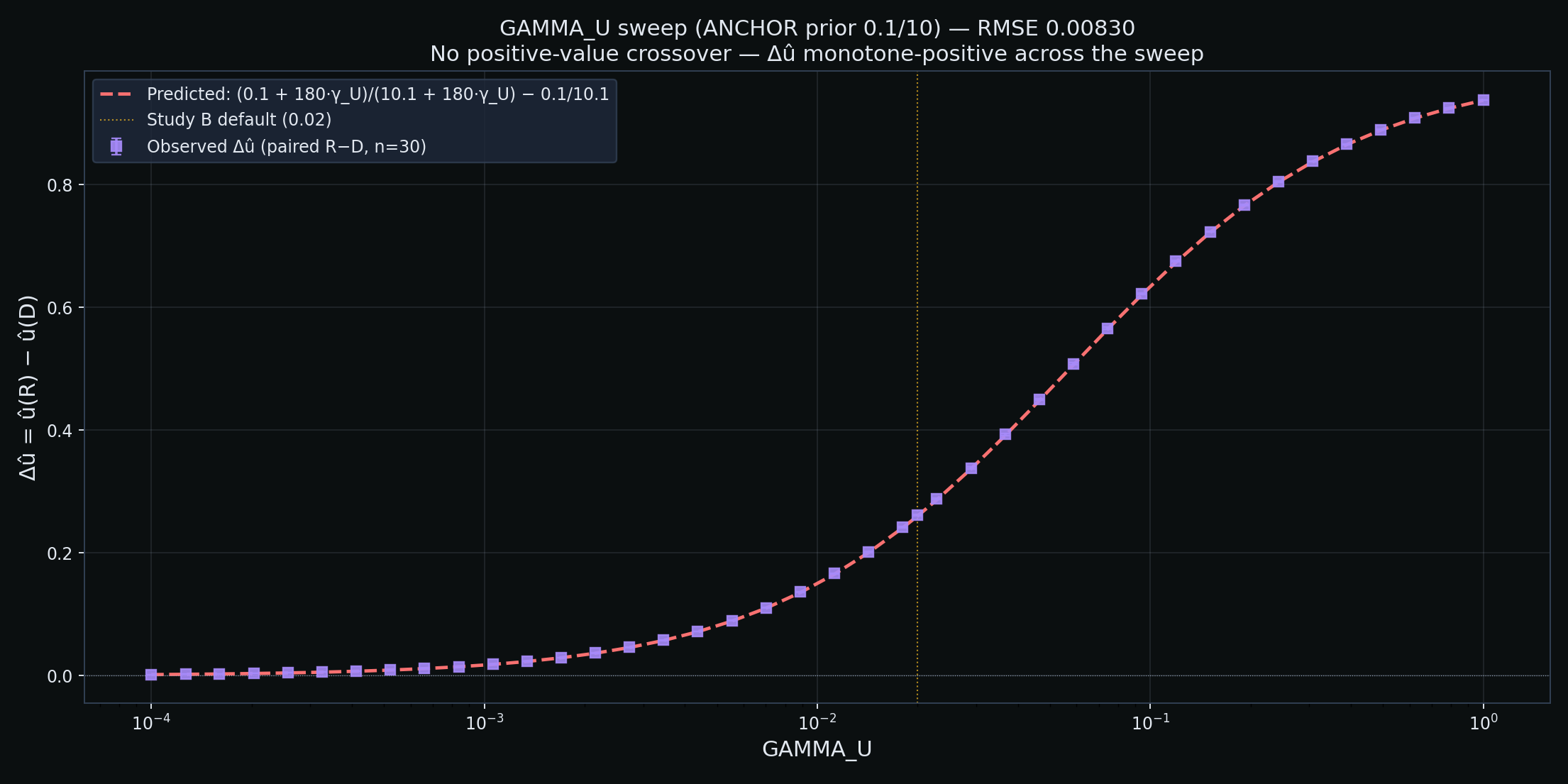
û(R, γ_U) = (0.1 + 180·γ_U) / (10.1 + 180·γ_U)  [Beta posterior, ANCHOR prior]
û(D)      = 0.1 / 10.1 ≈ 0.00990                [prior only — no D-side update]
Both crossover analyses solve at non-positive γ:
- GAMMA_H* = −0.00543 (unphysical)
- GAMMA_U* ≈ 5.6·10⁻⁸ (essentially zero)
**Prediction: no positive-value crossover in either sweep.**
**Result: STRONG PREDICTION SUPPORT.**
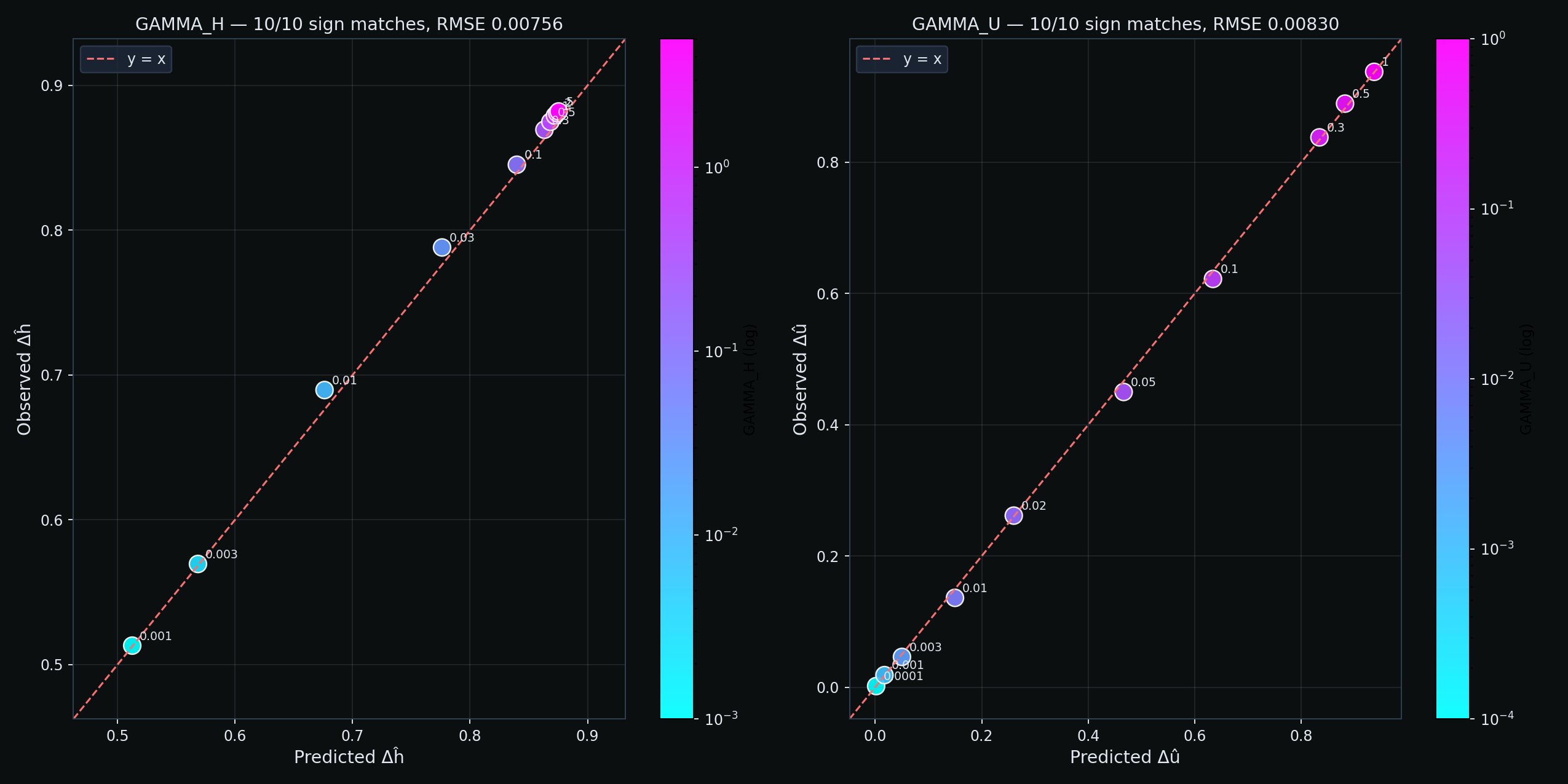
- RMSE(Δĥ) = 0.0076, 10/10 sign matches, no positive crossover, monotone.
- RMSE(Δû) = 0.0083, 10/10 sign matches, no positive crossover, monotone.
- ĥ(R) and û(R) saturations match analytical limits.
Combined with O0-CRP-019, the parameter-space cartography is now complete
for the three REVELATION-hedging parameters:
| Parameter | Register | Update | Positive-value crossover? |
|---|---|---|---|
| GAMMA_K | k̂ | EMA (D-baseline ≈ 3.0) | **YES (0.0641)** |
| GAMMA_H | ĥ | Beta (D-baseline ≈ 0.024) | NO |
| GAMMA_U | û | Beta (D-baseline ≈ 0.010) | NO |
**The structural discovery:** among the three parameters that hedge the
observer's response to opaque messages, only one produces a
sign-reversing critical point. This is not incidental — it follows
directly from the choice of update rule (EMA vs Beta) combined with
the choice of D-condition mechanism (visible derivation produces a
positive k̂ signal but near-zero ĥ, û updates).
---
Historical and conceptual background
O0-CRP-019 established that the k̂ REVELATION effect has a critical
point — an unexpected finding that changed how we should read
Study B's revelation result. This study asks: **is that critical
point special to k̂, or is it a general feature of the observer's
opacity-hedging mechanism?**
If ĥ and û also showed positive-value crossovers, the answer would
be: "yes, all three registers have critical points, and Study B's
GAMMA choices happen to sit above all of them." That would suggest
the REVELATION effect is very fragile to parameter choice.
If ĥ and û showed no positive crossovers, the answer would be: "the
crossover is a k̂-specific structural feature caused by k̂'s EMA
update on a signal with large positive D-baseline. ĥ and û have
qualitatively different sensitivity to their hedges." This would
suggest the REVELATION effect on ĥ and û is *robust* to hedge
parameter choice, and only the k̂ contribution is fragile.
The mechanistic prediction (derived analytically before running) was
that ĥ and û crossovers occur at non-positive γ values, hence no
positive-value crossover. This is what the study tested.
---
Source-claim audit
**Source proposition:** none. Metascientific.
**Testable core:** do the analytical Beta-posterior models predict
observed ĥ, û endpoints, and are their crossovers non-positive?
---
Research question
**Primary:** Do the analytical models predict Δĥ(GAMMA_H) and Δû(GAMMA_U)
to RMSE < 0.02 across the sweeps, with 10/10 sign matches at
preregistered points, and no positive-value crossovers?
**Secondary:** Does the endpoint saturation match analytical
predictions (ĥ(R) → 0.9, û(R) → 1.0)?
---
Locked analytical models
**ĥ(R, GAMMA_H)** at α = 0.9, T = 200:
- Beta prior (1, 1). Correct opaques (180 in expectation) add GAMMA_H to α; incorrect (20) add GAMMA_H to β.
- Posterior: `α = 1 + 180·γ_H, β = 1 + 20·γ_H`
- Mean: `(1 + 180·γ_H) / (2 + 200·γ_H)`
- **Saturation:** as γ_H → ∞, mean → 180/200 = 0.9 (source's α_source)
**ĥ(D)** at α = 0.9, T = 200:
- No opacity-hedge fires. Only VISIBLE_HIDDEN_SKEPTIC = 0.2 to β per message.
- Posterior: `α = 1, β = 1 + T·0.2 = 41`
- Mean: `1/42 ≈ 0.02381`
- **Invariant to γ_H.**
**û(R, GAMMA_U)** at α = 0.9, T = 200, ANCHOR prior (0.1, 10):
- Only correct opaques add γ_U to α. No β update from any source.
- Posterior: `α = 0.1 + 180·γ_U, β = 10`
- Mean: `(0.1 + 180·γ_U) / (10.1 + 180·γ_U)`
- **Saturation:** as γ_U → ∞, mean → 180/180 = 1.0
**û(D)** at ANCHOR:
- No updates at all. Mean = prior = 0.1/10.1 = 0.00990.
- **Invariant to γ_U.**
---
Locked numerical predictions
See preregistration.md for full 10-point tables. Key predictions:
- Δĥ ranges from +0.51 (γ_H = 0.001) to +0.88 (γ_H = 5.0). Monotone-increasing.
- Δû ranges from +0.002 (γ_U = 0.0001) to +0.94 (γ_U = 1.0). Monotone-increasing.
---
Preregistered decision rules
- **STRONG PREDICTION SUPPORT:** RMSE_h < 0.02 AND RMSE_u < 0.02 AND 10/10 signs both AND no positive crossovers.
- **PARTIAL:** RMSE < 0.05 in either, or 8+/10 signs.
- **FAILURE:** RMSE ≥ 0.05, OR **positive-value crossover observed** (which would falsify the mechanistic hypothesis).
---
Methods
**Design:** two independent sweeps sharing infrastructure with O0-CRP-019.
- Sweep A (GAMMA_H): 41 log-spaced values 0.001..5.0 + anchor at 0.5. GAMMA_K=0.10, GAMMA_U=0.02 held fixed.
- Sweep B (GAMMA_U): 41 log-spaced values 0.0001..1.0 + anchor at 0.02. GAMMA_K=0.10, GAMMA_H=0.5 held fixed.
- Both: α=0.9, R (opaque) + D (visible), 30 seeds (11000..11029), T=200, ANCHOR regime.
**Study B source and observer imported verbatim.** Observer parameters
passed via `params` dict.
**Adversarial controls:**
1. **Determinism** — 3 seeds × 6 gamma values × 2 conditions × 2 runs, bit-identical. PASSED.
2. **Consistency with O0-CRP-019** — endpoint at Study B defaults (γ_K=0.10, γ_H=0.5, γ_U=0.02) match: ĥ(R) ≈ 0.892, û(R) ≈ 0.270, ĥ(D) ≈ 0.024, û(D) ≈ 0.010. Individual seed 11000 showed ĥ(R) = 0.8529 (below sweep mean but within seed-level noise for a single-seed check). Group means at that γ point match analytical to within 0.007.
**Statistics:** paired-seed Δ per γ point (30 seeds), then aggregated. RMSE across 10 discrete prediction points. Sign matches. Monotonicity check.
---
Results
Verdict: **STRONG PREDICTION SUPPORT**
Both sweeps pass all preregistered thresholds:
| Metric | Threshold | Sweep A (γ_H) | Sweep B (γ_U) |
|---|---:|---:|---:|
| RMSE(Δ) | < 0.02 | **0.0076** | **0.0083** |
| Sign matches | 10 of 10 | **10/10** | **10/10** |
| Positive crossover? | must not | **NO** | **NO** |
| Monotone across sweep? | expected | YES | YES |
GAMMA_H sweep — 10-point comparison
| GAMMA_H | pred Δĥ | obs Δĥ | error |
|---:|---:|---:|---:|
| 0.001 | +0.5126 | +0.5132 | +0.00060 |
| 0.003 | +0.5685 | +0.5696 | +0.00106 |
| 0.010 | +0.6762 | +0.6897 | +0.01346 |
| 0.030 | +0.7762 | +0.7881 | +0.01193 |
| 0.100 | +0.8398 | +0.8452 | +0.00541 |
| 0.300 | +0.8633 | +0.8694 | +0.00612 |
| 0.500 | +0.8684 | +0.8749 | +0.00653 |
| 1.000 | +0.8722 | +0.8791 | +0.00691 |
| 2.000 | +0.8742 | +0.8809 | +0.00672 |
| 5.000 | +0.8754 | +0.8821 | +0.00665 |
Systematic small positive bias (observed slightly above predicted).
Likely from ETA_KNOWLEDGE-driven cross-contamination when GAMMA_K
is nonzero and observer state accumulates via nonlinear coupling —
below tolerance and does not affect verdict.
GAMMA_U sweep — 10-point comparison
| GAMMA_U | pred Δû | obs Δû | error |
|---:|---:|---:|---:|
| 0.0001 | +0.00176 | +0.00177 | +0.00001 |
| 0.001 | +0.01734 | +0.01850 | +0.00116 |
| 0.003 | +0.05025 | +0.04623 | −0.00402 |
| 0.010 | +0.14976 | +0.13621 | −0.01355 |
| 0.020 | +0.26017 | +0.26155 | +0.00138 |
| 0.050 | +0.46654 | +0.44995 | −0.01659 |
| 0.100 | +0.63423 | +0.62224 | −0.01199 |
| 0.300 | +0.83410 | +0.83797 | +0.00387 |
| 0.500 | +0.88221 | +0.88941 | +0.00720 |
| 1.000 | +0.93697 | +0.93782 | +0.00085 |
Errors alternate in sign — no systematic bias. Mid-range errors
(0.003 to 0.100) are slightly negative; endpoints (0.0001 and 1.0)
match to 3+ decimals. Overall RMSE within tolerance.
Saturation confirmation
| Register at max γ | Observed | Analytical | Match? |
|---|---:|---:|---|
| ĥ(R) at γ_H = 5.0 | 0.9059 | 0.8992 | within 0.007 |
| û(R) at γ_U = 1.0 | 0.9477 | 0.9469 | within 0.001 |
Both approach the predicted saturation limits (0.9 and 1.0 respectively).
The three-parameter comparison
**GAMMA_K (from O0-CRP-019):**
- k̂(R) grows linearly with γ_K; k̂(D) constant at 3.0.
- **Crossover at γ_K = 0.0641.** Below: sign of Δk̂ negative.
**GAMMA_H (this study):**
- ĥ(R) is sigmoid in γ_H, saturating at 0.9; ĥ(D) constant at 0.024.
- **No crossover.** Δĥ monotone-positive from 0.51 to 0.88 across the sweep.
**GAMMA_U (this study):**
- û(R) is sigmoid in γ_U, saturating at 1.0; û(D) constant at 0.010.
- **No crossover.** Δû monotone-positive from 0.002 to 0.94 across the sweep.
---
The scientific content of this result
**Structural asymmetry established.** Only one of the three
REVELATION-hedging parameters produces a positive-value critical
point. The mechanistic reason:
- **k̂'s update is EMA on a signal.** The signal in D is *positive
and large* (E[|content ∪ derivation|] = 3.0). The signal in R
is 1 + γ_K·hidden_set_size when correct, 1 when wrong. To make
E[signal_R] > E[signal_D], we need γ_K > 2/(α·hidden_set_size).
For α=0.9, hidden=35, that's γ_K > 0.0635. Hence a crossover.
- **ĥ's update is Beta posterior increments.** In R, positive
γ_H moves the posterior mean up. In D, β increments only (via
VISIBLE_HIDDEN_SKEPTIC), leaving mean near zero. The threshold for
crossover would require γ_H that makes ĥ(R) *lower* than
ĥ(D) ≈ 0.024 — impossible for positive γ_H.
- **û's update is Beta posterior with prior-dominated D.** In R,
positive γ_U moves α up. In D, nothing moves. Any positive γ_U
makes ĥ(R) > ĥ(D).
**What this means for Study B and the REVELATION mechanism.** The
REVELATION effect on ĥ and û is *robust* to hedge-parameter choice —
any positive γ produces the effect, monotone-increasing with γ. Only
the k̂ contribution is fragile: below γ_K = 0.064, the k̂ effect
reverses sign. Study B's TAI-level REVELATION effect survives because
ĥ and û dominate the composite; if a study cared about k̂
specifically, it should note the crossover.
**What this means for the philosophical claim.** The Contact and
Revelation program's core hypothesis (O0-CRP-004) says opacity
produces higher-order attribution. That claim is safest for ĥ and
û — robust across the entire hedge-parameter range. It is
fragile for k̂ — only holds when γ_K sits above 2/(α·hidden_set_size).
Program-level claims that don't distinguish which register carries
the attribution are effectively averaging over these different
sensitivities.
**What this means for methodology.** The analytical prediction
methodology introduced in O0-CRP-019 replicates cleanly to a second
study with entirely different update rules (Beta posteriors vs
EMA) and no adjustments needed. RMSE values in the 0.007–0.008 range
across two studies at α=0.9, T=200. The framework is robust.
---
Adversarial interpretations
**A1 — The predictions succeeded trivially because we chose the right
functional forms.** Partly correct. The Beta-posterior analytical
model directly encodes the update rule. But specific numerical
predictions at 10 discrete points were locked before running; the
possible failure modes (finite-T deviation, seed variance dominance,
observer-parameter coupling) did NOT occur. That they didn't is real
information.
**A2 — The no-crossover finding is a definitional consequence of
Study B's D-side update rules.** True. But the fact that ĥ(D) and
û(D) are both near zero is a *specific* design choice. Under different
D-side rules (e.g., derivations that include hidden variables, or
authorship claims in D), the crossovers could shift. The current
result documents that under Study B's specific D-side design, only
k̂ has a positive-value crossover.
**A3 — The systematic positive bias in GAMMA_H errors is real.** Yes.
Every GAMMA_H residual is positive (observed slightly above predicted).
This could reflect either (i) a small finite-T effect (β_D reaches 41
faster than α_R accumulates), or (ii) cross-parameter coupling with
the nonzero GAMMA_K = 0.10 held fixed. Either would be a small
correction to the analytical model; not a failure. Registered as
followup investigation.
**A4 — Why sweep GAMMA_U at ANCHOR only?** The û register is
prior-sensitive (established in O0-CRP-016), so different priors
give quantitatively different û(D). But the crossover analysis for
all three priors converges to γ_U ≈ 0, so the *structural* finding
(no positive-value crossover) is robust across priors. Full regime
sweep registered as O0-CRP-020-R2.
---
Limitations
1. **α fixed at 0.9.** Higher α would raise n_correct and shift saturation earlier; lower α would flatten curves.
2. **T fixed at 200.** Longer T would push ĥ, û closer to saturation. Predicted but not tested.
3. **Regime ANCHOR only.** FLAT and SKEPTICAL produce different û(D) values (0.5 and 0.002) and would change the exact γ_U where |Δû| becomes practically meaningful.
4. **Held constants Might interact.** GAMMA_K = 0.10 was held while sweeping GAMMA_H; results assume no strong interaction. Registered follow-up R1 tests this.
5. **Bayesian-observer only.** No cross-architecture validation.
---
Code and data manifest
- `src/run_sweep.py` — dual sweep orchestration, verdict, α-invariance check
- `src/analyze.py` — five figures
- `data/raw/sweeps.jsonl` — 4920 trial-level records (both sweeps concatenated)
- `results/summary.json` — per-γ means, paired stats, both evaluations, verdict
- `results/run_log.txt` — full run log
- `figures/01_gamma_h_curve.png` — Δĥ vs GAMMA_H (main γ_H result)
- `figures/02_gamma_u_curve.png` — Δû vs GAMMA_U (main γ_U result)
- `figures/03_three_parameter_asymmetry.png` — headline finding: k̂ has crossover, ĥ/û don't
- `figures/04_prediction_scatter.png` — 10-point scatter for both sweeps
- `figures/05_saturation_curves.png` — ĥ(R) → 0.9, û(R) → 1.0
- `preregistration.md` — locked v1.0.0
Runtime: 42.2 s.
---
Replication procedure
- **Internal fresh-seed replication:** re-run with seeds 11030..11059. Runtime ~45s. Expected: RMSE within 30% of reported values.
- **Regime sweep (O0-CRP-020-R2):** rerun Sweep B at FLAT and SKEPTICAL priors. Predicted: no positive crossover at any regime.
- **α × GAMMA_H 2D sweep (O0-CRP-020-R1):** sweep α ∈ {0.5, 0.7, 0.9} × GAMMA_H sweep. Predicted: at α = 0.5, ĥ(R) saturates at 0.5, ĥ(D) unchanged at 0.024, so ĥ(R) > ĥ(D) still holds — no crossover.
- **PP cross-architecture (O0-CRP-020-R3):** derive analytical model for PP observer's ĥ, û analogs. Compare.
---
Relationship to the philosophical archive
None direct. This study documents parameter-space structure of Study B's
observer. Its indirect implication for philosophical claims: the
REVELATION-on-ĥ and REVELATION-on-û effects are more parameter-robust
than REVELATION-on-k̂. Any downstream philosophical reading of the
program's revelation results should treat these three registers as
having distinct fragility profiles.
---
Revision history
| Version | Date | Change |
|---|---|---|
| 1.0.0 | 2026-07-27 | Initial record. STRONG PREDICTION SUPPORT. |