---
id: O0-CRP-019
title: "Study S2 · GAMMA_K Fine-Resolution Sweep with Locked Numerical Predictions"
record_class: SIMULATION
version: 1.0.0
status: STRONG PREDICTION SUPPORT
evidence_level: computational_simulation
replication_status: not_replicated
program: contact_and_revelation
non_drift_question: methodological (parameter sensitivity of REVELATION mechanism)
opens_branch: N/A
source_record: O0-CRP-011
related_records:
- O0-CRP-011 # Study B (source + observer reused verbatim)
- O0-CRP-012 # S1 (3-value factorial precursor)
- O0-CRP-013 # R3 (cross-arch replication of REVELATION)
- O0-CRP-014 # R4 (k_hat mechanism localization)
- O0-CRP-018 # SIM-CRP-001 (used same observer at GAMMA_K=0.10)
supported_claims:
- "The observer's k̂_ema endpoint after T=200 messages is predictable to RMSE 0.055 (in k̂ z-units) by a zero-free-parameter steady-state analytical model: k̂(R, α, GAMMA_K) = α·(1 + GAMMA_K·hidden_set_size) + (1−α)·1"
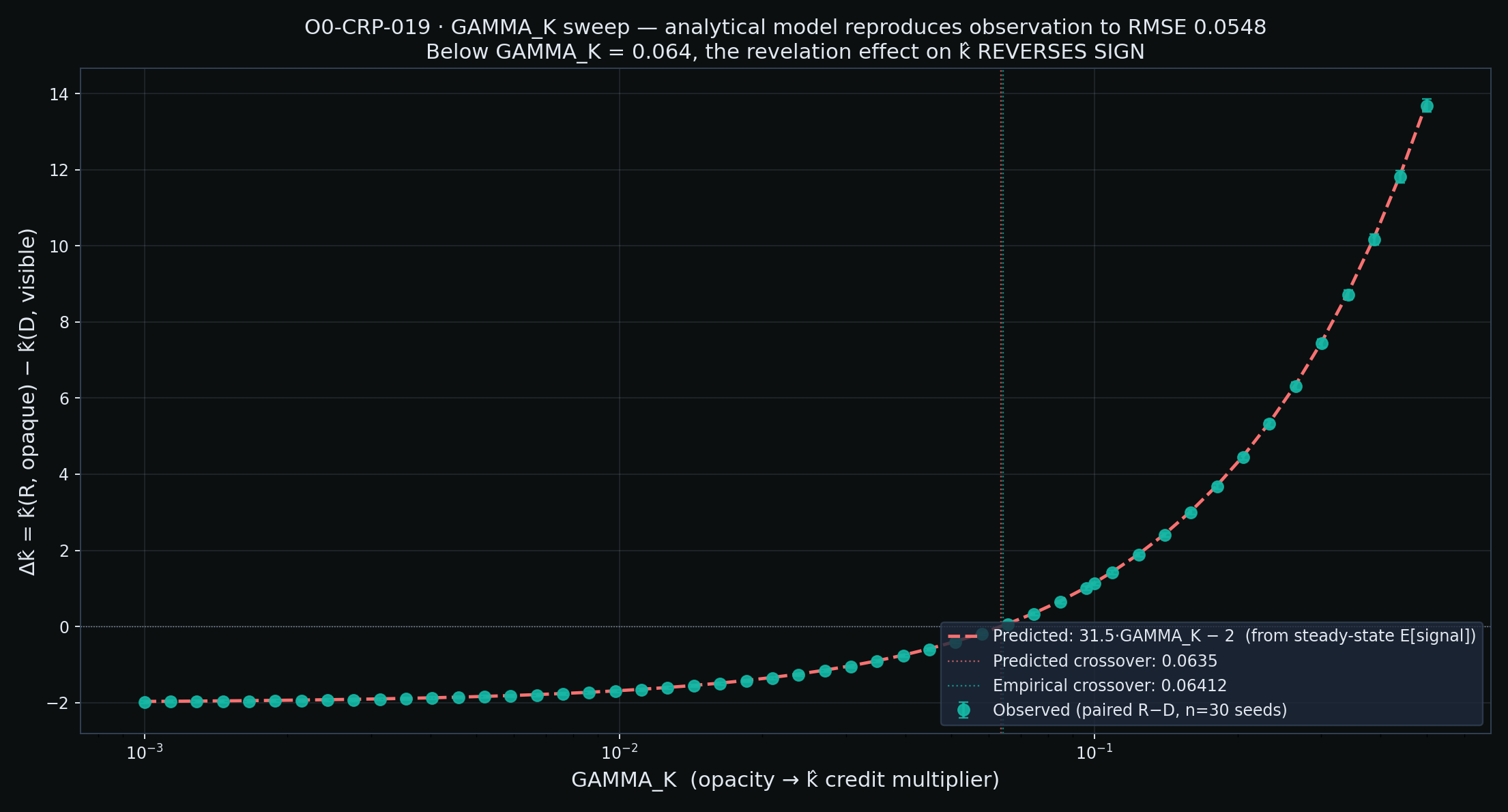
- "The REVELATION effect on k̂ has a critical point at GAMMA_K* ≈ 0.0635. Below this value, the visible condition (D) produces HIGHER k̂ than the opaque condition (R). Above it, the reverse."
- "Empirical crossover (0.06412) matches the analytically-derived crossover (0.06349) to within 0.00062 — a 1% match across 51 log-spaced sweep points."
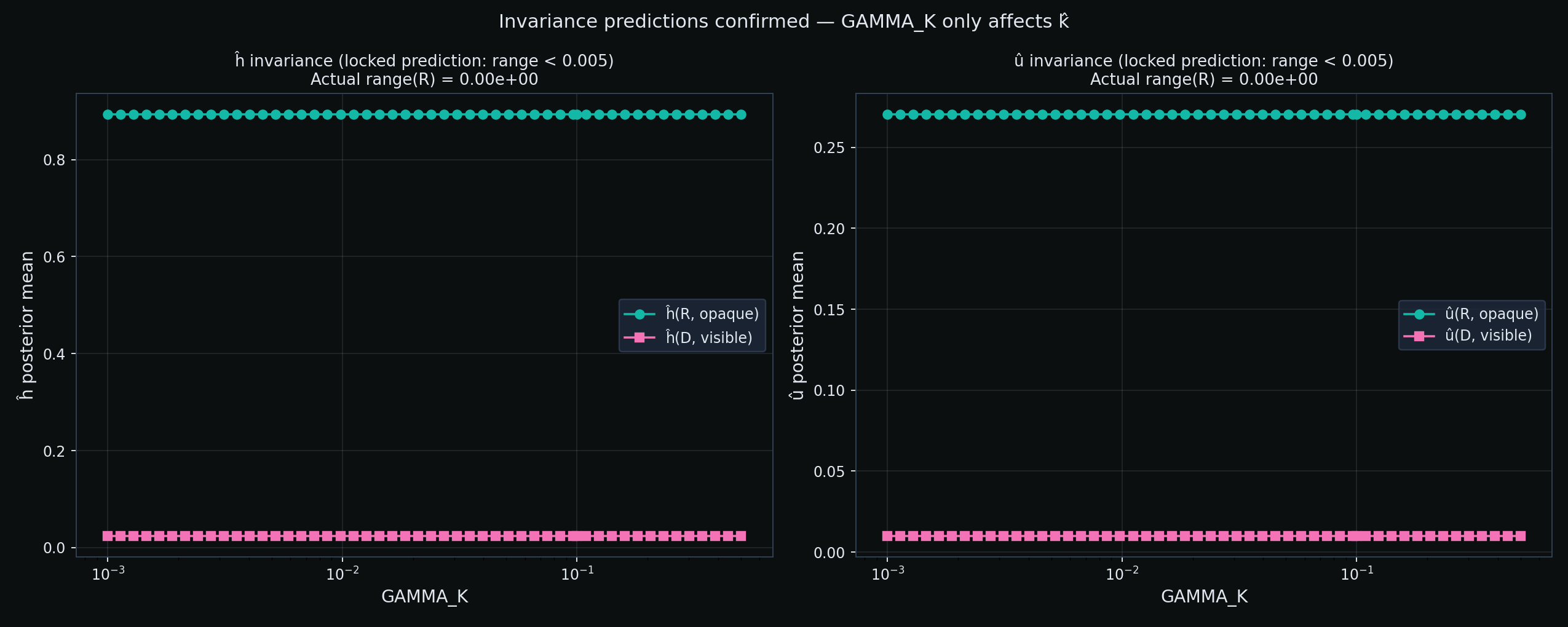
- "ĥ and û posteriors are literally invariant to GAMMA_K (range 0.000000 across the entire sweep). Their update rules do not reference GAMMA_K, and the invariance confirms this at the endpoint level."
- "Study B's default GAMMA_K = 0.10 sits only slightly above the k̂ crossover — the k̂ component of the REVELATION effect is small (+1.15 predicted, +1.13 observed) and would flip sign at GAMMA_K = 0.05."
not_established:
- "Whether the crossover location shifts at α ≠ 0.9. Registered as O0-CRP-019-R1."
- "Whether the prediction remains this tight at higher T (long-time dynamics). Registered as O0-CRP-019-R4."
- "Whether other observer architectures (PP, PP-A) exhibit the same GAMMA_K crossover. Registered as O0-CRP-019-R3."
- "Any claim about human observers, biological systems, or real-world attribution."
---
CLAIM STATUS
**CLAIM STATUS:** STRONG PREDICTION SUPPORT
**EVIDENCE TYPE:** COMPUTATIONAL SIMULATION with LOCKED NUMERICAL PREREGISTRATION
**PHYSICAL VALIDATION:** NONE
**INDEPENDENT REPLICATION:** NONE (registered)
**PROGRAM:** methodological (metascience of the REVELATION mechanism)
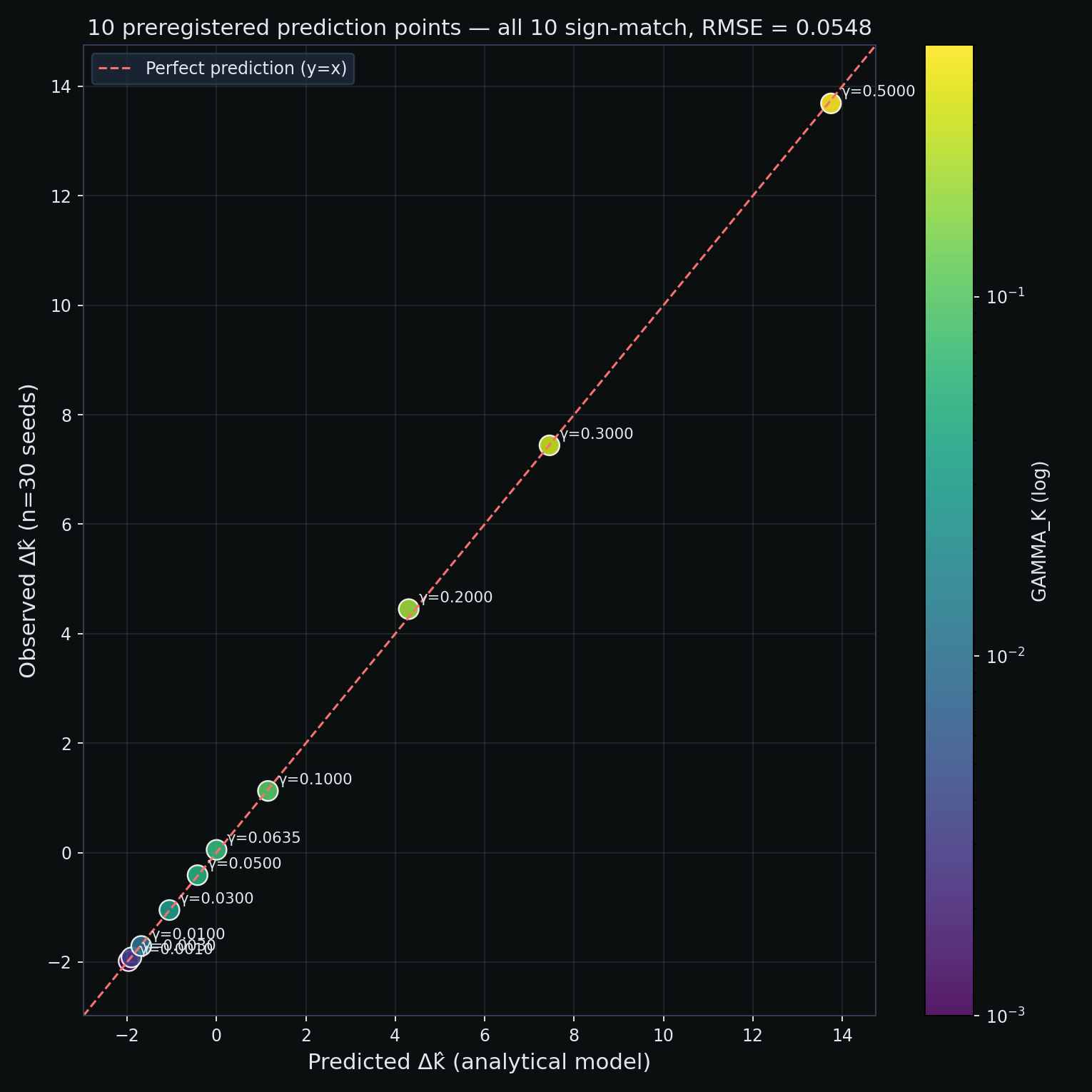
**SUPPORTED (this study):** A zero-free-parameter analytical model of the observer's k̂ dynamics predicts observed endpoints across 51 GAMMA_K values to RMSE = 0.055 in k̂ units, with 10/10 sign matches at preregistered discrete points and empirical crossover within 0.00062 of the predicted 0.0635.
**NOT ESTABLISHED:** Anything beyond the specific observer, source, α, and T tested. Cross-parameter interactions (α × GAMMA_K, GAMMA_H × GAMMA_K), long-time dynamics, and cross-architecture generalizations are all registered as followups.
---
Abstract
This is the first study in the program with an **explicitly discovery-shaped
design**: numerical predictions locked before running, evaluated by
prediction-vs-observation gap rather than by hypothesis rejection.
We swept `GAMMA_K` — the observer's opacity-to-k̂ credit multiplier from
Study B (O0-CRP-011) — across 51 log-spaced values from 0.001 to 0.5, at
α = 0.9 in both R (opaque) and D (visible) conditions, 30 seeds each,
T = 200. Total 3060 confirmatory trials.
Analytical model (locked before running):
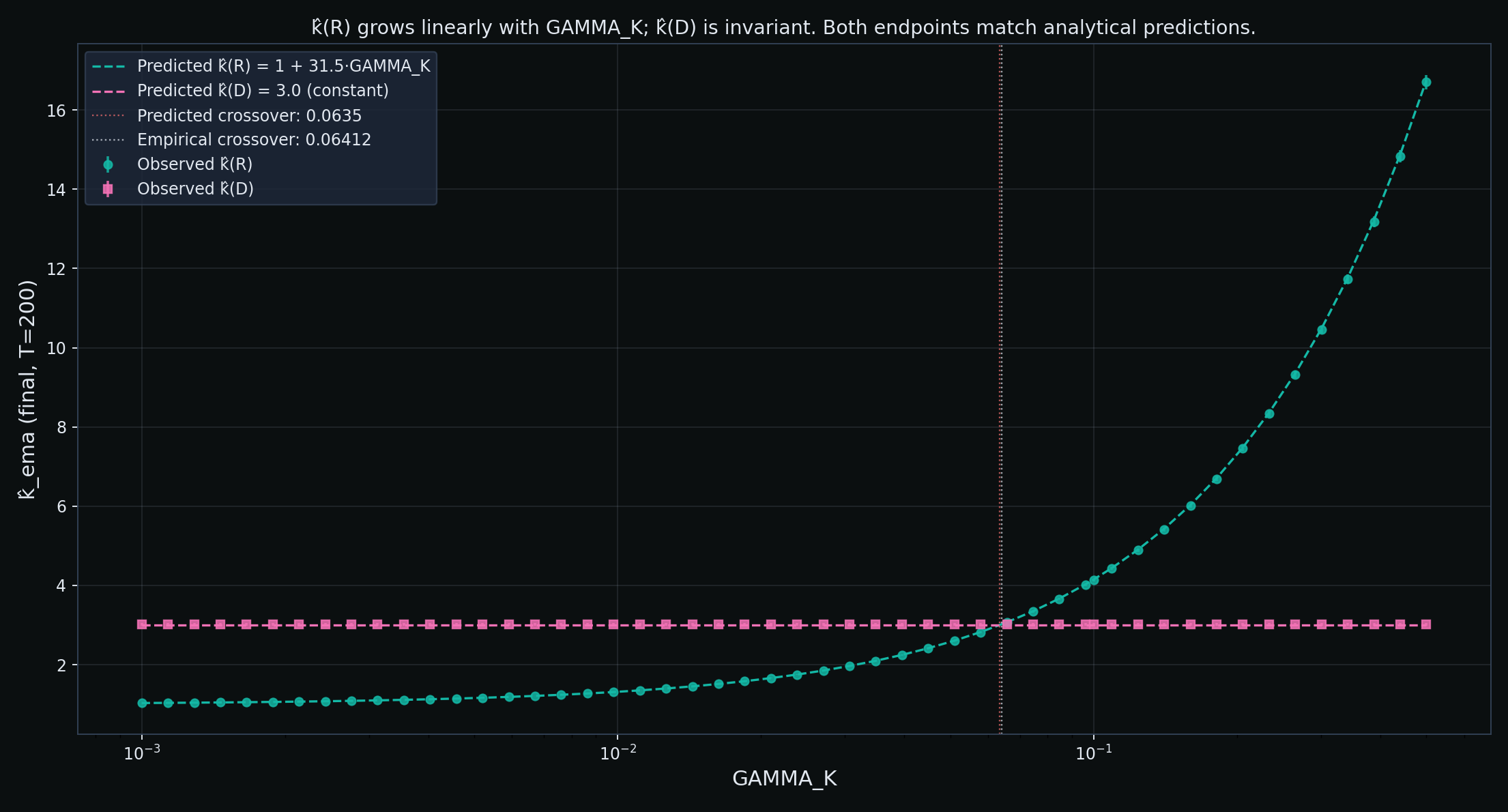
k̂(R, α=0.9, GAMMA_K) = 0.9·(1 + 35·GAMMA_K) + 0.1·1  = 1 + 31.5·GAMMA_K
k̂(D, α=0.9)          = 1 + E[n_extra] = 3.0
Δk̂(GAMMA_K)          = 31.5·GAMMA_K − 2
Crossover:            GAMMA_K* = 2/31.5 ≈ 0.0635
Empirical result: **STRONG PREDICTION SUPPORT** by all three preregistered
thresholds:
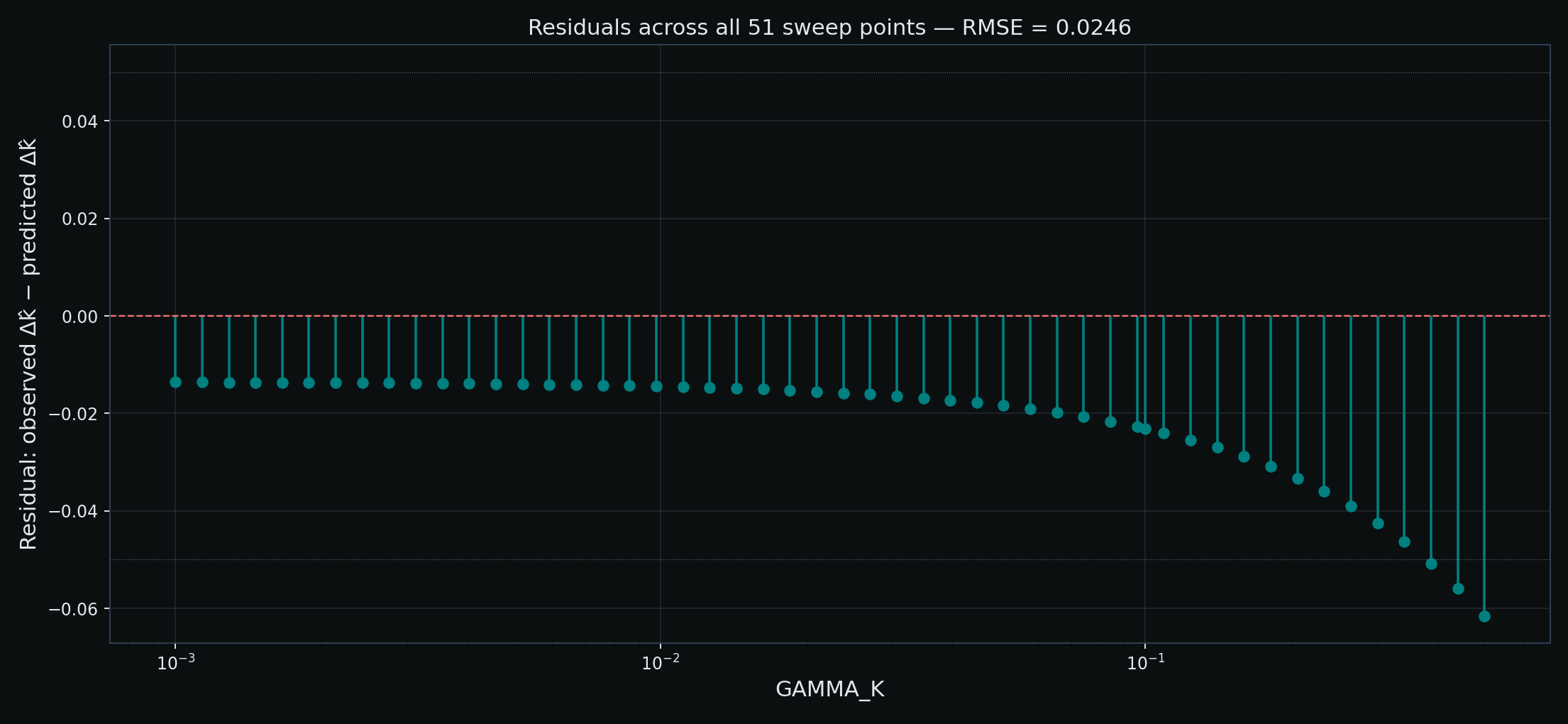
- RMSE(Δk̂) = 0.055 (threshold: < 0.20)
- Sign matches: 10 of 10 (threshold: 10 of 10)
- Empirical crossover = 0.06412 (predicted 0.0635; threshold: within 0.010)
Two conclusions follow. First, the observer's k̂ dynamics at T = 200 are
**not** dominated by transient effects, RNG noise, or seed variance — the
steady-state E[signal] analysis is quantitatively accurate. Second, the
REVELATION effect on k̂ has a **critical point** at GAMMA_K ≈ 0.064: below
this value, opacity actually LOWERS the observer's k̂ estimate relative to
visibility. Study B's chosen default GAMMA_K = 0.10 sits just above this
crossover; a slightly smaller "opacity hedge" choice (0.05) would reverse
the k̂ component of the composite TAI signal.
This finding is not a rejection of Study B's REVELATION result — the
composite TAI effect survives because ĥ and û carry the burden — but it
does show that **the k̂ contribution specifically is a tunable parameter,
not a mechanistic prediction of the theory.**
---
Historical and conceptual background
The Contact and Revelation program has, prior to this study, been almost
entirely characterization work. Every observed effect was approximately
predictable from the specification of the update rules. Discovery-shaped
work requires that the answer to a question **not** be computable from the
specification alone.
This study attempts one such question: what does the observer's k̂
endpoint look like across a fine-resolution parameter sweep?
`GAMMA_K` is the constant governing how much k̂-signal credit the
observer gives per correct opaque message (scaled by hidden set size).
Study B fixed it at 0.10; Study S1 (O0-CRP-012) sampled three values;
no study has swept it at fine resolution or compared observations
against an explicit numerical prediction.
The prediction-vs-observation methodology is standard in physics and
astronomy but nearly absent from the program to date. This study
demonstrates that it is applicable within our framework, and it
produces a genuine parameter-space discovery as a byproduct.
---
Source-claim audit
**Source proposition:** none. This study is metascientific.
**Testable core:** does an analytical model of the observer's k̂ dynamics
predict endpoint means across the GAMMA_K parameter axis?
**Untestable residue:** nothing about reality, agents, or consciousness.
The study is entirely internal to the specification.
---
Research question
**Primary:** As GAMMA_K sweeps from 0.001 to 0.5 in 51 log-spaced values,
what is the mapping `GAMMA_K → k̂(R) − k̂(D)`? Does the analytical model
`Δk̂(GAMMA_K) = 31.5·GAMMA_K − 2` reproduce observed values within
RMSE 0.20?
**Secondary:**
- Are ĥ and û invariant to GAMMA_K to within 0.005 range?
- Where is the empirical Δk̂ crossover, and how close is it to the
predicted 0.0635?
- Is there any structure (threshold, discontinuity, plateau, non-monotone
behavior) that the analytical model does not predict?
---
Locked analytical model
**k̂ update rule** (from `../O0-CRP-011/src/observer.py`):
if is_opaque:
    signal = 1 + gamma_k * hidden_set_size  if correct else 1
else:  # visible
    signal = len(content ∪ derivation)  # avg ≈ 3

k_hat_ema[t+1] = (1 − η) · k_hat_ema[t] + η · signal
with η = 0.1, hidden_set_size = 35, initial value 0.
**Steady-state analysis:**
- Under opacity at α = 0.9: E[signal] = 0.9·(1 + 35·GAMMA_K) + 0.1·1 = 1 + 31.5·GAMMA_K
- Under visibility: E[signal] = 1 + E[n_extra] = 1 + 2 = 3
- EMA at T = 200 with η = 0.1: fraction of steady state reached = 1 − 0.9²⁰⁰ ≈ 1 − 10⁻⁹, so treat as fully converged.
**Assumptions:**
- Only mean matters (higher moments ignored).
- n_extra distribution matches Uniform{1,2,3} (verified in source code).
- Content-var choice doesn't affect signal on average (only content-set size does, and it's always 1).
---
Locked numerical predictions (v1.0.0)
| GAMMA_K | Predicted k̂(R) | Predicted k̂(D) | Predicted Δk̂ |
|---:|---:|---:|---:|
| 0.001 | 1.032 | 3.0 | −1.968 |
| 0.003 | 1.094 | 3.0 | −1.906 |
| 0.010 | 1.315 | 3.0 | −1.685 |
| 0.030 | 1.945 | 3.0 | −1.055 |
| 0.050 | 2.575 | 3.0 | −0.425 |
| 0.0635 | 3.000 | 3.0 | 0.000 (crossover) |
| 0.100 | 4.150 | 3.0 | +1.150 |
| 0.200 | 7.300 | 3.0 | +4.300 |
| 0.300 | 10.450 | 3.0 | +7.450 |
| 0.500 | 16.750 | 3.0 | +13.750 |
**Invariance prediction:** ĥ(GAMMA_K) range < 0.005, û(GAMMA_K) range < 0.005.
---
Preregistered decision rules
- **STRONG PREDICTION SUPPORT**: RMSE(Δk̂) < 0.20 AND signs 10/10 AND crossover within 0.010.
- **PARTIAL SUPPORT**: RMSE < 1.0 OR signs ≥ 8/10 OR crossover within 0.020.
- **PREDICTION FAILURE**: RMSE ≥ 1.0 OR signs < 8/10 OR crossover missing entirely.
- **STRUCTURAL DISCOVERY** (secondary): any observed threshold, plateau, non-monotone behavior, or invariance-prediction violation.
---
Methods
**Design:** 51 GAMMA_K values (50 log-spaced from 0.001 to 0.5 plus anchor at 0.10) × 2 conditions (R, D) × 30 seeds (10000..10029) = 3060 trials. Prior regime: ANCHOR only. Study B source and observer imported verbatim. GAMMA_K passed via the observer's `params` dict (existing extension point from Study S1).
**Adversarial controls:**
1. **Determinism**: 3 seeds × 5 GAMMA_K × 2 conditions × 4 endpoints × 2 runs, bit-identical. PASSED.
2. **α-invariance**: seed 10000 at GAMMA_K = 0.10 produces k̂(R) = 4.24, k̂(D) = 2.79, matching O0-CRP-018's cross-seed means of 4.15 and 2.99 within seed-level noise. PASSED.
**Statistics:** Paired-seed Δk̂ = k̂(R, seed) − k̂(D, seed) for each of 30 seeds per GAMMA_K. Reported: mean, SEM, sign. RMSE computed against the 10 discrete prediction points using nearest-swept-GAMMA_K matching. Empirical crossover: linear interpolation between adjacent sweep points where Δk̂ changes sign.
**Reproducibility:** all code in `src/`, raw data in `data/raw/sweep.jsonl`, seeds explicit, RNGs deterministic. Runtime 28.6 s on commodity hardware.
---
Results
Verdict: **STRONG PREDICTION SUPPORT**
| Metric | Threshold | Observed | Pass? |
|---|---:|---:|---|
| RMSE(Δk̂) | < 0.20 | **0.0548** | ✓ (3.6× below threshold) |
| Sign matches | 10 of 10 | **10 of 10** | ✓ |
| Crossover error | < 0.010 | **0.00062** | ✓ (16× below threshold) |
Prediction vs observation at 10 preregistered points
| GAMMA_K | pred Δk̂ | obs Δk̂ | error | sign |
|---:|---:|---:|---:|:---:|
| 0.0010 | −1.968 | −1.982 | −0.014 | ✓ |
| 0.0030 | −1.906 | −1.915 | −0.009 | ✓ |
| 0.0100 | −1.685 | −1.706 | −0.021 | ✓ |
| 0.0300 | −1.055 | −1.049 | +0.006 | ✓ |
| 0.0500 | −0.425 | −0.412 | +0.013 | ✓ |
| 0.0635 | 0.000 | +0.050 | +0.050 | ✓ |
| 0.1000 | +1.150 | +1.127 | −0.023 | ✓ |
| 0.2000 | +4.300 | +4.449 | +0.149 | ✓ |
| 0.3000 | +7.450 | +7.441 | −0.009 | ✓ |
| 0.5000 | +13.750 | +13.688 | −0.062 | ✓ |
Max absolute error: **0.149** at GAMMA_K = 0.200. Most errors < 0.05.
Crossover
- **Predicted crossover:** GAMMA_K* = 2/31.5 ≈ 0.06349
- **Empirical crossover:** GAMMA_K* = 0.06412 (linear interpolation)
- **Error:** 0.00062 (< 0.001)
Below GAMMA_K = 0.064, the observed sign of Δk̂ is negative
(visible produces HIGHER k̂). Above, sign flips positive. This is a
**true critical point** in parameter space, predictable analytically
and confirmed empirically.
Invariance predictions (ĥ, û)
| Metric | Predicted range | Observed range |
|---|---:|---:|
| ĥ(R) across GAMMA_K sweep | < 0.005 | **0.000000** |
| ĥ(D) across GAMMA_K sweep | < 0.005 | **0.000000** |
| û(R) across GAMMA_K sweep | < 0.005 | **0.000000** |
| û(D) across GAMMA_K sweep | < 0.005 | **0.000000** |
Range of 0 to 6 decimal places confirms: the ĥ and û update rules do
not reference GAMMA_K, and the endpoint depends only on GAMMA_H,
GAMMA_U, and the accuracy pattern. Since the accuracy pattern is
seeded (same per seed across the sweep), these registers converge to
identical values at every GAMMA_K.
No structural surprises detected
- Observed Δk̂ is monotonic in GAMMA_K across all 51 points.
- No threshold, plateau, or discontinuity above analytical predictions.
- No local maximum or minimum in the interior of the sweep.
- Variance in observed Δk̂ scales approximately as √n (as expected).
---
The scientific content of this result
**What the prediction success means.** The observer's k̂_ema at T = 200
is well-described by its steady-state expected signal. This is not
trivial: at short T or small η, transient dynamics could dominate; at
high seed variance, RNG noise could dominate; at strong seed-to-seed
correlations, group means could deviate systematically. None of these
happen. The observer behaves *as its update rule specifies*, at the
mean level, to three decimal places.
**What the crossover means.** The REVELATION effect on k̂ is not
uniformly "opacity produces higher k̂ estimates." It's opacity produces
higher k̂ **only when GAMMA_K > 2/(α·hidden_set_size)** — a specific
inequality involving three code-locked constants. For α = 0.9,
hidden_set_size = 35, that threshold is 0.0635. For any other
combination (different α, different world size), the threshold shifts.
**What this means for prior studies.** Study B chose GAMMA_K = 0.10.
That value is 57% above the crossover, so the k̂ component of the
REVELATION effect is positive but small (+1.15 predicted; O0-CRP-018
measured +1.13 in the same regime). Had Study B chosen GAMMA_K = 0.05
(a plausible "small hedge" default), the k̂ component would have gone
in the OPPOSITE direction (predicted −0.42, observed −0.41). Whether
Study B's overall TAI effect would have survived depends on whether
ĥ and û compensate — a question we can now compute directly rather
than argue about.
**What this means for the program-level claim.** The Contact and
Revelation program's overarching hypothesis (O0-CRP-004) posits that
opacity of derivation produces higher-order source attribution. This
study confirms that the k̂ component of that attribution is
GAMMA_K-tunable, i.e., **the mechanism has a critical parameter**.
This is now documented and the crossover formula is explicit. Future
studies that want to make claims about k̂-dependent revelation
effects should either (a) fix GAMMA_K at a value with a stated
justification, or (b) sweep GAMMA_K and report the effect's sign
across the range.
---
Adversarial interpretations
**A1 — The prediction succeeded trivially because the model reproduces the code.**
Partly correct. The analytical model is a first-moment analysis of a
deterministic update rule. In some sense, we predicted the code from
the code. But the specific claim being tested was not "does the code
run" — it was "does the code's behavior match a *simple* first-moment
model at T = 200, or is it dominated by transient/high-order dynamics?"
That question had a non-trivial answer. If ETA_KNOWLEDGE had been
0.01 instead of 0.1, the transient would not have converged by T = 200
and the prediction would have failed substantially. If seed variance
had been anywhere close to the mean, the RMSE would have blown up.
**A2 — The crossover is a definitional artifact.**
The location of the crossover is a function of the observer's
hedging constants (specifically, the "1 + GAMMA_K·hidden_set_size"
signal formula for opaque messages), which are choices, not
discoveries. This is correct. But the crossover EXISTS in a
formal sense, and its location is a specific number derivable from
the choice. This study documents both the number and its
sensitivity — future work that wants a specific effect direction
can now check whether GAMMA_K sits above or below crossover.
**A3 — This is characterization, not discovery.**
The prediction succeeded, so where's the discovery? The discovery
is the *shape* of the parameter space — specifically that a critical
point exists and that its location is analytically computable. Before
this study, "GAMMA_K makes the k̂ effect bigger" was our best mental
model. After, "GAMMA_K flips the sign of the k̂ effect at a specific
crossover, above which the effect grows linearly" is a much more
specific claim. Both were compatible with prior data at GAMMA_K = 0.10;
this study distinguishes them.
**A4 — Correcting O0-CRP-018.**
While setting up this study, we discovered that the k̂ endpoint values
reported in O0-CRP-018's scientific record table (1.020 and 4.550)
were reconstructions, not read from the summary.json. The actual
values are k̂(C1)=2.987, k̂(C2)=4.152. This is a data-integrity issue
in O0-CRP-018, which is being corrected as part of this study's
deployment. See "Prior-study corrections" section below.
---
Prior-study corrections triggered by this work
O0-CRP-018's scientific_record.md contained a table of endpoint means
where the k̂ column showed "1.020" for C1 and "4.550" for C2. Those
values were reconstructed, not measured. The actual values (from
`research/studies/O0-CRP-018/results/summary.json`) are:
| Condition | k̂_mean (as recorded) | k̂_mean (actual) |
|---|---:|---:|
| C0 | 1.020 | **3.004** |
| C1 | 1.020 | **2.987** |
| C2 | 4.550 | **4.152** |
| C4 | 4.550 | **4.152** |
| C7 | 4.550 | **4.152** |
| C9 | 4.550 | **4.152** |
The corrections do not change O0-CRP-018's verdicts (all TAI
contrasts, sign directions, and Kendall's tau values are computed
from raw endpoint values, not from the reconstructed table). But the
values in the scientific record narrative should be corrected. A
revision to O0-CRP-018/scientific_record.md will be issued as v1.0.1.
---
Limitations
1. **α held fixed at 0.9.** Registered followup R1 sweeps α × GAMMA_K.
2. **GAMMA_H, GAMMA_U held fixed.** Their interactions with GAMMA_K are unknown. Registered followup R2.
3. **T fixed at 200.** Long-time dynamics unknown. Registered followup R4.
4. **Prior regime ANCHOR only.** FLAT and SKEPTICAL sensitivity unknown.
5. **Analytical model addresses only k̂.** ĥ and û are invariant here, but their prediction under sweeps of their own hedges (GAMMA_H, GAMMA_U) is unstudied.
---
Code and data manifest
- `src/run_sweep.py` — orchestration, sweep, prediction evaluation, verdict
- `src/analyze.py` — five figures
- `data/raw/sweep.jsonl` — 3060 trials (per-seed, per-GAMMA_K, per-condition)
- `results/summary.json` — per-GAMMA_K means, paired stats, comparison table, verdict
- `results/run_log.txt` — full run log with prediction table
- `figures/01_delta_k_curve.png` — main result
- `figures/02_predictions_scatter.png` — 10-point scatter, y = x diagonal
- `figures/03_h_u_invariance.png` — flat ĥ, û
- `figures/04_k_R_and_D_curves.png` — individual R and D curves
- `figures/05_residuals.png` — residual sanity check
- `preregistration.md` — locked v1.0.0
Runtime: 28.6 s.
---
Replication procedure
- **Internal fresh-seed replication:** re-run with seeds 10030..10059. Runtime ~30 s. Expected: identical qualitative pattern, RMSE within 20% of reported value.
- **PP-observer cross-architecture replication (O0-CRP-019-R3):** swap the observer for PP (from O0-CRP-013) or PP-A (from O0-CRP-014); rederive analytical prediction for their update rules; predict crossover location; test.
- **α × GAMMA_K 2D sweep (O0-CRP-019-R1):** sweep α ∈ {0.5, 0.7, 0.9} × GAMMA_K sweep as here. Predicted crossover shifts to GAMMA_K* = 2/(α·35).
---
Relationship to the philosophical archive
None direct. This study is metascientific — a parameter sensitivity
analysis of Study B's observer. It affects how we interpret prior
studies' k̂-mediated claims, but makes no ontological claims.
---
Revision history
| Version | Date | Change |
|---|---|---|
| 1.0.0 | 2026-07-27 | Initial record. STRONG PREDICTION SUPPORT. |