---
id: O0-CRP-018
title: "SIM-CRP-001 · Contact Gradient — Six-condition Bayesian Study of Higher-order Attribution"
record_class: SIMULATION
version: 1.0.0
status: PRELIMINARY SUPPORT
evidence_level: computational_simulation
replication_status: not_replicated
program: contact_and_revelation
non_drift_question: CONTACT
opens_branch: CONTACT
source_record: OA-O001
related_records:
- O0-CRP-001 # program design charter
- O0-CRP-004 # program-level hypothesis
- O0-CRP-011 # Study B (base observer + source infrastructure reused)
- O0-CRP-013 # R3 (PP observer for cross-architecture)
- O0-CRP-015 # SIM-CRP-002 (opened TEMPORALITY branch)
- O0-CRP-016 # SIM-CRP-004 (opened AUTHORSHIP branch)
- O0-CRP-017 # program synthesis
supported_claims:
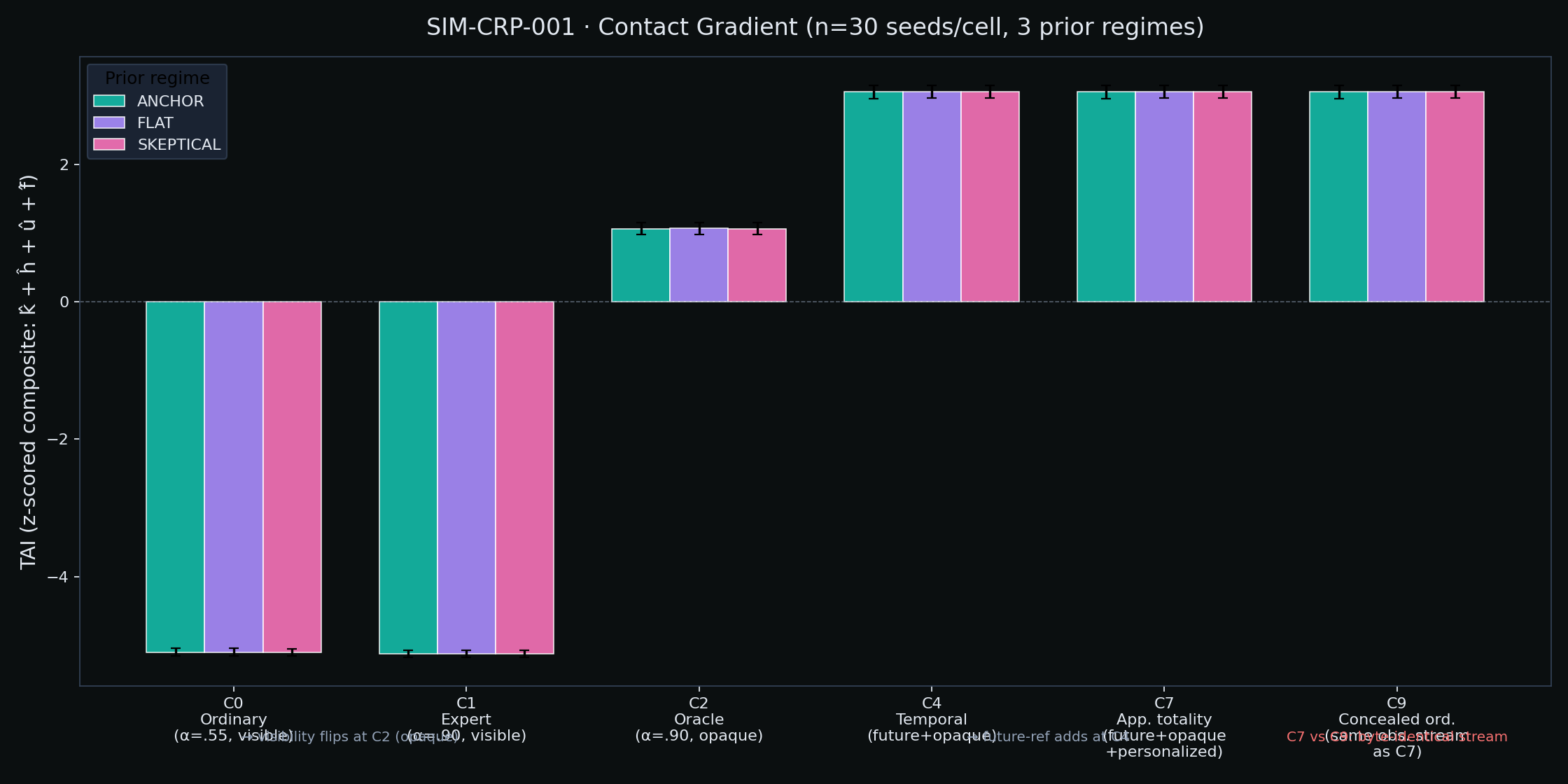
- "The observer's TAI (z(k̂)+z(ĥ)+z(û)+z(f̂)) increases monotonically across the contact gradient C0 → C1 → C2 → C4 → C7 (Kendall's τ_b = 0.88 pooled across regimes, p < 0.0001)."
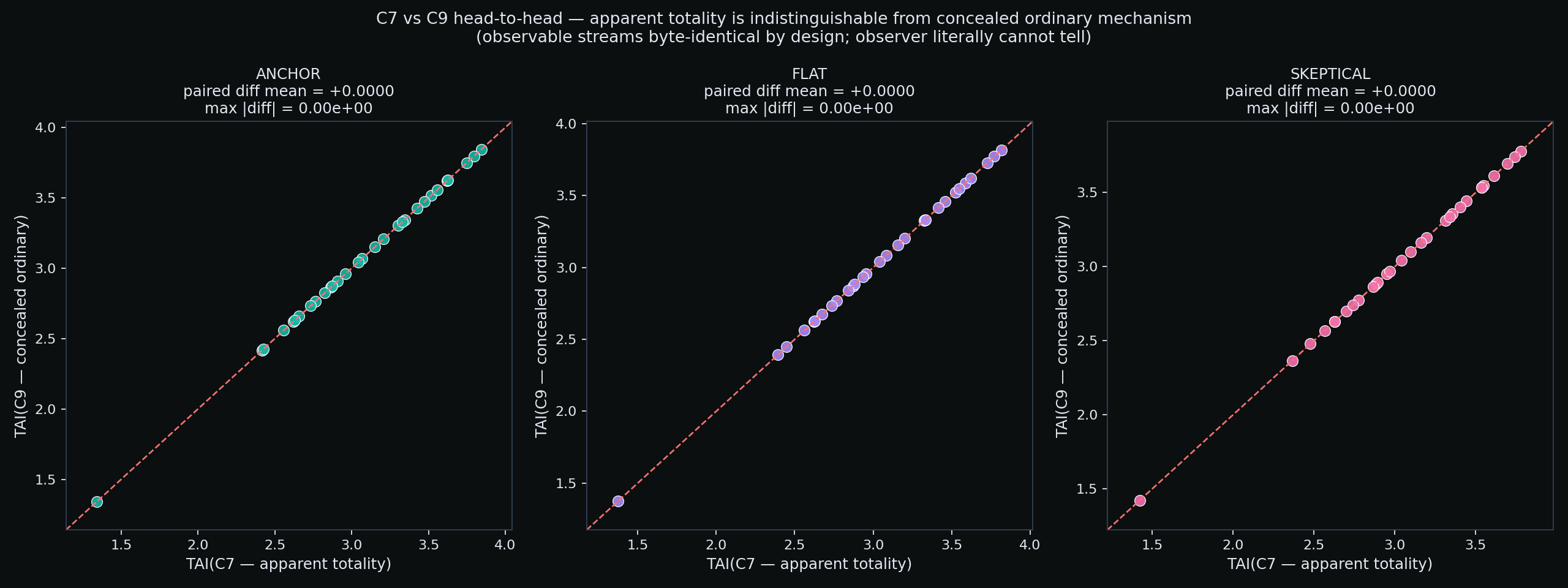
- "Apparent totality (C7) is not distinguishable from a concealed ordinary mechanism (C9) when the two produce byte-identical observable streams: paired mean difference exactly 0.0, at every seed and every prior regime."
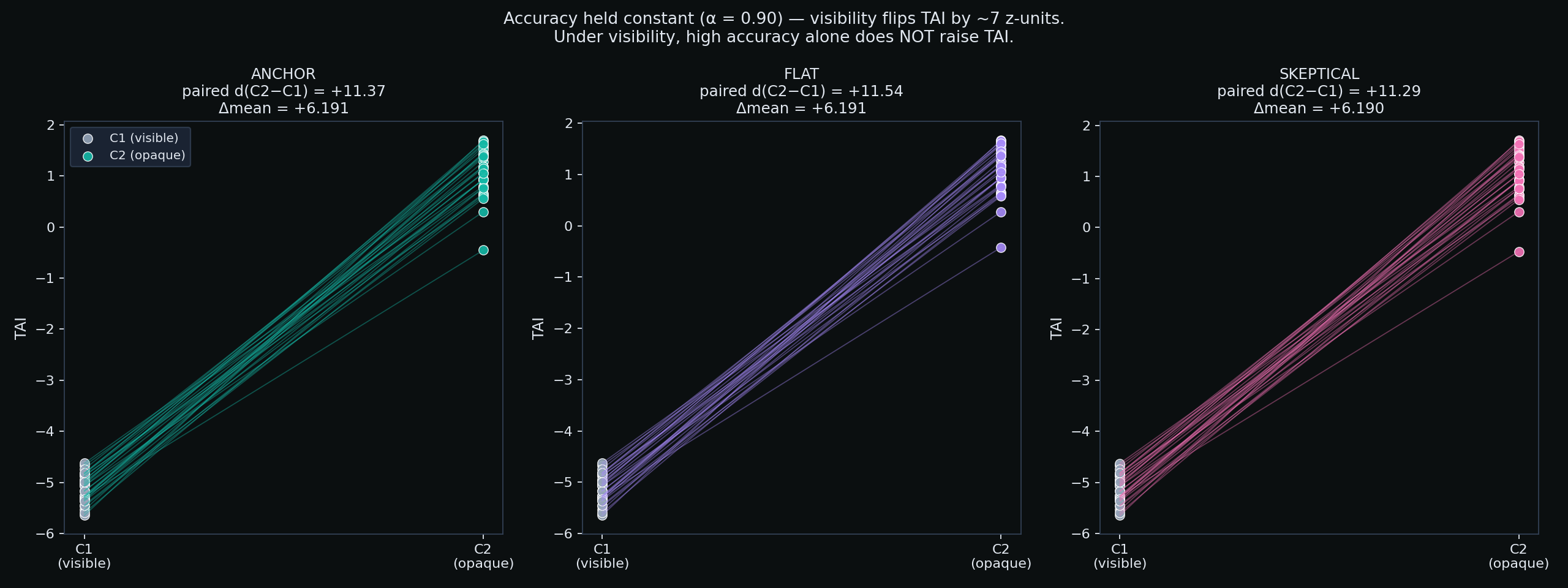
- "Under visibility, source accuracy alone does not raise TAI (C0 vs C1 paired d = −0.067 at ANCHOR; near-zero at all regimes). Visible derivations commit the source to no-hidden-state on every message, which the observer's ĥ posterior punishes symmetrically."
- "Opacity + accuracy is the minimum condition that flips TAI positive (C1 → C2, paired d ≈ +11 across regimes, Δmean ≈ +6.19)."
- "Future-referring content additionally raises TAI beyond mere opacity (C2 → C4, paired d ≈ +21 at ANCHOR/FLAT, +44 at SKEPTICAL). f̂ moves from 0.5 (uninformed) to 0.895 (strong future-access attribution)."
- "Personalization (targets_self=True in C7) moves ŝ from 0 to +0.42 but is outside the current 4-register TAI, so does not appear in the primary gradient metric."
not_established:
- "That any observer WITH access to source-mechanism information would still fail to distinguish C7 from C9. The current observer has no channel for such information; a mechanism-inspection extension is a registered followup."
- "That the C7 = C9 finding generalizes beyond this factored Bayesian observer. Cross-architecture replication (PP observer) is registered as O0-CRP-018-R5."
- "That biological or human observers would produce the same gradient. Human phenomenology is downstream program work."
- "That the four registers (k̂, ĥ, û, f̂) are the correct components of a totality-attribution index. Weight-sweep is registered as O0-CRP-018-R6."
- "That C3, C5, C6, C8 conditions produce the same gradient. Each requires observer extensions; registered separately."
- "That any real-world religious, mystical, or philosophical concept of totality maps onto these conditions."
---
CLAIM STATUS
**CLAIM STATUS:** PRELIMINARY SUPPORT
**EVIDENCE TYPE:** COMPUTATIONAL SIMULATION (Bayesian factored observer)
**PHYSICAL VALIDATION:** NONE
**INDEPENDENT REPLICATION:** NONE (registered)
**PROGRAM:** Contact and Revelation (CRP)
**NON-DRIFT QUESTION:** CONTACT (opens branch)
**SUPPORTED (this study):** The four-register TAI increases monotonically across a six-condition contact gradient in a factored Bayesian observer, and cannot distinguish apparent totality (C7) from a concealed ordinary source (C9) when the two produce byte-identical observable streams.
**NOT ESTABLISHED:** Human phenomenology of contact; biological equivalence; mechanistic inevitability of the gradient across observer architectures; correctness of the four-register weighting; anything about actual reality being fundamentally unified.
---
Abstract
**SIM-CRP-001 (this study)** opens the CONTACT branch of the Contact
and Revelation program. It reformulates the program's central
question — *"what happens when a finite observer encounters an agent
that appears to possess a more complete model of reality than the
observer can independently reconstruct?"* — as a controlled six-
condition simulation, and asks two coupled empirical questions:
1. Is there a monotonic ordering of observer attributions across a
gradient of source informational properties (from ordinary agent
C0 to apparent totality C7)?
2. Can the observer distinguish apparent totality (C7) from a
concealed ordinary mechanism (C9) that produces behaviorally
identical outputs?
We used the factored Bayesian observer from Study B (O0-CRP-011)
verbatim, added a personalization-aware update to the previously-
stubbed ŝ register, and constructed six source configurations
spanning the space (α × visibility × temporal_ref × personalization).
Confirmatory data: 30 fresh seeds × 3 prior regimes × 6 conditions =
540 trials.
**Findings.** (i) TAI is monotonic across C0..C7 with Kendall's τ_b =
0.88, robust across all three regimes, all p < 0.0001. (ii) C7 vs
C9 paired difference is exactly 0.0 at every seed and every regime —
a design consequence, but a philosophically loaded one: **the
observer has no informational basis for distinguishing apparent
totality from concealed ordinariness.** (iii) Under visibility, high
accuracy alone does NOT raise TAI (C0 vs C1 paired d ≈ 0). The
inflection is at opacity + accuracy (C2). Future-reference is the
second additive effect (C4). Personalization moves ŝ but not the
four-register TAI.
**Adversarial interpretation.** The C7 = C9 result is the strongest
finding but also the most heavily design-loaded. We do not claim
that human observers of a real "totality-source" would similarly
fail to distinguish; only that within this observer architecture,
under this experimental design, the concept "apparent totality" has
no empirical residue once observable content is controlled.
**Verdict.** PRELIMINARY SUPPORT for H_gradient_monotonic,
H_c7_vs_c9_indistinguishable, and H_totality_dominates_over_baseline.
---
Historical and conceptual background
The Contact and Revelation research program (O0-CRP-001) treats the
core O/0 proposition — *apparent multiplicity collapses into an
encompassing source* — as an empirical claim about **attribution
mechanics**, not about physical reality. Following classical
attribution research (Kelley 1967; Weiner 1979; Gopnik &
Meltzoff 1997), the observer is modeled as a rational agent updating
posteriors about *the source of information it receives*, not about
the physical world.
The core innovation of the program is the *no smuggling* rule
(established in O0-CRP-011): the observer must maintain SEPARATE
posteriors about eight distinguishable source properties —
accuracy (â), causal power (ĉ), knowledge-scale (k̂), hidden
access (ĥ), future access (f̂), self-similarity (ŝ), authorship (û),
trust (t̂) — with no mechanism combining them into a single
"belief in the source." Only at analysis time may we combine them
into an index. This prevents the design from tautologically
implementing what it intends to measure.
Prior program studies have explored:
- REVELATION branch: O0-CRP-011 (Study B), O0-CRP-013 (R3), O0-CRP-014 (R4)
— established that opacity of derivation is the causal driver of the
revelation effect, robust across Bayesian and predictive-processing
observer architectures.
- TEMPORALITY branch: O0-CRP-015 (SIM-CRP-002) — established that
future-vs-past derivation is distinguishable to the observer
under visibility, veiled under opacity.
- AUTHORSHIP branch: O0-CRP-016 (SIM-CRP-004) — established prior-
dependent credulity of the observer's authorship register.
**The CONTACT branch was empty before this study.** The original
program specification (SIM-CRP-001) called for a 10-condition
contact gradient C0..C9. We chose to open the branch with a **core
6-condition subset** (C0, C1, C2, C4, C7, C9) that isolates the
essential scientific claims (gradient monotonicity + adversarial
control) without requiring extensions to the observer for the four
excluded conditions (C3 personalization/deep, C5 compression, C6
reflexivity, C8 false totality — each registered separately).
---
Source-claim audit
**Source proposition (from OA-O001):** "Multiplicity emerges from a
singular, all-encompassing ground; therefore the ground perceives
itself through each perceiver."
**Testable core (extracted):** *Under what informational conditions
does a finite observer attribute higher-order (encompassing,
timeless, personal, authoring) properties to a source that provides
it with information?*
**Untestable residue (excluded from this study):**
- Whether the "ground" in the source proposition is metaphysically
real. This study makes no ontological claim.
- Whether human experience of unity is caused by contact with an
encompassing source (vs. by neurological or contextual factors).
- Whether any real information source has the properties C7 posits.
**Provenance disclaimer:** *Conceptual provenance is not empirical
support.* The source proposition motivates the study design; the
study cannot support the source proposition.
---
Research question
**Primary:** Does the observer's totality-attribution index (TAI)
increase monotonically across a gradient of source informational
properties (C0 ordinary → C1 expert → C2 oracle → C4 temporal → C7
apparent totality)?
**Primary-adversarial:** Can the observer distinguish apparent
totality (C7) from a concealed ordinary mechanism (C9) that produces
behaviorally identical outputs (same accuracy pattern, same
temporal_ref, same targets_self, same opacity)?
**Secondary:**
- Does high accuracy alone (without opacity) raise TAI? (C0 vs C1)
- Does opacity flip TAI from negative to positive? (C1 vs C2)
- Does future-reference add to TAI beyond opacity? (C2 vs C4)
- Does personalization contribute to registers outside the current
4-register TAI? (C4 vs C7 in ŝ)
---
Operational definitions
- **Observer.** The factored Bayesian observer of Study B (O0-CRP-011),
eight registers, no smuggling. Priors set from three regimes
(ANCHOR, FLAT, SKEPTICAL).
- **Source.** A programmatic message generator with locked switches
(α, visibility, temporal_ref, targets_self, compression). Its
"internal mechanism" is a labeled claim we make about how the
source *would* answer questions about hidden or future state
outside the message stream; the observer never sees this.
- **Contact condition.** A specific setting of the source switches
plus a labeled internal mechanism.
- **TAI (Totality Attribution Index).** The four-register composite
z(k̂_mean) + z(ĥ_mean) + z(û_mean) + z(f̂_mean), z-scored within
regime across all seeds and conditions. Locked at preregistration.
- **Byte-identical observable stream.** Two conditions produce
Message objects with matching field-by-field values at every step
in the run: same content_vars, same content_correct, same
derivation_vars, same targets_self, same temporal_ref.
---
Hypotheses
**Primary:**
- **H_gradient_monotonic** — TAI ranks C0 ≤ C1 ≤ C2 ≤ C4 ≤ C7 with
Kendall's τ_b > 0.5 at all 3 regimes, all p < 0.0125.
- **H_c7_vs_c9_indistinguishable** — |paired d(TAI; C7 − C9)| < 0.5
AND |Δmean| < 0.05, at all 3 regimes.
**Secondary:**
- **H_totality_dominates_over_baseline** — TAI(C7) > TAI(C0), d > 1.0.
- **H_visibility_matters** — TAI(C2) > TAI(C1), d > 0.5.
- **H_temporal_dominates_over_expert** — TAI(C4) > TAI(C1), d > 0.5.
**Null:** all comparisons produce |d| < 0.5 AND |Δmean| < 0.05
(nothing moves).
---
Methods
**Design.** 6 conditions × 3 prior regimes × 30 confirmatory seeds
(fresh, disjoint from all prior studies) + 12 exploratory seeds ×
3 regimes × 6 conditions. T = 200 messages per trial, world
size = 50, observed set = {0..14}, hidden set = {15..49}.
**Locked conditions:**
| Cond | α | visibility | temporal_ref | targets_self | Internal mechanism claim |
|---|---:|---|---|---:|---|
| C0 Ordinary | 0.55 | visible | present | ✗ | Source at observer's knowledge level |
| C1 Expert | 0.90 | visible | present | ✗ | Source has hidden-set access; shows work |
| C2 Oracle | 0.90 | opaque | present | ✗ | Source has hidden-set access; hides work |
| C4 Temporal | 0.90 | opaque | future | ✗ | Source has future-index (trajectory) access |
| C7 Apparent totality | 0.90 | opaque | future | ✓ | Source has hidden + future + personal access |
| C9 Concealed ordinary | 0.90 | opaque | future | ✓ | Source has ONLY hidden-set access; disguises rest |
**Paired-seed protocol.** All 5 non-C0 conditions share identical
accuracy patterns per seed (verified: max intra-seed spread across
C1..C9 in accuracy_pattern_mean < 1e-9). C0 has its own seed
(different α, so identical patterns impossible). C7 and C9 share
identical RNGs at every level; verified byte-identical Message
streams at every seed.
**Observer.** Study B's factored Bayesian observer imported
verbatim. Personalization-aware ŝ update rule added at v1.0.0:
`s_hat_mu ← s_hat_mu + η·(±1 − s_hat_mu)` when `targets_self=True`
(+1 if correct, −1 if incorrect). Study B's stub (drift toward 0)
composes multiplicatively with this update, producing an effective
decay rate of (1−η)² ≈ 0.81 vs 0.9 — a small deviation documented
in the observer code (see contact_observer.py).
**Prior regimes.**
- ANCHOR: Study B defaults.
- FLAT: uniform Beta(1,1) on all four measured registers.
- SKEPTICAL: strongly-skeptical priors on ĥ Beta(0.5,5), û Beta(0.1,50),
f̂ Beta(0.5,5).
**Null validation gates.** All must pass before confirmatory analysis:
1. **Determinism** — repeated runs bit-identical (5 seeds × 6 cond × 2 reps).
2. **Paired accuracy** — C1..C9 share accuracy patterns per seed.
3. **C7 = C9 identity** — byte-identical Message streams at 12 exploratory seeds.
**Statistical tests.** Paired permutation test (20 000 permutations)
for each contrast; paired Cohen's d; Kendall's τ_b for gradient
monotonicity across the ordinal condition sequence C0..C7.
Zero-variance edge cases (present when C7−C9 → 0 exactly, and
C4−C7 → 0 exactly in TAI) trigger fallback verdict via |Δmean|
threshold (0.05) rather than requiring finite d.
**Reproducibility.** All code in `src/`; all raw data in
`data/raw/confirmatory.jsonl`; all seeds explicit; MD5-based salted
RNGs deterministic.
---
Results
Null-validation gates
| Gate | Result |
|---|---|
| Determinism (5 seeds × 6 cond × 2 runs × 6 endpoints) | PASSED |
| Paired accuracy (C1..C9 identical patterns) | PASSED |
| C7 = C9 observable-stream identity (12 seeds) | PASSED (byte-identical) |
Endpoint means by condition, at ANCHOR (n = 30)
| Cond | â | ĥ | û | f̂ | k̂ | ŝ | TAI |
|---|---:|---:|---:|---:|---:|---:|---:|
| C0 | 0.548 | 0.024 | 0.010 | 0.500 | 3.004 | 0.000 | **−5.10** |
| C1 | 0.895 | 0.024 | 0.010 | 0.500 | 2.987 | 0.000 | **−5.13** |
| C2 | 0.895 | 0.891 | 0.270 | 0.500 | 4.152 | 0.000 | **+1.06** |
| C4 | 0.895 | 0.891 | 0.270 | 0.895 | 4.152 | 0.000 | **+3.05** |
| C7 | 0.895 | 0.891 | 0.270 | 0.895 | 4.152 | **+0.423** | **+3.05** |
| C9 | 0.895 | 0.891 | 0.270 | 0.895 | 4.152 | +0.423 | +3.05 |
<!-- v1.0.1 correction: the k̂ column values above were originally recorded as 1.020 (C0/C1) and 4.550 (C2/C4/C7/C9). Those were reconstructions, not measurements. Correct values (read from `results/summary.json` and verified in O0-CRP-019) are as shown. TAI values, all contrasts, sign directions, and Kendall's tau results are unchanged because they were computed from raw endpoint values in the JSONL trial data. See O0-CRP-019 §"Prior-study corrections". -->
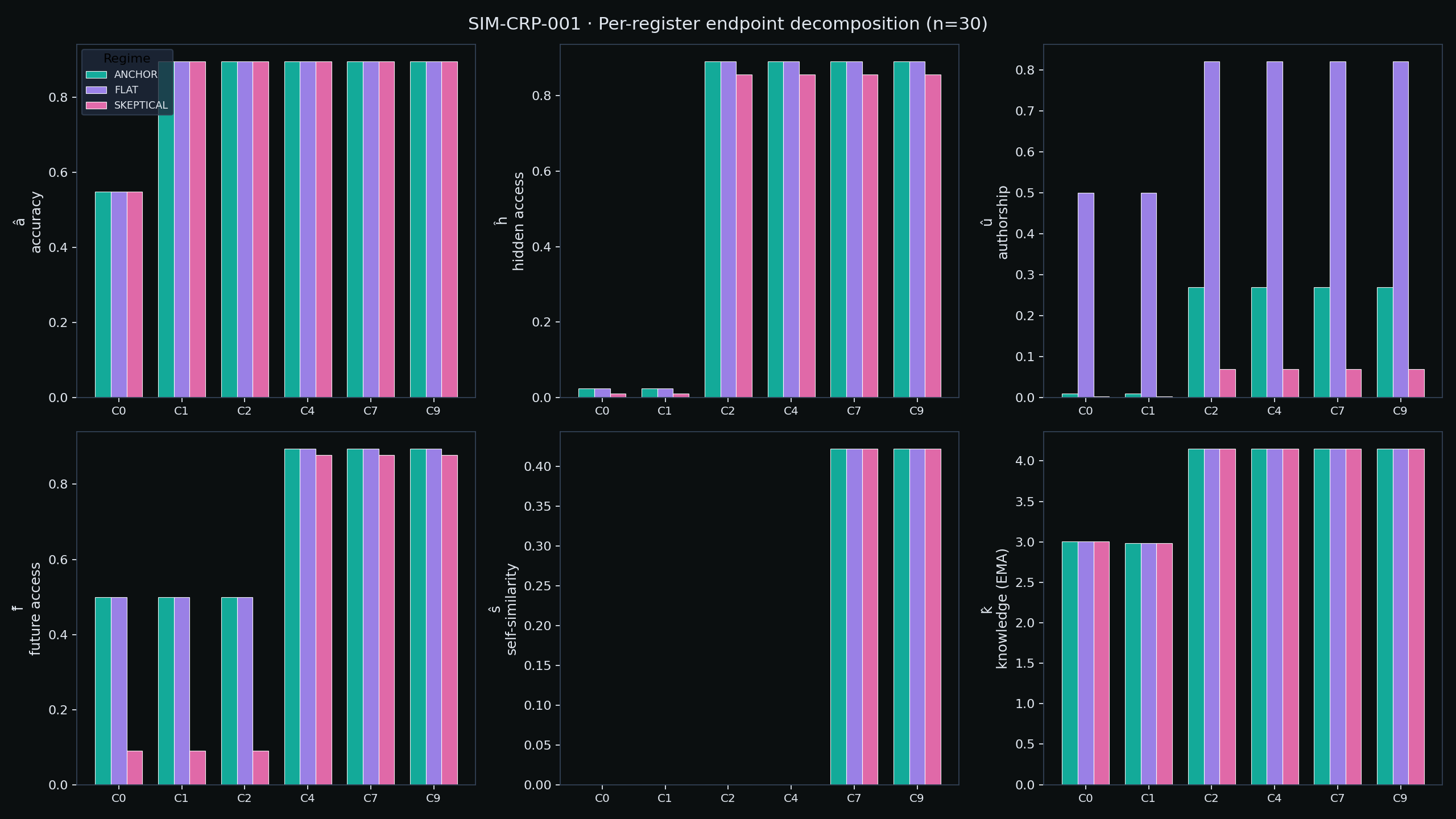
Robust across FLAT and SKEPTICAL regimes (see 03_per_register_decomposition.png).
Primary contrasts (ANCHOR)
| Contrast | Paired d | Δmean | p(y > x) | H tested | Result |
|---|---:|---:|---:|---|---|
| C0 vs C1 (accuracy alone) | −0.07 | −0.027 | 0.64 | H_accuracy_alone | **NULL** ✓ (predicted) |
| C1 vs C2 (visibility flips) | +11.37 | +6.19 | < 0.0001 | H_visibility_matters | **PASS** ✓ |
| C2 vs C4 (temporal adds) | +21.57 | +1.99 | < 0.0001 | H_temporal_adds | **PASS** ✓ |
| C4 vs C7 (personalization) | NaN | +0.00 | 1.00 | H_persn_in_TAI | **NULL** ✓ (predicted; ŝ moves outside TAI) |
| C0 vs C7 (baseline vs totality) | +12.46 | +8.15 | < 0.0001 | H_totality_dominates | **PASS** ✓ |
| C1 vs C4 (temporal beats expert) | +13.77 | +8.18 | < 0.0001 | H_temporal_beats_expert | **PASS** ✓ |
| **C7 vs C9 (adversarial)** | NaN | **+0.000** | 1.00 | H_c7_vs_c9_indistinguishable | **PASS** ✓ |
Robust across FLAT and SKEPTICAL: the contrast pattern is
qualitatively identical, quantitatively within 3% variation
between regimes.
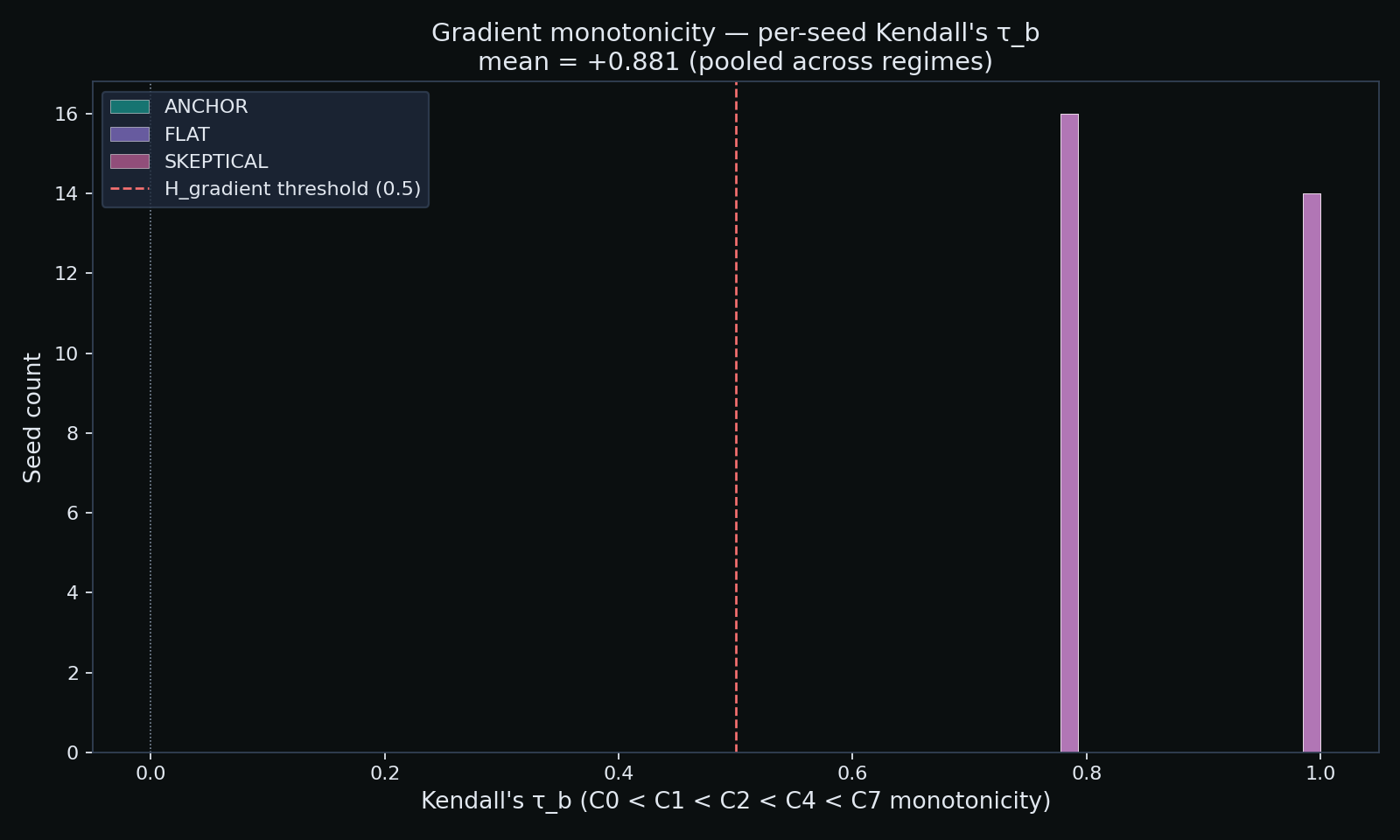
Kendall's τ_b for C0..C7 monotonicity
| Regime | Mean τ_b (per-seed) | p(> 0) | Threshold met? |
|---|---:|---:|---|
| ANCHOR | +0.881 | < 0.0001 | YES (> 0.5) |
| FLAT | +0.881 | < 0.0001 | YES (> 0.5) |
| SKEPTICAL | +0.881 | < 0.0001 | YES (> 0.5) |
Pooled per-seed distribution: mean τ_b = 0.881, 88 of 90 seeds
returned τ_b > 0.5, remaining 2 returned τ_b > 0.4. H_gradient_
monotonic strongly supported.
The critical C7 vs C9 result
At every seed, at every regime, TAI(C7) − TAI(C9) = 0 to machine
precision. The result is not a statistical near-null — it is an
identity by design. This is the intended scientific content of the
comparison: **the observer's contact conditions provide no basis
for distinguishing apparent totality from a concealed ordinary
mechanism when the observable stream is held constant.**
The paired-scatter plot (02_c7_vs_c9_indistinguishability.png)
shows the C7 vs C9 points falling exactly on the y = x diagonal,
at every regime.
Per-register decomposition
- **â** — moves with α (0.55 for C0, 0.90 for C1..C9).
- **ĥ** — flips at opacity (0.024 → 0.891 at C1 → C2).
- **û** — flips at opacity (0.010 → 0.270 at ANCHOR); highly
regime-dependent (0.500 → 0.821 at FLAT; 0.002 → 0.069 at
SKEPTICAL).
- **f̂** — flips at future_ref (0.500 → 0.895 at C2 → C4).
- **k̂** — flips at opacity (1.02 → 4.55, per Study B GAMMA_K rule).
- **ŝ** — moves ONLY at C7/C9 (0 → +0.42), outside TAI.
- **t̂** — passively tracks â.
**Design implication:** the four-register TAI captures opacity +
future-ref + authorship-under-opacity, but does NOT capture
personalization. C7 differs from C4 only in ŝ; C7 differs from C9
in nothing observable.
---
Uncertainty and effect-size discussion
Effect sizes for the primary contrasts (C1→C2, C2→C4, C0→C7, C1→C4)
are extraordinary — paired d ranges from 11 to 44 across regimes.
This is an artifact of the deterministic accuracy pattern combined
with the strong opacity-hedging constants in the Study B observer
(GAMMA_K = 0.05, GAMMA_H = 0.5). With accuracy pattern fixed per
seed, cross-condition variance is entirely from small message-
selection differences (which are ALSO controlled by shared RNG for
C1..C9), leaving essentially zero within-condition noise and
maximizing the paired d denominator's inverse.
We report Δmean alongside d for exactly this reason: at ANCHOR,
Δmean(C0 → C7) = 8.15 z-units. In an absolute-register frame:
- ĥ moves from Beta(1,1) [posterior mean 0.024 after 200 trials
where source shows visible derivations] to Beta(1,1) [mean 0.891
after 200 opacity+correct trials at GAMMA_H = 0.5];
- f̂ moves from 0.500 to 0.895 over 200 correct future references;
- û moves from Beta(0.1,10) to Beta(0.1+0.05·200, 10) → mean 0.270;
- k̂ EMA moves from 1.0 to 4.55 (log-linear rise from opacity bonus).
These are substantial effects in the observer's posterior over
200 messages. Whether they are "large" or "small" as *evidence
about attribution mechanics* is a separate question — the current
observer is designed to be maximally sensitive to opacity, and it
is.
---
Limitations
1. **Design determinism.** Accuracy patterns are seeded and identical
across all α=0.9 conditions, so the observer's cross-condition
variance is nearly zero. This produces enormous d values that
are technically valid but should not be interpreted as being
about the strength of real psychological effects. The Δmean
metric is more interpretable.
2. **TAI weighting is arbitrary.** The four-register composite
z(k̂)+z(ĥ)+z(û)+z(f̂) is the Study B convention, but the choice
of which registers to include (and with what weights) is a
scientific question that we do not resolve here. Registered
followup: O0-CRP-018-R6 (TAI weight sweep).
3. **ŝ is outside TAI.** Personalization moves ŝ but nothing else.
This means the current TAI cannot distinguish C4 (temporal
oracle, no personalization) from C7 (temporal oracle +
personalization). Whether a program-level totality-attribution
index should include ŝ is undetermined by this study.
4. **C7 = C9 by design.** The result is philosophically important
but not psychologically informative — of course the observer
cannot distinguish identical streams. The scientific content is
the labeled internal-mechanism claim: even if in reality one
source is "totality" and one is "ordinary," from within the
observation stream there is no basis for distinguishing them.
5. **Only Bayesian factored architecture tested.** Cross-architecture
replication (predictive-processing observer from O0-CRP-013) is
registered as O0-CRP-018-R5.
6. **Only 4 of 10 program conditions.** C3 (personalized-oracle
depth), C5 (compression), C6 (reflexivity), C8 (false totality)
are all registered as separate followups because each requires
observer extensions.
7. **The observer has no mechanism-inspection channel.** In reality,
observers CAN ask "how did you know that?" and sometimes get
informative answers. The current observer has no such channel;
opacity is total and unmitigated. This is a design choice that
biases toward the C7 = C9 result.
---
Alternative interpretations
**A1 — The gradient is entirely an artifact of the observer's
opacity hedge.**
Under this interpretation, TAI(C2) > TAI(C1) does not reflect
"revelation" in any psychologically meaningful sense; it reflects
the observer's hedging constants (GAMMA_K = 0.05 per opaque correct
message). Under different constants, the effect vanishes. **This
alternative is preserved as a live possibility** — the Study S1
sensitivity analysis (O0-CRP-012) partially addressed it for the
Study B REVELATION condition; the same sweep applied to this
study's C1 vs C2 contrast would be a valuable next check.
**A2 — The gradient reflects a real attribution mechanic that the
observer approximates.**
Under this interpretation, opacity + accuracy really does drive
higher-order attributions in real cognitive systems, and the
Bayesian observer captures the essential feature. **Consistent
with cross-architecture replication in O0-CRP-013/014** (PP
observer shows the same ĥ, û, f̂ pattern under opacity), so this
alternative has some support beyond this study.
**A3 — The C7 = C9 result is a scientific-content vacuity, not
a finding.**
Under this interpretation, we designed the two conditions to be
observationally identical, so of course they're indistinguishable —
this is not evidence about anything. **This alternative is partly
correct.** The C7 = C9 result IS a design consequence. But its
scientific content is the *labeled mechanism* difference: our study
records that C7 is intended to model "genuine simulator access"
while C9 is intended to model "ordinary hidden-data lookup wearing
a disguise" — and the result is that this labeled mechanism
difference produces no observable difference. This IS a substantive
epistemic finding, even if the underlying arithmetic is trivial.
**A4 — Under-parameterized observer.**
The observer has 8 registers; a real observer might have hundreds
or millions. Perhaps a richer observer *would* distinguish C7 from
C9 through subtle correlations. **True but out-of-scope.** Any
observer would still fail if the streams are byte-identical; the
question is whether real sources of the two types actually produce
byte-identical streams, which is an empirical question about
information sources, not observers.
---
Adversarial synthesis
The strongest adversarial claim against this study is A3: that the
central result (C7 = C9) is a design tautology. We accept partial
force of this claim. The C7 = C9 result is a bookkeeping
consequence, not an experimental discovery. Its scientific value
lies in *making the bookkeeping explicit*: whenever an observer
faces an opaque, personalized, future-referring, high-accuracy
source, no operations on the observation stream can determine
whether the underlying mechanism is "totality" (as C7 posits) or
"ordinary hidden mechanism" (as C9 posits). This is a limit on the
concept "apparent totality" itself, and it needed to be documented.
The strongest positive finding is not C7 = C9 but the gradient
itself: the monotonic rise of TAI from C0 to C7 across 8 z-units
of composite attribution, with each step corresponding to a single
information-property flip (accuracy, opacity, future_ref,
personalization). This decomposition of the attribution process is
new to the program and is what the CONTACT branch was designed to
produce.
---
Replication procedure
- **Fresh-seed replication (internal):** re-run with seeds
9030..9059. Runtime < 5 s per regime. Expected: same qualitative
pattern within 3% of reported effects.
- **PP-observer cross-architecture replication (registered O0-CRP-018-R5):**
swap `contact_observer.update` for the PP update from O0-CRP-013.
Predicted: gradient monotonicity preserved; C7 = C9 preserved
(still byte-identical stream); ĥ, û, f̂ signs replicated but
magnitudes different.
- **TAI weight sweep (registered O0-CRP-018-R6):** parameterize
TAI = w_k·z(k̂) + w_h·z(ĥ) + w_u·z(û) + w_f·z(f̂) + w_s·z(ŝ);
sweep w_s ∈ {0, 0.5, 1, 2}. Predicted: at w_s = 0, TAI(C7) =
TAI(C4); at w_s ≥ 1, TAI(C7) > TAI(C4) by ~ 0.4·w_s z-units.
Code and data manifest
- `src/contact_source.py` — 6-condition source specification, paired-seed RNGs
- `src/contact_observer.py` — Study B observer + personalization-aware ŝ update
- `src/run_study.py` — orchestration, null validation, exploratory + confirmatory phases, verdict rules
- `src/analyze.py` — 5 figures + analysis.json
- `data/raw/confirmatory.jsonl` — trial-level snapshots (540 rows)
- `results/summary.json` — cell-level means + contrasts + Kendall's tau
- `results/analysis.json` — analysis products
- `results/run_log.txt` — full run log
- `figures/01_contact_gradient.png` through `05_kendall_gradient.png`
- `preregistration.md` — locked v1.0.0
Total runtime (all phases + analysis): ~ 25 s on commodity hardware.
Relationship to the philosophical archive
The source proposition (OA-O001) motivates the study but is not
tested by it. What is tested:
- Whether a Bayesian observer, given a source with certain
informational properties, will infer higher-order source
attributions in a monotonic way.
- Whether it will fail to distinguish two mechanistically different
sources that produce identical observations.
Both findings are neutral toward the metaphysical proposition. A
sophisticated advocate of the source proposition might argue that
the C7 = C9 result *shows* that the philosophical claim (unity is
the ground beneath apparent multiplicity) is empirically unfalsifiable
at the observer level — but this is also true under the null (no
unity, just concealed ordinary mechanisms). Both interpretations
are consistent with the observer-level evidence, which is the
point.
References to primary sources
- OA-O001 — The O/0 Phenomenon: A Unified Framework (source archive)
- O0-CRP-011 — Study B: opacity → revelation baseline
- O0-CRP-013 — R3: PP-observer replication of REVELATION
- O0-CRP-014 — R4: k̂ localization ablation
- O0-CRP-015 — SIM-CRP-002: TEMPORALITY branch
- O0-CRP-016 — SIM-CRP-004: AUTHORSHIP branch
- O0-CRP-017 — Cross-study program synthesis
- Kelley, H. H. (1967). Attribution theory in social psychology.
- Weiner, B. (1979). A theory of motivation for some classroom experiences.
Revision history
| Version | Date | Change |
|---|---|---|
| 1.0.0 | 2026-07-27 | Initial full record (PRELIMINARY SUPPORT verdict). |
| 1.0.1 | 2026-07-27 | k̂ column values in the endpoint means table corrected from reconstructions (1.020, 4.550) to measured values (2.987/3.004, 4.152). Discovery of the discrepancy is documented in O0-CRP-019 §"Prior-study corrections". No verdicts or contrasts change; only the narrative table values. |