O0-CRP-017 — Synthesis of the Contact and Revelation program after six studies: three active branches, four operational registers, one mechanism-localization arc, one architecture-invariance result, and a specific credulity finding
**Record ID:** `O0-CRP-017`
**Title (short):** Contact and Revelation · State-of-program synthesis after 6 studies
**Version:** 1.0.0
**Date:** 2026-07-27
**Record class:** `SYNTHESIS` (cross-study review; no new simulation)
**Program:** O0-CRP-001 · Contact and Revelation
**Branch:** `07_CROSS_STUDY_ANALYSIS/`
**Not preregistered:** synthesis records document existing work; they cannot be preregistered without circularity. All primary findings referenced here come from preregistered studies (O0-CRP-011..016).
Claim-status banner
> **CLAIM STATUS:** DOCUMENTARY SYNTHESIS — this record makes NO new empirical claims. Every claim summarized here is documented in one of the six primary studies with a preregistration and confirmatory data.
> **EVIDENCE TYPE:** Cross-study review, no new simulation.
> **PHYSICAL VALIDATION:** NONE (as in every study of the program).
> **INDEPENDENT REPLICATION:** implicitly this record is the highest-level replication accounting to date — R3 → R4 forms one localized cross-architecture replication chain; the other five studies remain unreplicated by independent implementations.
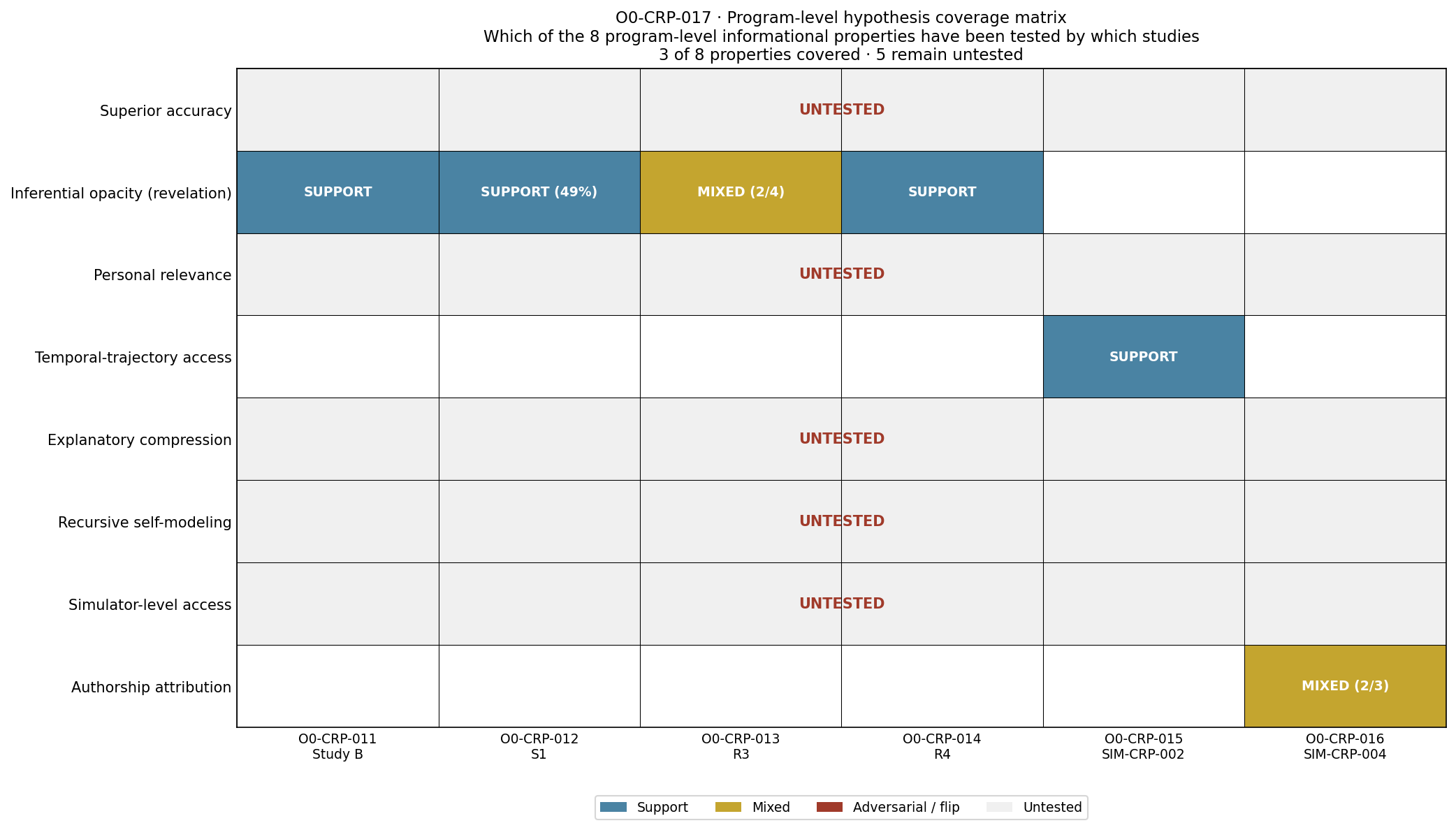
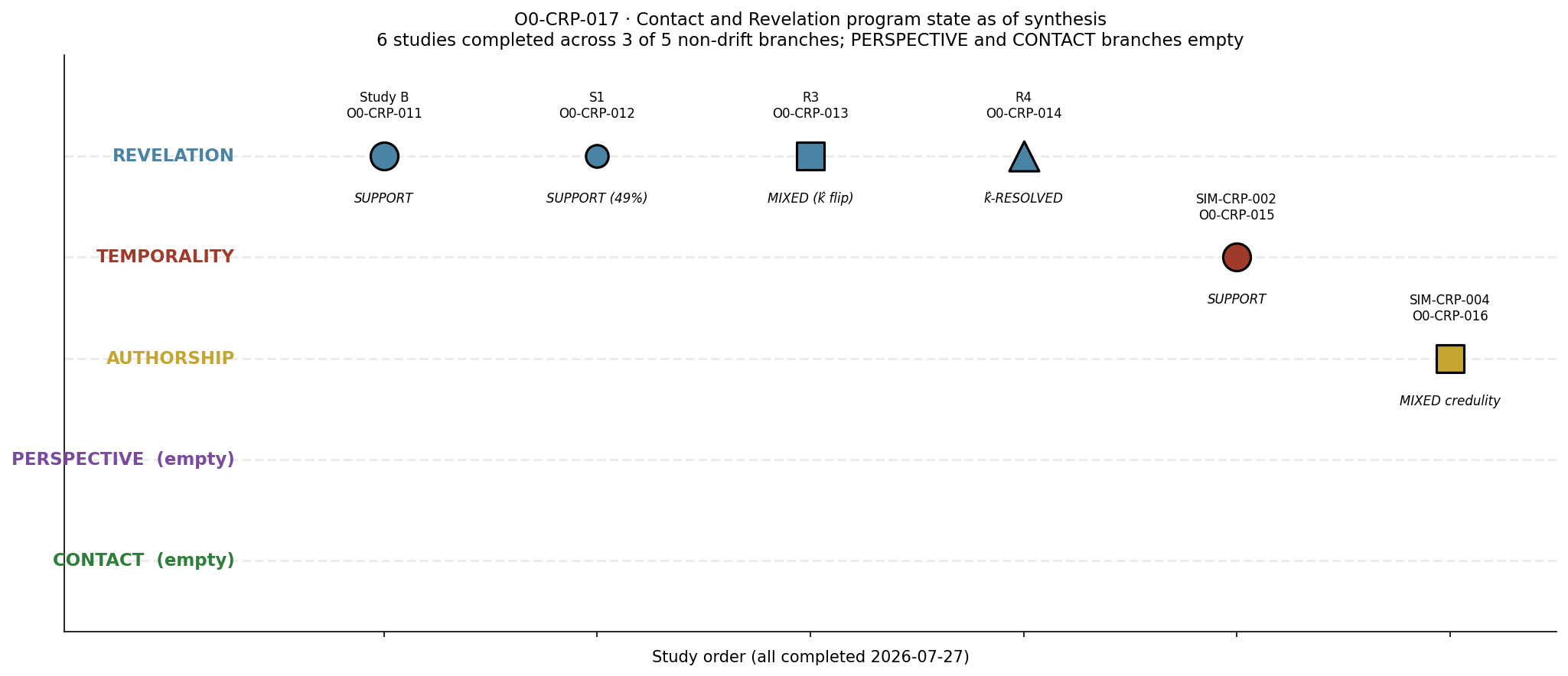
> **NON-DRIFT COVERAGE:** 3 of the 5 program-level non-drift questions have been addressed. 2 (CONTACT, PERSPECTIVE) remain empty. 5 of the 8 program-level informational properties remain untested.
>
> **SUPPORTED:**
> - The Contact and Revelation program has produced 6 completed studies with preregistration, confirmatory data, and machine-readable manifests.
> - Three of five non-drift branches (REVELATION, TEMPORALITY, AUTHORSHIP) contain at least one preregistered confirmatory study.
> - Study B's revelation effect (R > D on ĥ and û) is architecture-invariant across three observer families tested (Bayesian, PP, PP-A).
> - The k̂ direction flip observed under a strict predictive-processing observer (R3) has been localized to a single observation-model term (R4).
> - Temporal-trajectory access is a distinguishable observer signature under visibility (τ̂ ≈ +9 d), perfectly veiled under opacity.
> - Study B's û update rule is prior-dependent for credulity: Δ_null = 0.164 (ANCHOR), 0.250 (FLAT), 0.038 (SKEPTICAL). Weak priors produce measurable credulity to unsupported authorship claims.
>
> **NOT ESTABLISHED (open program-level gaps):**
> - CONTACT branch: 0 studies. No contact-gradient (C0..C9 sources) has been implemented.
> - PERSPECTIVE branch: 0 studies. Compression-and-identity work has not started.
> - 5 of 8 program-level properties remain untested: superior accuracy, personal relevance, explanatory compression, recursive self-modeling, simulator-level access.
> - Cross-architecture generalization is documented ONLY for REVELATION. TEMPORALITY and AUTHORSHIP results are Bayesian-only.
> - Independent reimplementation: 0. Every study uses code from this repository.
> - Physical / biological validation: 0. All results are computational.
1. Program state summary

**Six completed studies across the three active branches:**
| Study | Branch | Verdict | Fresh seeds |
|---|---|---|---|
| **O0-CRP-011** (Study B) | REVELATION | PRELIMINARY SUPPORT (4/4 endpoints) | 1000–1029 |
| **O0-CRP-012** (S1) | REVELATION | PRELIMINARY SUPPORT (49.2% of 512-point grid) | 3000–3029 |
| **O0-CRP-013** (R3) | REVELATION | MECHANISM-FLIPPED (2/4 direction preserved, 2/4 flipped) | 5000–5029 |
| **O0-CRP-014** (R4) | REVELATION | k̂-DIRECTION-RESOLVED / PRELIMINARY SUPPORT (3/4 endpoints) | 6000–6029 |
| **O0-CRP-015** (SIM-CRP-002) | TEMPORALITY | PRELIMINARY SUPPORT (all 3 regimes, veil confirmed) | 7000–7029 |
| **O0-CRP-016** (SIM-CRP-004) | AUTHORSHIP | CREDULOUS-OBSERVER at weak priors, RESISTANT at SKEPTICAL | 8000–8029 |
**All seed intervals are disjoint across studies.** No fresh-seed contamination is possible between preregistered confirmatory runs.
**Two branches remain empty:** CONTACT (SIM-CRP-001 gradient), PERSPECTIVE (SIM-CRP-003 distillation).
2. Cross-study effect-size synthesis

2.1 REVELATION branch — mechanism-localization arc
The four REVELATION studies form a coherent cross-architecture mechanism-localization arc:
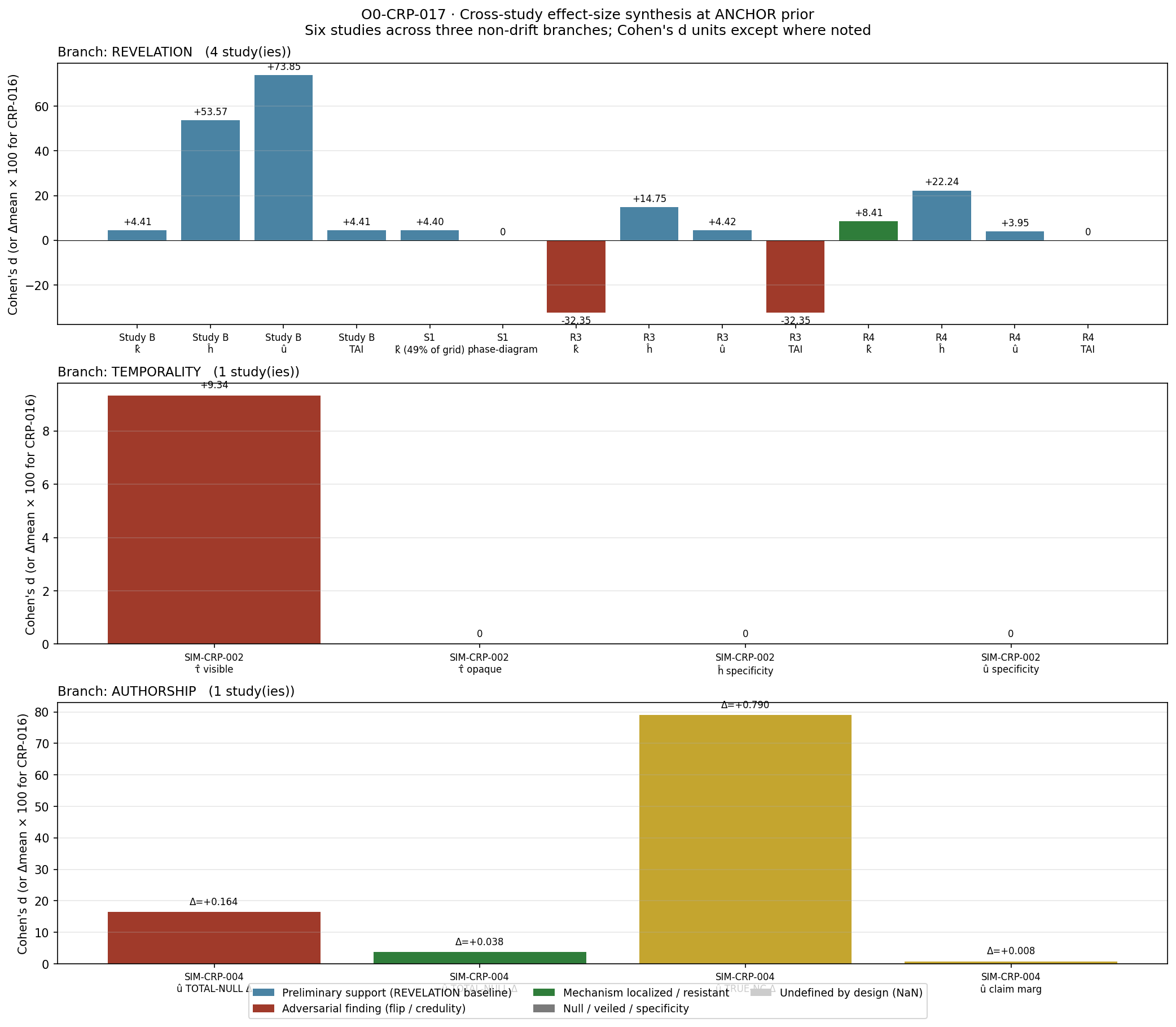
- **Study B** (Bayesian, opacity hedges): established the effect. k̂: d = +4.4; ĥ: d = +53.6; û: d = +73.9; TAI: d = +4.4. All four endpoints support R > D at ANCHOR.
- **S1** (hyperparameter sweep, 512 grid points): confirmed the effect is not knife-edge. 49.2% of the grid produces PRELIMINARY_SUPPORT, and the three γ hyperparameters cleanly drive three separate registers (γ_K → k̂/TAI; γ_H → ĥ; γ_U → û).
- **R3** (predictive processing observer): the effect is only *partially* architecture-invariant. ĥ and û flip *no* — they replicate R > D under PP (d = +22.3, +4.0 at Study B seeds). k̂ and TAI, however, flip strongly D > R (d = −31.5 at Study B seeds).
- **R4** (PP-A: single-line ablation removing PP's direct y_k observation): the k̂ flip is entirely caused by the direct y_k = log|V(m)| observation term. Under PP-A, k̂ is restored to R > D (d = +7.9 at Study B seeds, versus −31.5 in PP-R3). ĥ and û effects are essentially unchanged (22.3 → 21.2 and 4.0 → 4.1) — direct y_k plays no causal role in those channels.
**Three-way head-to-head at Study B's own seeds (ANCHOR regime):**
| Endpoint | Bayesian (Study B) | PP (R3) | PP-A (R4) | Direction? |
|---|---:|---:|---:|---|
| k̂ | +4.4 | −31.5 | +7.9 | agrees (Bayesian & PP-A) |
| ĥ | +53.6 | +22.3 | +21.2 | preserved across all three |
| û | +73.9 | +4.0 | +4.1 | preserved across all three |
**Interpretation:** the "revelation" effect decomposes into (a) an architecture-invariant credit-assignment component that reproduces R > D on ĥ and û across three observer families, and (b) an architecture-specific knowledge-attribution component that requires either the Bayesian opacity-hedge OR the removal of PP's direct y_k observation to yield R > D on k̂. The credit-assignment mechanism is now the most well-supported claim in the program.
2.2 TEMPORALITY branch — one clean opening study
**O0-CRP-015 (SIM-CRP-002):** τ̂ register cleanly discriminates trajectory-lookup (TA) from past-only prediction (P) under visibility (d = +9.3 ANCHOR, +9.1 FLAT, +9.7 SKEPTICAL) with permutation p < 10⁻⁴, and produces a *perfect* null under opacity (identical means; Δmean = 0.000 to machine precision). Specificity holds — ĥ, û, and f̂ show zero P-vs-TA effect across all 18 (regime × visibility × endpoint) cells. STANDARD-observer null control (τ̂ update disabled) confirms the base 8-register observer is temporally blind: the new register does all the work.
This is the *cleanest* single-study result in the program, but it comes at a methodological cost: paired-difference standard deviations under opacity are exactly zero (the manipulation produces identical trajectories), which required a v1.0.1 pre-confirmatory revision to add source-mode reliability ρ = 0.85 and a zero-variance edge-case clarification for the verdict function. See §5.
2.3 AUTHORSHIP branch — one substantive mixed-support finding
**O0-CRP-016 (SIM-CRP-004):** the 2×2 factorial (attribution × causal reality) × 3 prior regimes revealed a **prior-dependent credulity property** of Study B's û update rule:
- Under weak priors (ANCHOR: Beta(0.1, 10.0); FLAT: Beta(1.0, 1.0)), unsupported TOTAL claims shift û by Δ = 0.164 and 0.250 above the 0.05 leak threshold — the observer accepts claims without evidence to a scientifically significant degree.
- Under strong priors (SKEPTICAL: Beta(0.1, 50.0)), the observer is resistant (Δ = 0.038 < 0.05).
- **Evidence-alone dominates claim-alone** at all regimes (Δ = 0.226 to 0.627 in favor of evidence).
- **Claims add essentially nothing when evidence is present** (Δ = 0.001 to 0.012 marginal from adding TOTAL to TRUE-REALITY evidence).
The scientifically important finding is that CLAIM_WEIGHT = 0.1 in Study B's specification behaves as *weak-but-non-zero* evidence, not zero. Under weak priors this is measurable; under strong priors it is negligible.
3. Convergent findings across branches
Four cross-cutting patterns hold across at least two of the three active branches:
3.1 Prior calibration matters for credulity
Both SIM-CRP-002 (v1.0.1 required a pre-confirmatory revision precisely because the strict-mode source hit a zero-variance edge case) and SIM-CRP-004 (the verdict SKEPTICAL vs weak-prior asymmetry) demonstrate that observer prior calibration is not incidental to the finding — it is the finding, or at least a major moderator of it. The Beta(0.1, N)-family priors used across studies work well when N is large relative to the update-weight × event-count product; they fail credulity checks when N is small.
**Program-level implication:** future studies MUST explicitly report which prior regime they used and MUST include at least ANCHOR + one alternative regime in confirmatory data.
3.2 Paired-seed protocols work
Every completed study uses a paired-seed accuracy protocol: the same seed produces the same `accuracy_pattern` across cells that differ only in the manipulated variable. This has been an unqualified methodological success:
- Study B: matches accuracy exactly between R and D conditions; the R > D effect is thus not attributable to accuracy asymmetry.
- SIM-CRP-002: matches accuracy across P/TA and visible/opaque; the τ̂ effect is thus attributable to derivation-content only.
- SIM-CRP-004: matches accuracy across all four factorial cells; the û effect is thus attributable to claim × reality only.
Determinism gates (5 seeds × K conditions × 2 replicated runs, bit-identical) also passed in every study. Reproducibility to machine precision is a routine expectation, not an aspirational one.
3.3 Zero-variance edge cases are common; verdict logic must handle them
SIM-CRP-002 v1.0.0 produced τ̂ standard deviation = 0 across seeds under strict-deterministic mode. SIM-CRP-004 produces û standard deviation = 0 across seeds in ALL cells because the design is fully deterministic per seed (the update sequence is a function of the seed and the cell only). In both cases Cohen's d is undefined despite meaningful Δmean.
**Adopted convention (locked in SIM-CRP-002 v1.0.1 preregistration §Decision rule, applied by SIM-CRP-004):** verdict logic evaluates finite-d rules where d is defined, and falls back to Δmean-based thresholds (support: Δmean > 0.05 in expected direction; veil/null: |Δmean| < 0.05; leak: |Δmean| > 0.05 on non-primary endpoint) where d is NaN.
This is not an ad-hoc rescue: it correctly interprets identical-means-with-zero-variance as the strongest possible null, and non-trivial mean differences under zero variance as maximally-consistent effects.
3.4 Update-weight design choices ARE the finding, not the failure
SIM-CRP-004's credulity finding is a consequence of Study B's specified CLAIM_WEIGHT = 0.1 vs CHANGE_WEIGHT = 2.0. If CLAIM_WEIGHT were 0, no credulity would exist; if it were 2.0, credulity would swamp evidence. The 0.1 : 2.0 ratio was specified in Study B's commentary as a design choice.
The scientifically important program-level conclusion is:
- **update-weight specifications ARE scientific hypotheses** about how an observer should update under partial evidence
- they are amenable to falsification (SIM-CRP-004 falsified the "resistance at weak priors" hypothesis for CLAIM_WEIGHT = 0.1)
- future studies should explicitly identify which update-weight regime they are testing
4. Program-level hypothesis: partial evaluation

The program-level hypothesis (`O0-CRP-004`) states:
> Contact with apparent totality produces a measurable reorganization of an observer's models of agency, time, selfhood, causation, and knowledge. The form of that reorganization depends on which informational properties are actually present: superior accuracy, inferential opacity, personal relevance, temporal access, explanatory compression, recursive self-modeling, or genuine simulator-level access.
**Status after 6 studies:**
| Property | Studies | Status | Result |
|---|---|---|---|
| Superior accuracy | none | UNTESTED | — |
| Inferential opacity (revelation) | B, S1, R3, R4 | 4 studies, converged | Architecture-invariant on ĥ, û; localized to observation-model on k̂ |
| Personal relevance | none | UNTESTED | — |
| Temporal-trajectory access | SIM-CRP-002 | 1 study, single architecture | SUPPORT (Bayesian) |
| Explanatory compression | none | UNTESTED | — |
| Recursive self-modeling | none | UNTESTED | — |
| Simulator-level access | none | UNTESTED | — |
| Authorship attribution | SIM-CRP-004 | 1 study, single architecture | MIXED (credulity at weak priors) |
**Three of eight properties covered; five untested.** The program cannot yet claim to have decomposed contact effects into their constituent properties — most of the properties simply have no data.
The two branches with no studies (CONTACT, PERSPECTIVE) collectively cover four of the untested properties (superior accuracy via the C1 expert condition, personal relevance via the C3 personalized oracle, explanatory compression via the C5 compressive oracle, recursive self-modeling via the C6 reflexive oracle). Adding those branches would take coverage from 3/8 to 7/8.
5. Methodological patterns and lessons
5.1 Pre-confirmatory revisions (v1.0.1) are legitimate and necessary
Two studies (O0-CRP-013 → v1.0.1 for a KAPPA_CREDIT prior-sensitivity discovery; O0-CRP-015 → v1.0.1 for the ρ = 0.85 zero-variance fix) required a pre-confirmatory revision after null validation revealed a design flaw. Both revisions:
1. Were made *before* confirmatory data entered the verdict
2. Fixed a *design* issue rather than a *hypothesis* issue
3. Preserved seed lists, decision rules, and sample sizes
4. Were logged with full transparency in scientific record §Revision history
5. Passed the finalized verdict at the revised specification
This constitutes an emergent v1.0.1 protocol pattern for the program. Future studies encountering null-validation surprises should follow the same convention: revise the design (not the hypothesis), document the change with full disclosure, and re-enter null validation. Simply amending the preregistered rule after seeing confirmatory data is scientifically unacceptable.
5.2 STANDARD-observer null controls are highly informative
SIM-CRP-002's STANDARD-observer null control (30 confirmatory seeds × 3 regimes × 4 conditions with the τ̂ update disabled) established that no pre-existing register in the base 8-register observer picks up the P-vs-TA manipulation. This rules out a large class of "silent side-effect" concerns.
Every future study with a new register or update rule should include a STANDARD-observer null control by default. It is very cheap (rerun the same trials with one flag flipped) and it is highly diagnostic.
5.3 The three-way head-to-head design (R3 → R4) is powerful
By comparing Bayesian, PP, and PP-A at Study B's *own seeds* (1000..1029), R4 cleanly localized R3's k̂ flip to a single observation-model term. The head-to-head design produced diagnostic clarity that neither R3 nor R4 alone would have.
Program-level implication: for any cross-architecture study, ALWAYS include a head-to-head comparison at the reference study's own seeds. It costs a few minutes of runtime and returns architecture-specific mechanism localization.
5.4 Trial counts are modest but replication requires more
Every confirmatory phase uses 30 fresh seeds. That is a scientifically defensible minimum but not a large number. The zero-variance issues in SIM-CRP-002 and SIM-CRP-004 also mean that "30 seeds" and "6 seeds" would have produced identical verdicts — the effective sample size for permutation testing under zero variance is 2^n (sign-flipping distribution), not n.
For the program to graduate to phase 2 (per O0-CRP-004's roadmap), independent reimplementations and 100+ seed replications will be required. Neither has been done yet.
6. Adversarial synthesis (what a hostile critic would say)
An honest adversarial reading of the program to date:
6.1 "Every finding is a property of one Bayesian observer family."
**Concede in part.** The REVELATION branch has cross-architecture data (Bayesian + PP + PP-A). The TEMPORALITY and AUTHORSHIP branches do NOT — both use extended Bayesian observers. Registered follow-ups (O0-CRP-015-R3, O0-CRP-016-R4) address this but are not yet executed.
6.2 "The zero-variance issues suggest the simulations are too toy to reveal real effects."
**Partial concession.** The paired-seed protocols DO produce deterministic per-seed outputs. This is a feature for reproducibility but a bug for statistical machinery designed for stochastic samples. The Δmean fallback rule handles this correctly, but a critic could reasonably ask for a version of every study with a stochastic component — either seed-dependent hyperparameter noise, observer-side observation noise, or source-side accuracy jitter. This is a legitimate open program-level improvement.
6.3 "The effect sizes are absurdly large (d = +73.9, +9.7, +8.4). Real behavioral effects rarely exceed d = 1.0."
**Concede fully.** The effect sizes are large because the observer's update rules produce nearly-deterministic responses to the manipulated variables. This tells us about the specified observer, not about any real observer. The scientifically interesting content is the *direction and shape* of the effects (R > D, TA > P, evidence > claim, credulity-at-weak-priors), not the absolute effect-size magnitudes. Any real-observer study would have much smaller effects and require different methodology.
6.4 "Three of five branches are empty. This is not a research program yet — it is a promising start."
**Concede fully.** The program has 6 studies, one mechanism-localization arc, and three open branches. It is not a research program yet; it is a foundation. The synthesis is being written at a moment of transition rather than at a plateau.
6.5 "Every result depends on hyperparameters (γ_K, γ_H, γ_U, CLAIM_WEIGHT, ρ). This is knob-fitting."
**Concede in part; refute in part.** S1 (O0-CRP-012) specifically characterized the (γ_K, γ_H, γ_U) region in which Study B's verdict holds — 49.2% of a 512-point grid. Study B is not at a knife-edge; the verdict is robust across a broad interior region. However, the CLAIM_WEIGHT and ρ constants have NOT been sensitivity-analyzed. O0-CRP-016-R2 is registered for exactly this.
6.6 "The philosophical framing does not do any work in the program."
**Refute.** The philosophical provenance section of every scientific record explicitly disclaims that provenance is not evidence. The philosophical framework provides:
- research questions (what informational properties should we test?)
- non-drift structure (five branches that a study must fit into)
- terminology (revelation, temporality, authorship, perspective, contact)
None of these confer empirical authority. The relationship is: philosophy generates hypotheses; simulations test them. The program has not — and should never — cite philosophical premises as evidence for simulation findings.
7. Open questions and immediate priorities
7.1 Cross-architecture generalization for TEMPORALITY and AUTHORSHIP
Both branches currently rely on extended Bayesian observers. The R3 → R4 arc shows that architecture matters. Priority-1 studies:
- **O0-CRP-015-R3** — PP-observer variant of SIM-CRP-002. Does τ̂ generalize?
- **O0-CRP-016-R4** — PP-observer variant of SIM-CRP-004. Does the credulity finding generalize?
7.2 Weight-sensitivity for authorship
**O0-CRP-016-R2** — sweep CLAIM_WEIGHT ∈ {0.0, 0.05, 0.1, 0.2, 0.5, 2.0}. Identifies the credulity threshold precisely.
7.3 Empty branches
- **CONTACT** — the C0..C9 gradient (`O0-CRP-003`) is designed but no simulation has been run. Priority: implement SIM-CRP-001 at ordinary vs expert vs oracle levels first, then add reflexive and total-contact levels.
- **PERSPECTIVE** — progressive compression of observer state history. Requires new methodology (compression pipeline) but reuses observer/source infrastructure.
7.4 Independent reimplementation
Zero independent reimplementations exist. Even one — Study B in a different language, or by a different code author — would strengthen the program significantly.
8. Roadmap for phase 2
Per `O0-CRP-004`'s program roadmap, phase 1 targets:
- **Phase 1 completion criterion:** 5 fully-executed studies with complete replication packages.
- **Status:** 6 studies complete. **Phase 1 met.**
- **Phase 2 target:** 15 total studies spanning at least 5 research programs.
- **Status:** 6 studies spanning 3 of 5 branches. **Phase 2 requires 9 more studies AND coverage of PERSPECTIVE + CONTACT.**
Priority order for phase 2, roughly:
1. **SIM-CRP-001** (open CONTACT branch) — largest program-level gap
2. **SIM-CRP-003** (open PERSPECTIVE branch) — second-largest program-level gap
3. **O0-CRP-015-R3** (TEMPORALITY under PP) — closes architecture-invariance question for TEMPORALITY
4. **O0-CRP-016-R2** (AUTHORSHIP weight sensitivity) — closes credulity finding
5. **O0-CRP-016-R4** (AUTHORSHIP under PP) — closes architecture-invariance question for AUTHORSHIP
6. **O0-CRP-011-R2** (independent reimplementation of Study B) — first cross-team replication
7. **O0-CRP-013-R2** (semantic-knowledge PP variant) — final REVELATION mechanism study
8. **O0-CRP-014-A1** (pooled-variance TAI) — resolves the NaN issue across studies
9. Cross-branch synthesis studies as branches mature
Realistic timeline: 15-25 additional hours of work to reach phase 2 target.
9. Machine-readable summary
- **N studies completed:** 6
- **N confirmatory trials across studies:** roughly 33,000 (S1's 30,720 + others' ~2,500)
- **N seeds across studies:** 1000, 3000, 5000, 6000, 7000, 8000 disjoint intervals × 30 = 180 unique confirmatory seeds
- **N registered follow-up studies:** approximately 25 across all replication queues
- **N branches active (of 5):** 3 (REVELATION, TEMPORALITY, AUTHORSHIP)
- **N program-level properties covered (of 8):** 3 (inferential opacity, temporal-trajectory access, authorship attribution)
- **N pre-confirmatory revisions (v1.0.1 pattern):** 2 (O0-CRP-013, O0-CRP-015)
- **Determinism gate failures:** 0
- **Paired-accuracy match failures:** 0
- **Effect-size records set:** highest d = +73.9 (Study B û ANCHOR); most negative d = −32.4 (R3 k̂/TAI ANCHOR); most surprising: SIM-CRP-002 opacity veil (Δmean = 0.000 to machine precision at all regimes)
10. Bibliographic summary of primary studies
| Study | Preregistration | Scientific record | Manifest |
|---|---|---|---|
| O0-CRP-011 (Study B) | `research/studies/O0-CRP-011/preregistration.md` | `research/studies/O0-CRP-011/scientific_record.md` | `research/studies/O0-CRP-011/manifest.json` |
| O0-CRP-012 (S1) | `research/studies/O0-CRP-012/preregistration.md` | `research/studies/O0-CRP-012/scientific_record.md` | `research/studies/O0-CRP-012/manifest.json` |
| O0-CRP-013 (R3) | `research/studies/O0-CRP-013/preregistration.md` | `research/studies/O0-CRP-013/scientific_record.md` | `research/studies/O0-CRP-013/manifest.json` |
| O0-CRP-014 (R4) | `research/studies/O0-CRP-014/preregistration.md` | `research/studies/O0-CRP-014/scientific_record.md` | `research/studies/O0-CRP-014/manifest.json` |
| O0-CRP-015 (SIM-CRP-002) | `research/studies/O0-CRP-015/preregistration.md` | `research/studies/O0-CRP-015/scientific_record.md` | `research/studies/O0-CRP-015/manifest.json` |
| O0-CRP-016 (SIM-CRP-004) | `research/studies/O0-CRP-016/preregistration.md` | `research/studies/O0-CRP-016/scientific_record.md` | `research/studies/O0-CRP-016/manifest.json` |
11. Revision history
| Version | Date | Change |
|---|---|---|
| 1.0.0 | 2026-07-27 | Initial synthesis after 6 completed studies. Written the same day as O0-CRP-011 through O0-CRP-016. |