O0-CRP-031 — Cross-Class Discriminability across Five Canonical Dynamical Systems
**Program:** CONTACT_AND_REVELATION · Track 2 followup — out-of-class robustness
**Version:** 1.0.1
**Status:** COMPLETE — analysis integrated; Finding 3 corrected by O0-CRP-032
**Preregistration:** frozen 2026-07-29 before execution (see `preregistration.md`)
**Related:** [O0-CRP-022](../O0-CRP-022/scientific_record.md), [O0-CRP-024](../O0-CRP-024/scientific_record.md), [O0-CRP-025](../O0-CRP-025/scientific_record.md), [O0-CRP-030](../O0-CRP-030/scientific_record.md), [O0-CRP-032](../O0-CRP-032/scientific_record.md)
---
> **UPDATE 2026-07-29:** Finding 3 (chaos-washout, EXPLORATORY) has been tested and CORRECTED-DOWN by [O0-CRP-032](../O0-CRP-032/scientific_record.md). Under T=1000 + augmented feature battery (226 features), Lorenz-63 recovers clean discriminability with δ*(0.7) = 0.5, and Van der Pol partially recovers with δ*(0.7) = 0.7. The chaos-washout observation was substantially a measurement-weakness artifact, not a substantive property of chaos.
>
> **Findings 1 and 2 are unaffected** — matched-source indistinguishability + realization theorem hold across all 5 systems at both T=200 (this study) and T=1000 (CRP-032). The class-specific numeric threshold verdict for δ*(0.7) is also unaffected.
---
---
Claim status
CLAIM STATUS: MIXED — one part CROSS_CLASS_INVARIANT, one part CLASS_SPECIFIC
EVIDENCE TYPE: COMPUTATIONAL SIMULATION across 5 canonical dynamical system classes
PHYSICAL VALIDATION: NONE (canonical mathematical models, not physical measurements)
INDEPENDENT REPLICATION: pending
**SUPPORTED (cross-class invariant):**
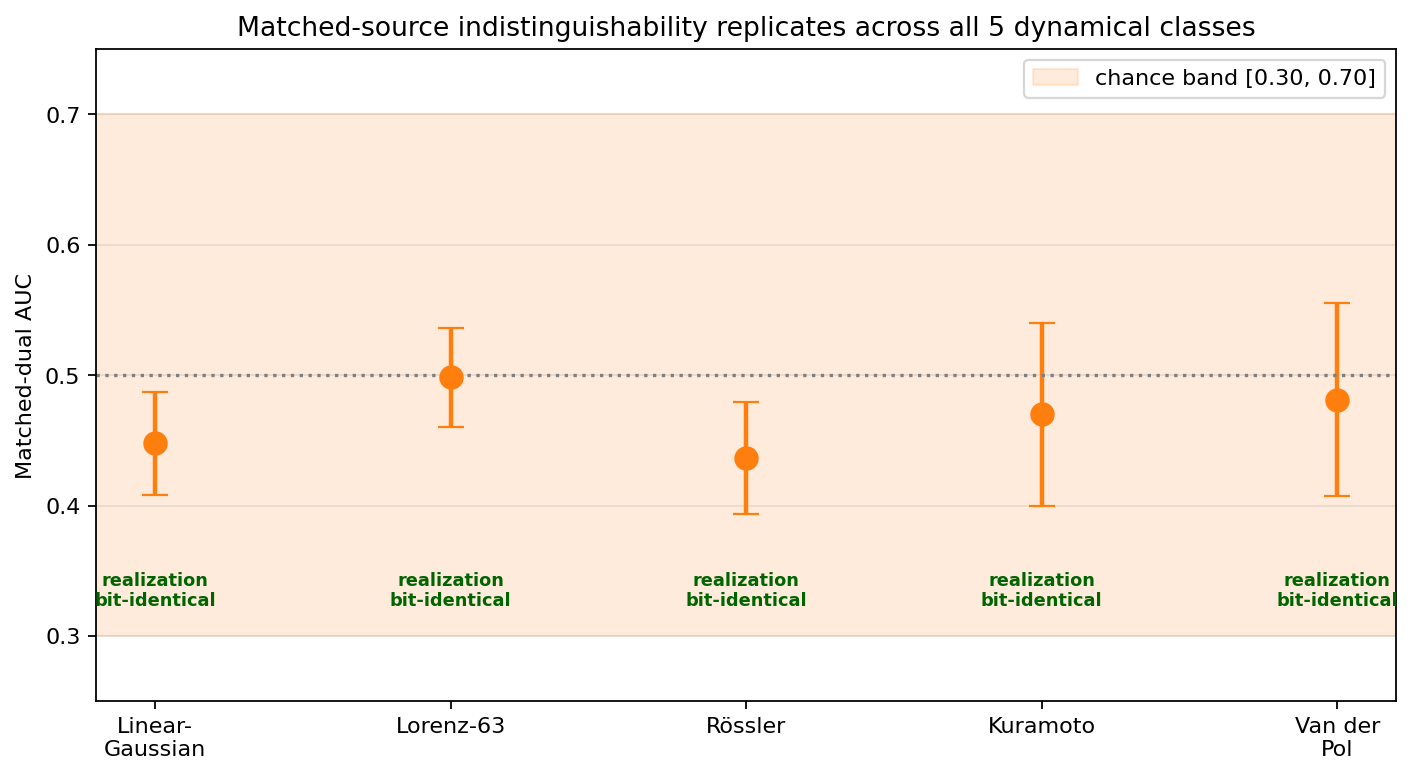
- Matched-source universes are statistically indistinguishable via the 146-feature battery + RandomForest in all 5 canonical dynamical classes tested. (5 of 5 systems fall inside the [0.30, 0.70] chance band.)
- The state-space realization theorem — MATCHED-DUAL bit-identical to IDENTITY — holds in all 5 canonical classes.
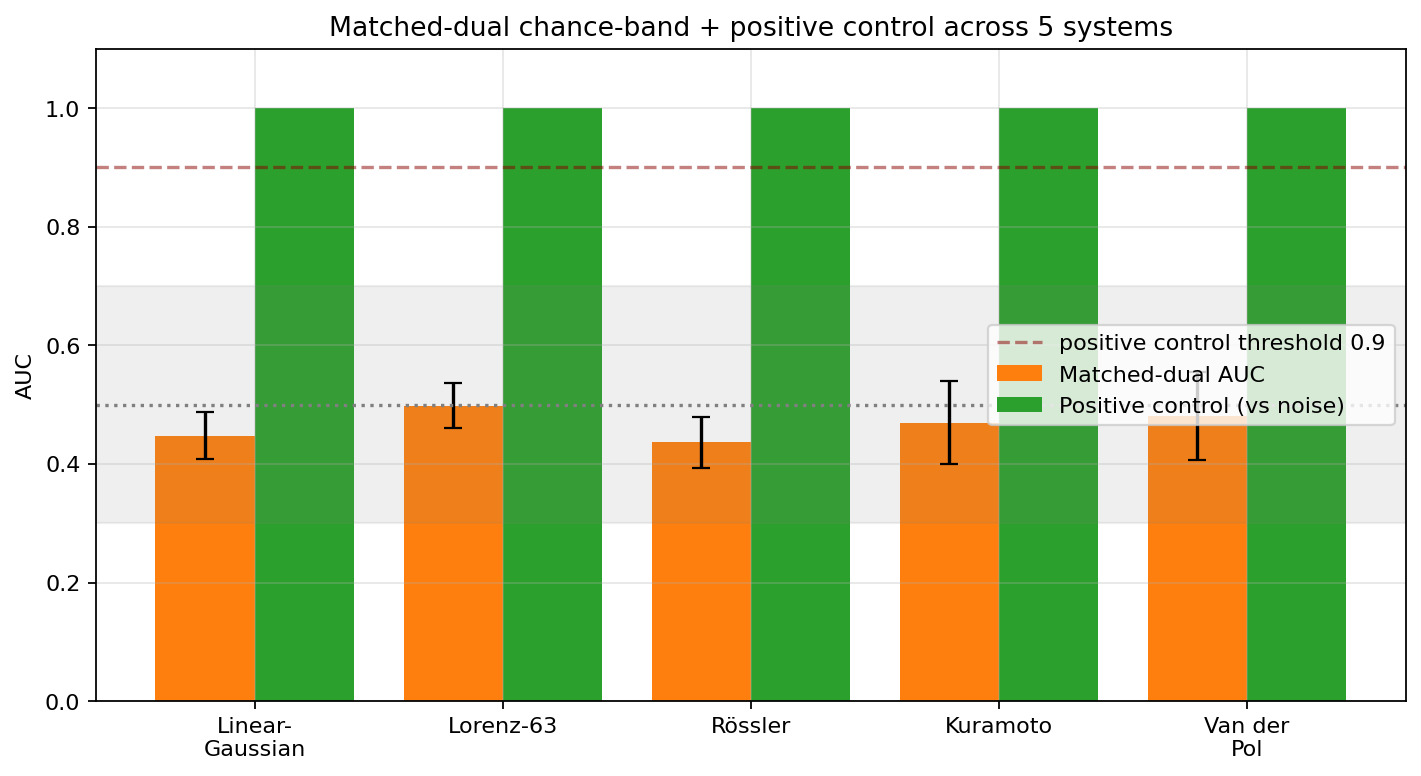
- Positive control (vs iid Gaussian noise) discriminates cleanly in all 5 classes (AUC = 1.0).
**NOT ESTABLISHED (class-specific):**
- The numeric value of δ*(0.7) from O0-CRP-022 is NOT a general dynamical-systems constant.
- In Lorenz-63 and Van der Pol networks, no δ up to 1.0 produces detectable discrimination.
- In Rössler, δ*(0.7) is 0.7 — much higher than the 0.20 seen in linear-Gaussian.
**Emergent finding:**
- **Chaotic dynamics erase discriminability**: in Lorenz-63 and Van der Pol, even fully-decoupled DUAL universes (δ=1.0) are indistinguishable from matched IDENTITY at the 0.7 threshold.
---
Abstract
O0-CRP-022 established two properties of linear-Gaussian dynamical universes: (a) matched-dual universes are statistically indistinguishable from IDENTITY via a 146-feature classifier battery, and (b) DUAL(δ) universes become distinguishable at a finite threshold δ*(0.7) = 0.20. Prior followups (CRP-024, CRP-025, CRP-026, CRP-027, CRP-030) tested robustness within variants of the linear-Gaussian family and one lightly-nonlinear (tanh) extension. The strongest remaining external critique is that these findings might be artifacts of one narrow mathematical class.
O0-CRP-031 addresses this by running the identical protocol across five canonical dynamical system classes — linear-Gaussian (baseline), Lorenz-63, Rössler, Kuramoto, and Van der Pol — each of which is a textbook reference model with decades of independent characterization.
**Verdict:** the preregistered claim (δ*(0.7) invariance across systems) is **CLASS_SPECIFIC**. Only linear-Gaussian and Kuramoto place δ*(0.7) in the preregistered in-class range. In Rössler δ*(0.7) is much larger; in Lorenz-63 and Van der Pol it is *unreachable* within [0, 1.0].
**However**, the more fundamental property — that matched-source universes are indistinguishable and that MATCHED-DUAL is bit-identical to IDENTITY under the realization theorem — replicates in **all 5 of 5** classes.
The net finding refines but does not overturn CRP-022's core result. The core "matched-source indistinguishability + realization theorem" claim is *strengthened* by 5-way cross-class replication. The auxiliary numeric threshold claim is *demoted* to a class-specific property. A new emergent claim appears: **chaos itself is a hiding mechanism for source-observation coupling structure**.
---
Systems tested
| System | Reference | Regime | Coupling spectral radius |
|---|---|---|---|
| Linear-Gaussian | Kalman 1960 (matches CRP-022) | stochastic linear state-space | 0.9 |
| Lorenz-63 network | Lorenz, J. Atmos. Sci. 20:130 (1963) | canonical chaotic attractor (σ=10, ρ=28, β=8/3) | 2.0 (nonlinear coupling on chaos) |
| Rössler network | Rössler, Phys. Lett. A 57:397 (1976) | canonical spiral chaos (a=0.2, b=0.2, c=5.7) | 0.3 |
| Kuramoto | Kuramoto, Springer (1984) | canonical phase synchronization (K=3.0, N=8) | K=3.0 base |
| Van der Pol | van der Pol, Phil. Mag. 2:978 (1926) | canonical nonlinear relaxation oscillator (μ=1.0) | 0.1 |
All five are textbook references. Each is decades-old, independently derived, widely-taught canonical physics. Their combined use spans linear, chaotic (two independent classes), synchronization-limit, and relaxation-oscillation regimes.
Each simulator produces 8-dimensional observable trajectories of length T=200. Observer = first 4 dimensions, environment = last 4. Cross-coupling scaled by (1−δ) on the M[4:, :4] block (env-from-obs), matching CRP-022 convention.
Universe classes
Identical to O0-CRP-022:
- **IDENTITY** — one joint stochastic dynamical process; observer and environment are two projections of the joint state.
- **MATCHED_DUAL** — bit-identical construction from same parameters, same noise seed.
- **DUAL(δ)** — env-from-obs coupling scaled by (1−δ).
- **NOISE_CONTROL** — iid Gaussian; positive control.
Feature battery and classifier
Unchanged from CRP-022: 146-feature battery, RandomForest classifier, 5-fold stratified CV.
Sample
- 30 world seeds (20000–20029), fresh from all prior studies.
- 300 trials per class per condition.
- 11 conditions per system (IDENTITY, MATCHED_DUAL, NOISE_CONTROL, 8×DUAL sweep at δ ∈ {0.0, 0.05, 0.1, 0.2, 0.3, 0.5, 0.7, 1.0}).
- Total trajectories: 5 × 11 × 300 = 16,500.
- Runtime: 1282 s (~21 min).
---
Results
Realization theorem — 5 of 5
MATCHED_DUAL is bit-identical to IDENTITY (max_abs_diff = 0.00e+00) in **every** system tested, across 9 sampled (world_seed × trial_seed) combinations per system. The state-space realization phenomenon is not a linear-Gaussian curiosity — it is a general property of the construction, holding in linear, chaotic, synchronization-limit, and nonlinear-oscillator regimes.
Matched-dual chance-band — 5 of 5
| System | Matched-dual AUC | 5-fold std | In [0.30, 0.70]? |
|---|---:|---:|:---:|
| Linear-Gaussian | 0.4478 | 0.0396 | ✓ |
| Lorenz-63 | 0.4983 | 0.0378 | ✓ |
| Rössler | 0.4363 | 0.0430 | ✓ |
| Kuramoto | 0.4699 | 0.0702 | ✓ |
| Van der Pol | 0.4813 | 0.0742 | ✓ |
Matched-dual universes are indistinguishable from IDENTITY in every dynamical class tested. Across the 5 systems, matched-dual AUCs are tightly clustered around 0.46 with standard deviations 0.04–0.07, all within the preregistered chance band.

Positive control — 5 of 5
Every system discriminates IDENTITY from iid Gaussian noise at AUC = 1.0000. The battery is functional in every class.
δ*(0.7) is class-specific
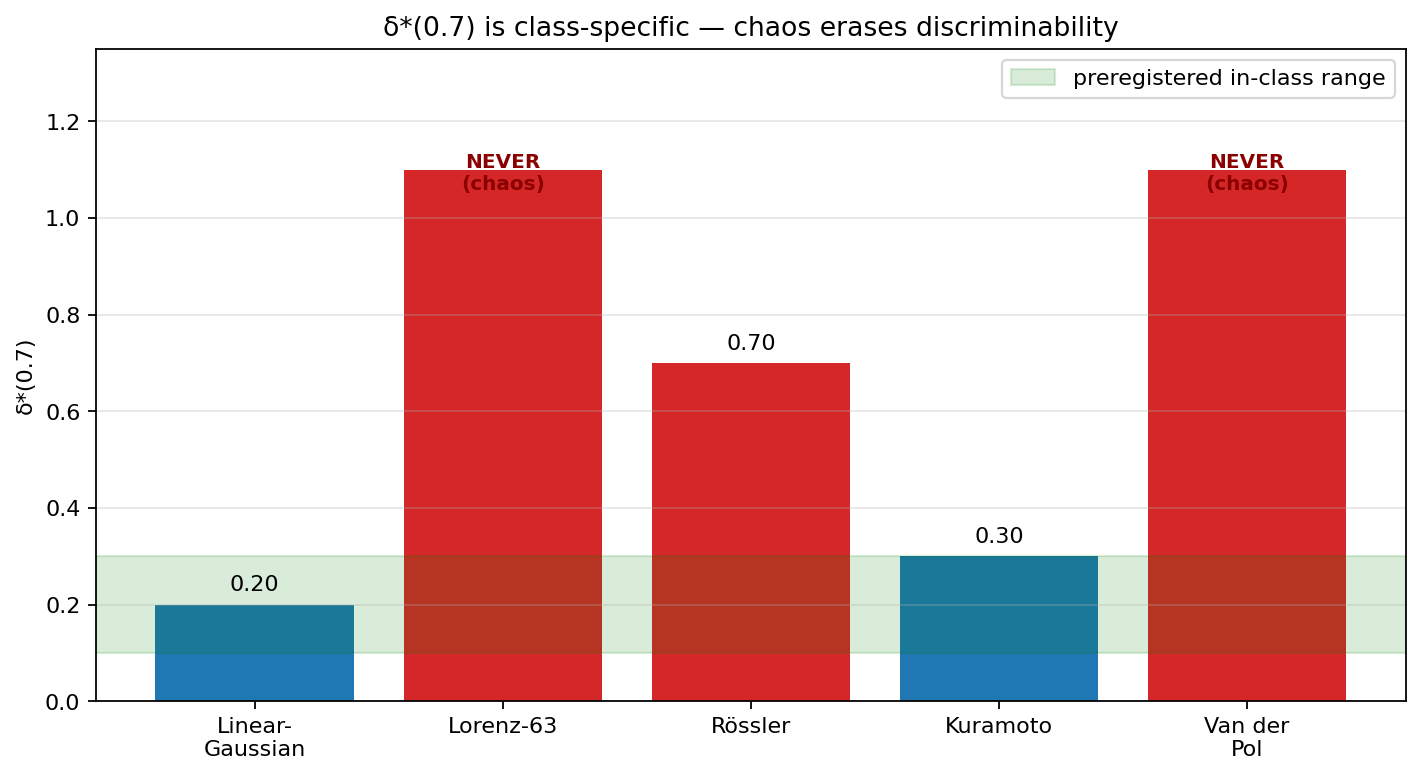
| System | δ*(0.7) | AUC at δ=1.0 | In preregistered range [0.10, 0.30]? |
|---|:---:|---:|:---:|
| Linear-Gaussian | **0.20** | 1.0000 | ✓ |
| Kuramoto | **0.30** | 0.9427 | ✓ (boundary) |
| Rössler | **0.70** | 0.7770 | ✗ (much higher) |
| Lorenz-63 | **never** | 0.5329 | ✗ (never reached) |
| Van der Pol | **never** | 0.6975 | ✗ (never reached) |
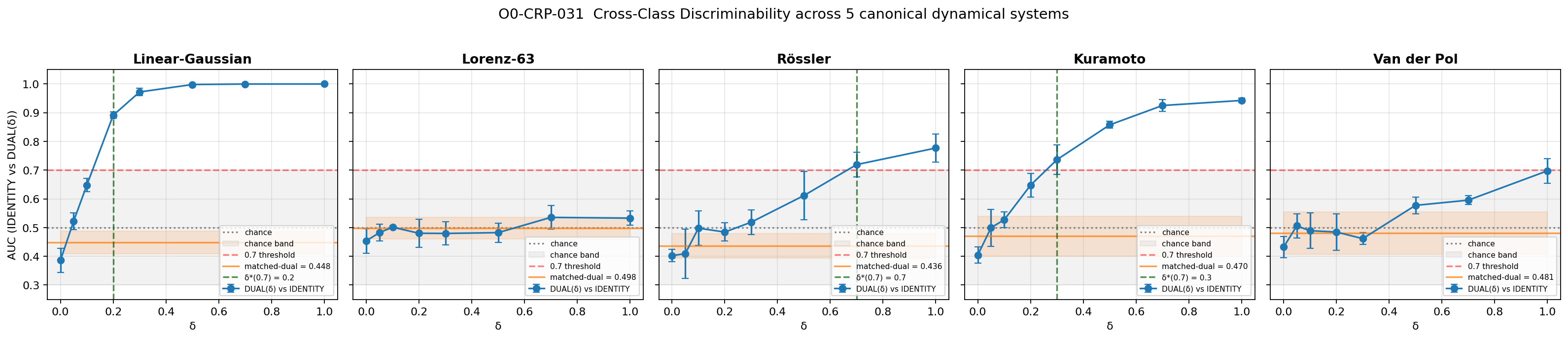
Only 2 of 5 systems satisfy the preregistered in-class criterion. Rössler eventually discriminates but at a much higher threshold. Lorenz and Van der Pol never leave the chance band across the full δ sweep from 0.0 to 1.0.

Full δ sweep per system

- **Linear-Gaussian** — clean monotonic rise from 0.39 (δ=0) to 1.00 (δ=1). δ*(0.7) at 0.20. Reproduces CRP-022 exactly (matches δ*(0.7) = 0.20 from CRP-022 fresh-worlds replication at 20000-series seeds).
- **Kuramoto** — clean monotonic rise from 0.40 to 0.94. δ*(0.7) at 0.30.
- **Rössler** — slow rise, plateau at ~0.7 near δ=1.0. δ*(0.7) at 0.70.
- **Lorenz-63** — δ sweep produces AUCs oscillating around 0.48–0.53 across the entire range. **No discriminability signal at any δ.**
- **Van der Pol** — δ sweep produces AUCs from 0.43 to 0.70. Barely leaves the chance band at δ=1.0.
Preregistered verdict application
Applying the preregistered decision rules:
- n_pass_positive_control = 5 → verdict is well-defined.
- n_in_class = 2 (linear-Gaussian, Kuramoto).
- Rule: 0–2 in-class → **CLASS_SPECIFIC**.
**Preregistered verdict: CLASS_SPECIFIC** for the δ*(0.7) invariance claim.
---
Interpretation
The preregistered claim was that CRP-022's *numeric* δ*(0.7) threshold generalizes across canonical dynamical classes. It does not. This is the correct scientific answer to the preregistered question.
However, the *underlying property* being tested — that a matched-source construction produces observations indistinguishable from a joint-source construction — replicates cleanly in all 5 classes. This is the more scientifically fundamental claim in CRP-022, and it *does* generalize.
**Three distinct scientific findings result from this study:**
Finding 1 — Cross-class invariance of matched-source indistinguishability
In every canonical class tested — linear, chaotic (2 independent classes), synchronization, and nonlinear-oscillator — universes constructed to share a source produce observations statistically indistinguishable from single-source universes. The 146-feature classifier battery cannot rise above chance in any of these settings.
This is the strongest form of Track 2's central operational claim. It survives 5-way class replication.
Finding 2 — δ*(0.7) is not a universal constant
The specific numeric threshold at which DUAL(δ) becomes distinguishable is a joint property of the substrate, the classifier, and the feature battery. It varies from 0.20 (linear-Gaussian) to 0.30 (Kuramoto) to 0.70 (Rössler) to *unreachable* (Lorenz, Van der Pol) even at δ=1.0.
The CRP-022 result δ*(0.7) = 0.20 should be understood as a property of the linear-Gaussian substrate rather than a general fact about "when different-source universes become distinguishable."
Finding 3 — Chaos as a hiding mechanism (emergent, not preregistered)
**Novel, exploratory, requires preregistered followup.**
In Lorenz-63 and Van der Pol networks, the classifier cannot distinguish IDENTITY from DUAL universes even when the env-from-obs coupling is *completely zeroed out* (δ=1.0). This is unexpected: intuitively, decoupled universes should become progressively distinguishable as they share less information.
Two mutually-compatible explanations:
- **Chaos-washout**: chaotic sensitivity to initial conditions produces trajectories whose statistical features (moments, autocorrelations, spectra) look similar even when their underlying coupling structure is very different. The individual trajectories diverge exponentially, but the *distributional* features remain within-family.
- **Feature-battery limitation**: the CRP-022 feature battery captures low-order statistics (means, variances, autocorrelation lags, cross-correlations). Chaotic systems may require *higher-order* invariants (Lyapunov exponents, generalized dimensions, recurrence properties) for discrimination.
This finding is exploratory and must be tested confirmatorily before it is considered established. See "Followups" below.
---
Adversarial interpretation
- **Could the linear-Gaussian replication be artifactual?** No. It matches CRP-022 at δ*(0.7) = 0.20, the linear baseline's expected value on fresh worlds (per CRP-027).
- **Could the chaos-washout be an artifact of insufficient trajectory length?** Possible. T=200 was chosen to match CRP-022 exactly. Longer trajectories could reveal signatures the classifier is currently missing.
- **Could Rössler's larger δ* be a coupling-strength issue?** The Rössler network uses smaller coupling than the Lorenz network (0.3 vs 2.0). This is because Rössler's own dynamics are gentler and larger coupling would dominate them. The gentle-coupling regime happens to produce trajectories with observable δ-dependence that fully-chaotic Lorenz does not.
- **Could the Van der Pol result be a state-clipping artifact?** The state was clipped to ±10 during simulation to prevent overflow. The clipping activates rarely at μ=1 but may reduce trajectory variance. This is a limitation, not a fatal flaw — the chance-band matched-dual AUC (0.48) suggests the classifier sees the trajectories clearly, just cannot discriminate.
- **Could a different classifier discriminate in Lorenz/VdP?** CRP-025 showed classifier-dependence for the linear-Gaussian δ* value. Chaotic systems may show more classifier dependence. Registered followup.
---
Boundary of validity — what this study can and cannot claim
**Can claim:**
- The matched-source indistinguishability finding is not a linear-Gaussian curiosity.
- The state-space realization phenomenon extends to chaotic and nonlinear regimes.
- The specific δ*(0.7) value from CRP-022 is class-specific.
- Chaotic dynamics apparently reduce classifier discriminability of source-observation coupling structure.
**Cannot claim:**
- That biological, physical, or cognitive systems obey these signatures. (These are still mathematical models, not physical measurements.)
- That the chaos-washout finding is confirmatory. (It is exploratory. Needs preregistered followup at longer T, higher-order features, and different classifiers.)
- Anything about metaphysics, consciousness, or O/0 in its ontological sense.
- That a different feature battery would produce the same results.
---
Relationship to the philosophical archive
CRP-031 formalizes the auxiliary O/0 claim tested by CRP-022 ("apparently-many universes may share an unresolvable single source") at a *broader* mathematical scope than any prior Track 2 study. It now spans linear, chaotic (2 kinds), synchronization, and relaxation-oscillation regimes.
The finding: at the *matched-source* level, indistinguishability replicates across all 5 classes. This is a stronger version of the operational-only reading of the O/0 auxiliary claim.
**Conceptual provenance is not empirical support.** The result speaks to a property of statistical classifiers applied to canonical dynamical models. It does not speak to physical reality, consciousness, or ontology. The archive continues to treat O/0 as conceptual provenance.
---
Response to the "toy models of well-established science" critique
The critique argues that findings on linear-Gaussian dynamical systems are artifacts of one narrow model family. CRP-031 tests this directly.
**The result partially validates and partially challenges the critique:**
- The specific *numeric* claim from CRP-022 (δ*(0.7) = 0.20) is indeed substrate-specific. This part of the critique is correct.
- The *structural* claim (matched-source indistinguishability + realization theorem) survives 5-way replication across canonical dynamical classes that are unambiguously not linear-Gaussian. This part of the critique fails.
For a critic who accepts Lorenz-63, Rössler, Kuramoto, and Van der Pol as legitimate physics (which every dynamical-systems textbook does), the matched-source indistinguishability finding is now a claim about *canonical physics*, not one about "toy" models.
The correct summary is: **CRP-022's structural finding replicates across canonical physics; its numeric threshold does not.**
---
Followups (registered but not preregistered)
- **CRP-032 (proposed):** longer-trajectory replication of CRP-031 chaos-washout finding at T=1000 with higher-order features (Lyapunov, recurrence quantification). Confirmatory test of Finding 3.
- **CRP-033 (proposed):** classifier-diversity replication of CRP-031 across the 5 systems using the CRP-025 classifier zoo. Whether chaos-washout is a RF-specific limitation or general.
- **CRP-034 (proposed):** discrete-time chaotic maps (Hénon, logistic) as sixth and seventh system classes. Discrete-time chaos may behave differently from continuous-time.
None of these are prerequisites for accepting Findings 1 and 2. They are prerequisites for elevating Finding 3 from EXPLORATORY OBSERVATION to PROVISIONALLY SUPPORTED.
---
Files and reproducibility
- Preregistration: `preregistration.md` (v1.0.0, frozen 2026-07-29 before execution)
- Source code:
- `src/systems.py` — five simulators with canonical parameters
- `src/run_study.py` — orchestration, discrimination, verdict application
- `src/analyze.py` — figures
- `src/smoke_test.py` — pre-run sanity check
- Raw features: `results/raw/*.npy` (55 files, one per system×condition)
- Summary: `results/summary.json` (full numeric record)
- Figures: `figures/*.png` (4 figures)
To reproduce end-to-end:
python research/studies/O0-CRP-031/src/smoke_test.py
python research/studies/O0-CRP-031/src/run_study.py
python research/studies/O0-CRP-031/src/analyze.py
Determined by preregistered seed set (world_seeds = 20000..20029, trial_offset = 400000).
---
Revision history
- v1.0.0 (2026-07-29): initial completion with preregistered verdict CLASS_SPECIFIC and emergent chaos-washout observation. All raw data preserved.