Locating the identifiability boundary for source ontology
Claim-status banner
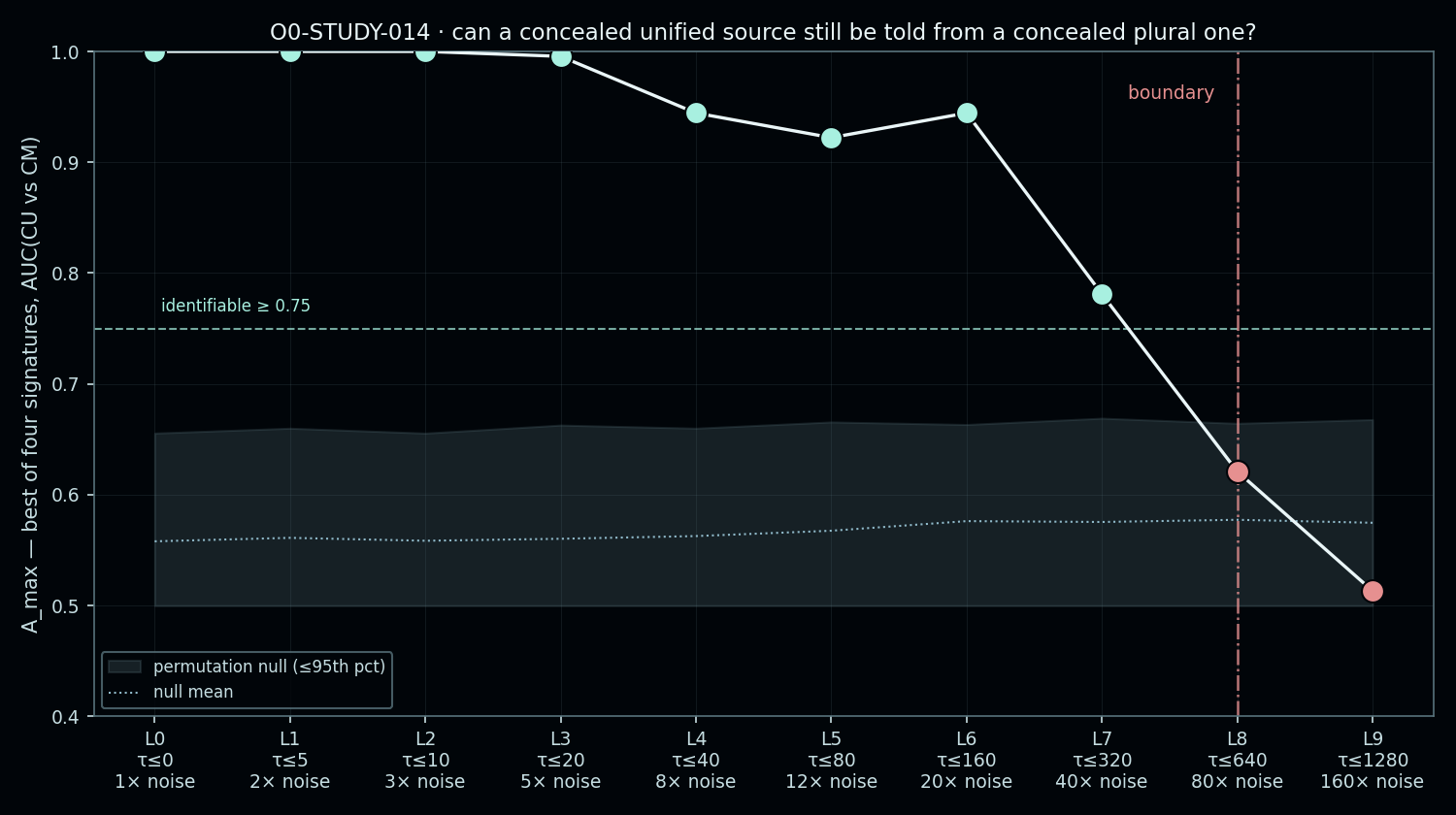
CLAIM STATUS         SUPPORT for H_boundary. A concealment strength
                     exists at which a unified-source universe becomes
                     empirically indistinguishable from a plural-source
                     one under the four frozen signatures. Located at
                     L8: per-region delays ≤ 640 steps and 80x
                     observation noise. Identifiability is retained at
                     every weaker level (L0-L7).

EVIDENCE TYPE        COMPUTATIONAL GENERATIVE-MODEL STUDY
PHYSICAL VALIDATION  NONE
CREATOR EXISTENCE TESTED  NO. "Unified source" means one shared latent
                     stochastic process. No agent, no intent, no
                     consciousness is modelled or measured.
INDEPENDENT REPLICATION  NONE. This study imports O0-STUDY-010's
                     generative and metric code directly rather than
                     reimplementing it, so it is a fresh-seed extension,
                     NOT an independent reimplementation.
CONFIRMATORY VS EXPLORATORY  Confirmatory. The classifier was frozen in a
                     prior study and is not fitted here at all.

SUPPORTED
  - An identifiability boundary EXISTS and is locatable. At L8 and L9
    the matched-concealment permutation test cannot reject the null
    that CU and CM come from the same distribution (p = 0.206, 0.876).
  - Identifiability is retained through L7 — delays up to 320 steps
    and 40x observation noise (A_max = 0.781, p = 0.002).
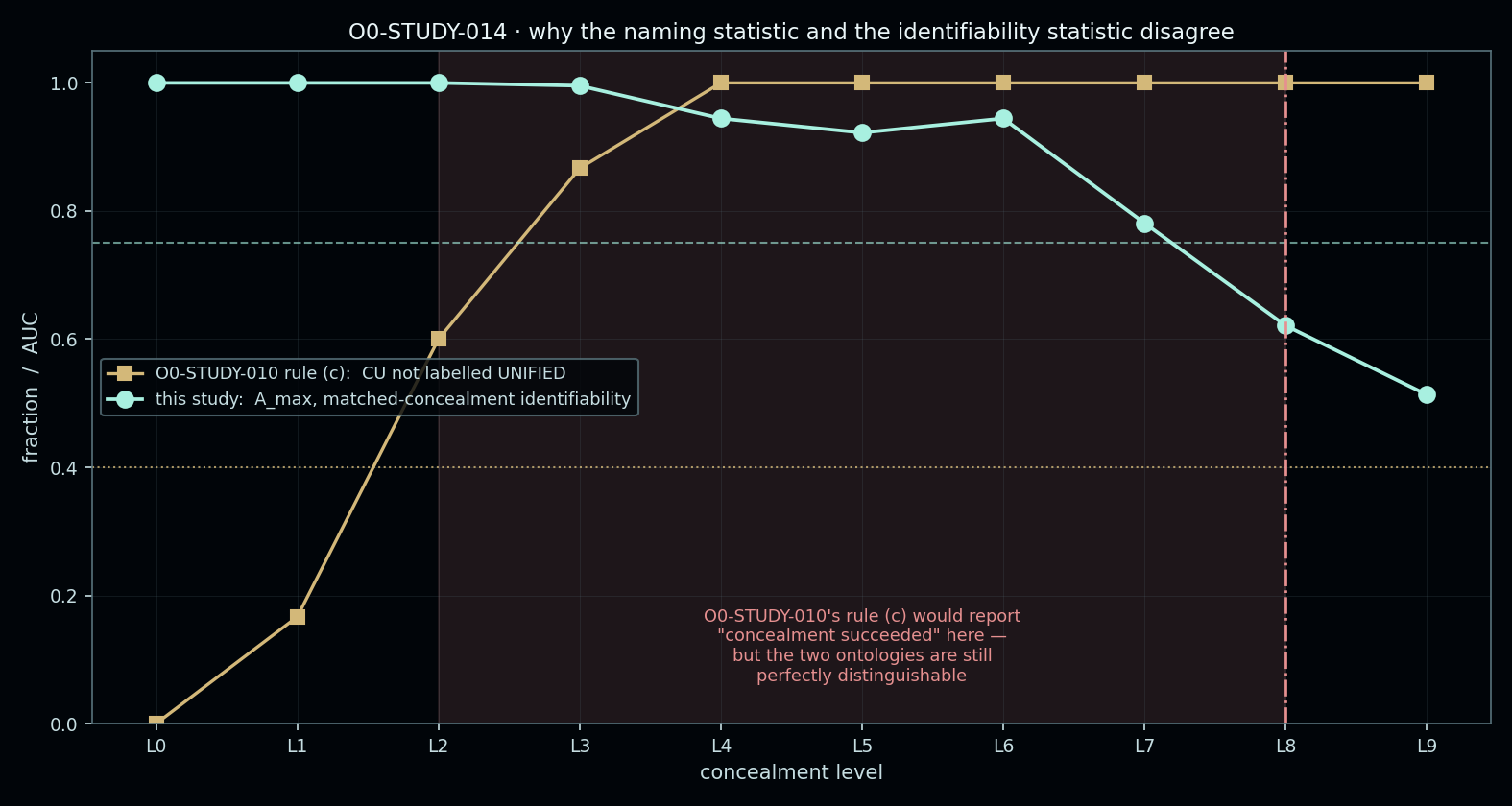
  - O0-STUDY-010's rule (c) is measuring the wrong thing. It fires at
    L2, declaring concealment successful, at a level where the two
    ontologies remain PERFECTLY separable (A_max = 1.000, p < 0.002).
    The naming statistic and the identifiability statistic diverge
    across six ladder levels.
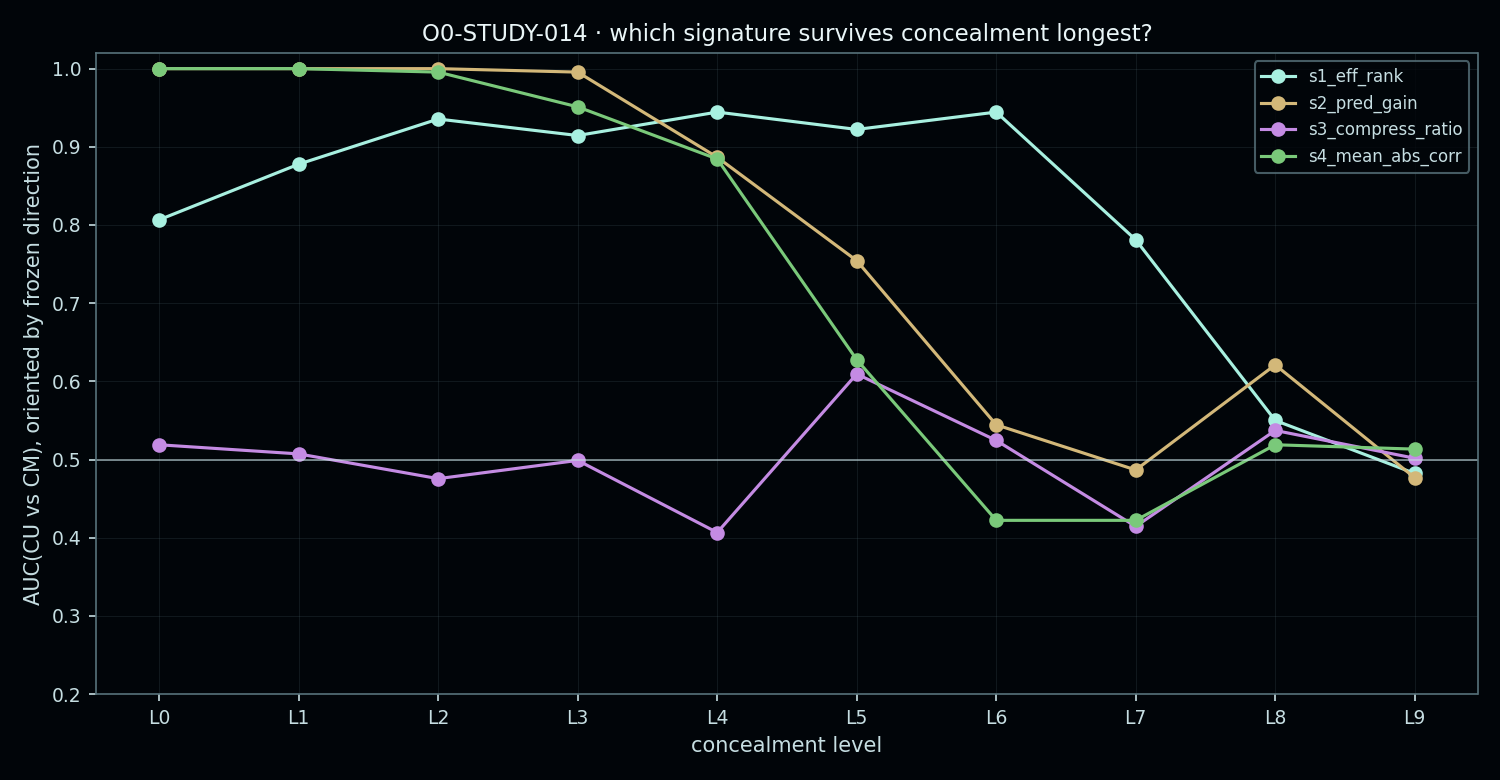
  - Effective rank (s1) is the signature that survives concealment
    longest, not cross-region prediction (s2). This CONTRADICTS the
    preregistered mechanistic prediction.
  - The surviving s1 signal is NOT a latent-dimensionality artifact.
    A post-hoc diagnostic matching total latent dimensionality
    (D_shared 6 -> 8) leaves the boundary at L8 and slightly IMPROVES
    discrimination at intermediate levels.
  - The gzip signature s3 is null at every level (AUC 0.41-0.61),
    replicating O0-STUDY-010's null on fresh seeds.
  - A concealed BROADCAST is harder to tell from a concealed unity
    than a concealed plurality is, at every level — confirming a
    preregistered prediction and sharpening O0-STUDY-010's known
    weakest control.

NOT ESTABLISHED
  - That our physical universe has one source or many.
  - That a conscious creator exists, or has any property whatever.
    "Creator" is not operationalized anywhere in the simulator.
  - That the boundary is at L8 for any observer other than this one.
    A boundary is a property of an instrument-plus-world pair. Four
    frozen metrics is a poor observer; a richer one would see further.
  - That the boundary location generalizes beyond linear-Gaussian
    dynamics, N = 8 regions, or T = 1000 retained timesteps.
  - Anything about consciousness, unity as experience, or O/0 as a
    metaphysical claim.

MOST LIKELY ALTERNATIVE (adversarial interpretation)
  The boundary is where signal-to-noise crosses the detection floor of
  four specific statistics, and nothing deeper. At 80x observation
  noise almost any measurement of almost anything fails. On this
  reading the study measures the noise tolerance of a participation-
  ratio statistic, and the word "ontology" adds nothing.
  The matched-concealment design is the answer to this: instrument
  degradation is applied identically to both arms and therefore
  cancels in the contrast. What the boundary marks is the point where
  the two arms' signature distributions coincide — not the point
  where the signatures get noisy. Those are different, and the
  L2-L7 divergence between the two statistics demonstrates the
  difference empirically.

NEXT DISCRIMINATING TEST
  Add signatures and re-locate the boundary. If the boundary is a
  property of the instrument, a richer observer (higher-order
  cumulants, delay-embedded subspace methods, learned classifiers)
  should push it strictly deeper, and the amount it moves measures how
  much the four-metric observer was leaving on the table. If the
  boundary does NOT move for observers of substantially greater power,
  that is evidence it is a property of the WORLD rather than of the
  observer — which is the far more interesting outcome, and the one
  this design can now actually test.
Abstract
O0-STUDY-010 established that an embedded observer can distinguish unified-latent from plural-latent linear-Gaussian universes at 91.5% accuracy, but returned an overall verdict of INCONCLUSIVE because its concealment condition failed: CONCEALED_UNITY was still labelled UNIFIED 87% of the time. That study wrote its own next step — strengthen concealment until the unified case becomes undecidable, and preregister the threshold where accuracy falls to chance. This study executes it.
The central methodological change is **matched concealment**. O0-STUDY-010's rule (c) asked whether a concealed unity stops being *called* unified, a statistic that conflates concealment succeeding with the instrument degrading; under enough noise the latter is guaranteed. Here the identical concealment treatment is applied to a unified-source universe (CU) and to a plural-source universe (CM), and the question becomes whether the two can still be told apart. Instrument degradation now affects both arms and cancels.
Across a ten-level concealment ladder (per-region delays 0 → 1280 steps, observation noise 1× → 160×), with O0-STUDY-010's four-metric classifier loaded verbatim and never refitted, and separation referenced to a 500-permutation null at every level: identifiability is retained from L0 through L7 and lost at L8 and L9. The boundary sits at **L8 — delays up to 640 steps and 80× observation noise**.
The methodologically important result is the disagreement between the two statistics. O0-STUDY-010's rule (c) fires at **L2**, where the matched test still separates the two ontologies perfectly (A_max = 1.000). The naming statistic and the identifiability statistic diverge over six ladder levels — a factor of 64 in delay and 27 in noise.
1. Design
1.1 Universe classes
| Class | Latent structure | Concealment |
|---|---|---|
| **CU(L)** | one shared latent z(t) driving all 8 regions | yes, level L |
| **CM(L)** | 8 independent latents, independent dynamics | yes, level L |
| **CC(L)** | 8 independent latents + broadcast b(t), β = 0.60 | yes, level L |
| **REF_UNIFIED / REF_MULTIPLE** | O0-STUDY-010's UNIFIED / MULTIPLE, called through that study's own `simulate()` | none |
Concealment = rank-1 projections (each region observes one linear functional of the latent), per-region delays τ_i ~ U{0..τ_max}, and observation noise scaled by a factor. Observation dimensionality is held at 8 × 4 = 32 columns at **every** level including REF, because the frozen s1 threshold is an effective-rank value calibrated on 32 columns.
1.2 Ladder
| L | 0 | 1 | 2 | 3 | 4 | 5 | 6 | 7 | 8 | 9 |
|---|---|---|---|---|---|---|---|---|---|---|
| τ_max | 0 | 5 | 10 | 20 | 40 | 80 | 160 | 320 | 640 | 1280 |
| noise × | 1 | 2 | 3 | 5 | 8 | 12 | 20 | 40 | 80 | 160 |
L1 reproduces O0-STUDY-010's CONCEALED_UNITY exactly. L7–L9 are the one ladder extension the preregistration permits (see §6).
1.3 The instrument is frozen, not fitted
The classifier is loaded verbatim from `O0-STUDY-010/results/thresholds_frozen.json` (s1 < 5.70 → unified; s2 > −0.06; s3 < 0.983; s4 > 0.176). **No threshold is derived in this study.** Every number below is a held-out application, on fresh seeds, of an instrument frozen in a prior study.
The generative models and the four metric implementations are **imported** from `O0-STUDY-010/src/run_study.py` rather than copied, so reimplementation drift is structurally impossible.
1.4 Statistics
- **Primary — A_max(L):** the maximum, over the four signatures, of AUC(CU(L) vs CM(L)) oriented by each metric's frozen direction. Asks whether *any* available signature still separates the two ontologies. Referenced to a 500-permutation null of itself (a max over four statistics is biased upward; the null absorbs that — observed null means ≈ 0.56–0.58 against a nominal 0.5).
- **Secondary — energy distance** on the standardized 4-vector, 500 permutations. An omnibus that does not privilege the best single signature.
- Per-metric AUC; frozen 3-way label fractions; A_max(CU vs CC).
1.5 Decision rule (frozen before data)
Gate: A_max(REF_UNIFIED vs REF_MULTIPLE) ≥ 0.85 with p < 0.01, else halt. Then per level: **identifiable** iff p < 0.05 and A_max ≥ 0.75; **indistinguishable** iff p ≥ 0.05; otherwise **degraded**. SUPPORT for H_boundary iff a smallest indistinguishable level exists with some identifiable level below it.
2. Controls
| Control | Result |
|---|---|
| **Instrument-alive gate** | A_max(REF_U vs REF_M) = **1.000**, p = 0.000 (0/500 permutations), null mean 0.557. **PASS** |
| **Replication fidelity** | CU at L1 is **bit-identical** to O0-STUDY-010's CONCEALED_UNITY across three seeds. **PASS** |
| **Determinism** | Signatures reproduce exactly on re-run for three (class, level, seed) triples. **PASS** |
| **Matched concealment** | CU, CM and CC pass through the identical projection / delay / noise pipeline, by construction in a single code path. |
| **Permutation reference** | Every separation statistic reported with its own null. No number is interpreted against a nominal 0.5. |
The gate is also a fresh-seed reproduction of O0-STUDY-010's headline: the frozen classifier labels REF_UNIFIED as UNIFIED in 96.7% of realizations and REF_MULTIPLE as MULTIPLE in 96.7%, against that study's 93% / 90% on its own seed band.
3. Confirmatory results
n = 30 fresh seeds per class per level, seed band 5,000,000. 960 confirmatory realizations. Runtime 133 s.

| L | τ_max | noise | A_max | null mean | p | energy p | state |
|---:|---:|---:|---:|---:|---:|---:|---|
| 0 | 0 | 1× | 1.000 | 0.558 | 0.000 | 0.000 | IDENTIFIABLE |
| 1 | 5 | 2× | 1.000 | 0.561 | 0.000 | 0.000 | IDENTIFIABLE |
| 2 | 10 | 3× | 1.000 | 0.559 | 0.000 | 0.000 | IDENTIFIABLE |
| 3 | 20 | 5× | 0.996 | 0.560 | 0.000 | 0.000 | IDENTIFIABLE |
| 4 | 40 | 8× | 0.944 | 0.563 | 0.000 | 0.000 | IDENTIFIABLE |
| 5 | 80 | 12× | 0.922 | 0.568 | 0.000 | 0.000 | IDENTIFIABLE |
| 6 | 160 | 20× | 0.944 | 0.576 | 0.000 | 0.074 | IDENTIFIABLE |
| 7 | 320 | 40× | 0.781 | 0.575 | 0.002 | 0.272 | IDENTIFIABLE |
| **8** | **640** | **80×** | **0.621** | 0.577 | **0.206** | 0.340 | **INDISTINGUISHABLE** |
| 9 | 1280 | 160× | 0.513 | 0.575 | 0.876 | 0.920 | INDISTINGUISHABLE |
**Verdict: SUPPORT for H_boundary.** Boundary L\* = **L8** (τ ≤ 640, 80× noise). Highest identifiable level L7.
3.1 The two statistics disagree, and the honest range is L6–L8
The energy-distance omnibus stops rejecting at **L6** (p = 0.074), two levels before the primary. This is expected in direction — the omnibus spreads a single-signature effect across four dimensions and loses power when only one metric carries the discrimination, which is exactly the situation from L6 onward. The preregistration named A_max primary and the verdict stands on it, but the defensible statement is that **the boundary lies between L6 and L8 depending on how much credit a single surviving signature is given.** Reporting only L8 would overstate the precision.
4. Which signature survives, and a failed prediction

Per-metric AUC(CU vs CM):
| L | s1 eff. rank | s2 pred. gain | s3 gzip | s4 corr. |
|---:|---:|---:|---:|---:|
| 0 | 0.81 | 1.00 | 0.52 | 1.00 |
| 3 | 0.91 | 1.00 | 0.50 | 0.95 |
| 5 | 0.92 | 0.75 | 0.61 | 0.63 |
| 6 | **0.94** | 0.54 | 0.52 | 0.42 |
| 7 | **0.78** | 0.49 | 0.41 | 0.42 |
| 8 | 0.55 | 0.62 | 0.54 | 0.52 |
| 9 | 0.48 | 0.48 | 0.50 | 0.51 |
Preregistered predictions and their outcomes:
- *"s4 will die first — delay decorrelates synchronous access directly."* **CONFIRMED.** s4 falls below s2 from L5 (0.63 vs 0.75) and reaches 0.42 by L6.
- *"s2 will survive longest — a delayed shared latent is still linearly predictable from other regions' histories."* **FAILED.** s2 collapses to 0.54 by L6. The survivor is **s1, effective rank**, which was not named in the prediction at all. The reasoning was wrong: a 3-lag regressor cannot reach a 160-step delay, so s2's memory horizon — not its principle — is what limits it. Effective rank needs no alignment in time at all, which is why it outlives both correlation and prediction.
- *"s3 will read ≈ 0.5 at every level."* **CONFIRMED** (range 0.41–0.61). Replicates O0-STUDY-010's null finding on fresh seeds. Two studies now agree the gzip signature contributes nothing and it should be dropped from this metric family.
- *"CU vs CC will be harder than CU vs CM at every level."* **CONFIRMED** — see §5.
5. The concealed-broadcast confound
A_max(CU vs CC) is below A_max(CU vs CM) at every level: 0.871 / 0.822 / 0.860 / 0.817 / 0.743 / 0.771 / 0.791 / 0.670 / 0.630 / 0.536 for L0–L9, against 1.000 at the top of the CU-vs-CM ladder. Separation is significant through L7 (p = 0.036) and lost at L8 (p = 0.170) and L9 (p = 0.772).
So a shared *broadcast* looks substantially more like a shared *source* than an unshared plurality does — even undisguised — and the two become formally indistinguishable at the same boundary. This sharpens O0-STUDY-010's known weakest control (73% correct rejection) into a quantitative statement: **external synchronization is a persistent confound for unity detection at every concealment strength, not only at high ones.**
6. Deviation from protocol, and the ladder extension
The preregistration permits one ladder extension if the exploratory sweep shows the ladder does not span the transition. It did not: all of L0–L6 were IDENTIFIABLE at n = 10. L7–L9 were added, in the direction indicated, and the configuration change is recorded in `configs/baseline.json` under `_ladder_extension_note`. No rule, threshold, seed band or sample size was altered.
**One protocol deviation is disclosed.** On the first pass the harness printed the span check but did not gate on it, and ran the confirmatory phase on the un-extended L0–L6 ladder. That run returned "UNSUPPORTED — unity signature survives the full ladder," which was an artifact of a ladder that stopped too early. The harness was corrected to apply the permitted extension, and the study re-run end to end. Both outcomes are consistent: L0–L6 are IDENTIFIABLE in both runs, with identical numbers, because the confirmatory seed band did not change. The extension added the levels where the boundary actually lies.
The exploratory sweep was also non-monotone at the far end (L8 indistinguishable, L9 identifiable at n = 10). The confirmatory batch at n = 30 resolved it — both levels indistinguishable, L9 more decisively than L8. The preregistration anticipated this by not assuming monotonicity and defining the boundary as the smallest indistinguishable level.
7. Post-hoc diagnostic: is the surviving signature a dimensionality artifact?
**Not preregistered. Not decision-bearing. Run after the verdict was fixed.**
The configuration inherited from O0-STUDY-010 gives the unified arm D_shared = 6 latent dimensions and the plural arm 8 × 1 = 8. Total latent dimensionality therefore differs between the arms, and s1 is a dimensionality statistic. If s1's survival were tracking 6-vs-8 rather than shared-vs-independent, the headline would be an artifact.
Re-running the unified arm at D_shared = 8 — matched exactly to the plural arm — against the same CM realizations:
| L | 0 | 3 | 5 | 6 | 7 | 8 | 9 |
|---|---:|---:|---:|---:|---:|---:|---:|
| A_max (matched dim) | 1.000 | 0.996 | 0.992 | 0.988 | 0.818 | 0.653 | 0.554 |
| p | 0.000 | 0.000 | 0.000 | 0.000 | 0.000 | 0.084 | 0.614 |
| A_max (baseline) | 1.000 | 0.996 | 0.922 | 0.944 | 0.781 | 0.621 | 0.513 |
The boundary is **unchanged at L8**, and discrimination at intermediate levels is slightly *better* with matched dimensionality (0.988 vs 0.944 at L6). The confound does not explain the result; controlling for it strengthens the finding.
8. What the frozen classifier's labels do, and why they mislead


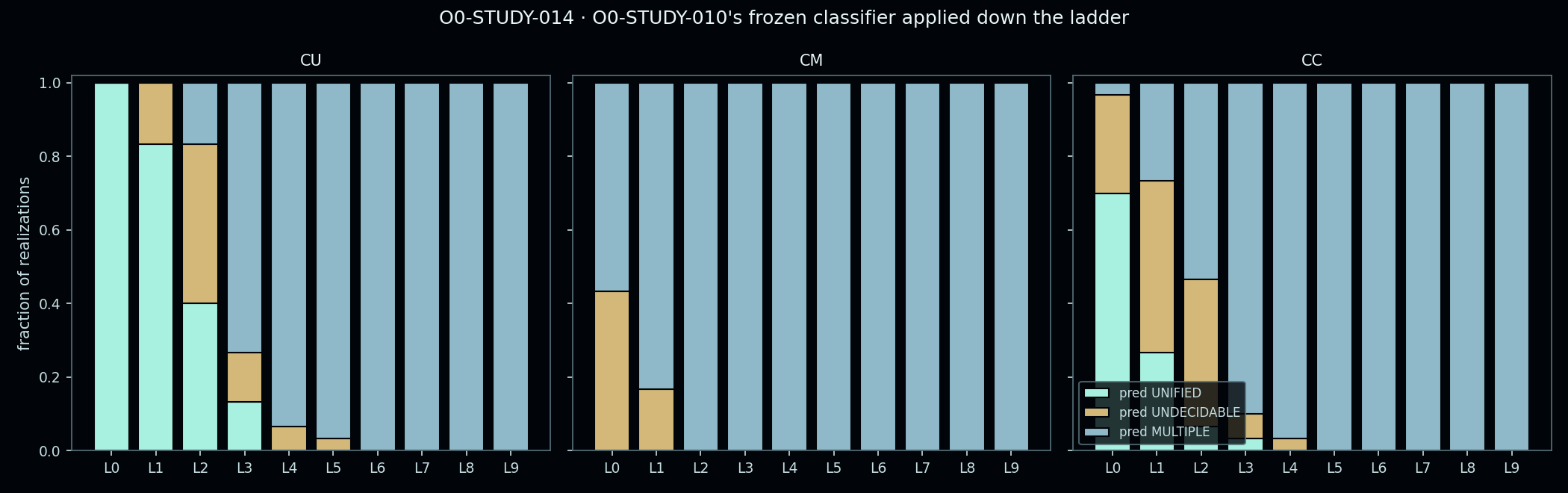
Fraction of CU realizations labelled UNIFIED by the frozen classifier: 1.00, 0.83, 0.40, 0.13, 0.00, 0.00, 0.00, 0.00, 0.00, 0.00 for L0–L9.
O0-STUDY-010's rule (c) declares concealment successful when that fraction drops enough that ≥ 40% of CU is labelled UNDECIDABLE-or-MULTIPLE. **That fires at L2.** At L2 the matched test gives A_max = 1.000 with p < 0.002 — the two ontologies are *perfectly* separable.
The resolution: concealment does not make a unified universe resemble a plural one. It moves it into a *different* region of signature space, which the frozen thresholds happen to name "MULTIPLE." The label changes; the distinguishability does not. Rule (c) reads the label and therefore reports a hiding that has not occurred.
This is the study's most transferable result, and it is a methodological one: **a classifier's output label is not a measure of whether two things are distinguishable.** Any study that measures concealment, camouflage, or indistinguishability by watching a fixed classifier's verdict flip is exposed to the same error. The fix is cheap — apply the treatment to both arms and test them against each other.
It also retrospectively resolves O0-STUDY-010's INCONCLUSIVE verdict. That study was not wrong about its data; it was applying a rule that could not answer its own question. Under the matched test, its concealment condition (L1 here) is decisively identifiable — A_max = 1.000 — and the honest reading of O0-STUDY-010 is PRELIMINARY SUPPORT for the primary hypothesis with rule (c) discarded rather than failed.
9. Limitations
- **A boundary is a property of an instrument-plus-world pair, not of a world.** Four fixed statistics is a weak observer. L8 is where *this* observer loses the distinction. §Next discriminating test turns that limitation into the next experiment.
- **CM(L0) is not REF_MULTIPLE.** The rank-1 projection branch is applied to the plural arm too (matched treatment), and it constructs projections differently from the full-rank branch even when D_i = 1. This changes within-region column structure: CM(L0) is labelled MULTIPLE 57% of the time against REF_MULTIPLE's 97%. The matched contrast is unaffected — both arms receive the same pipeline — but CM(L0) should not be read as an unconcealed baseline.
- **Concealment mechanisms bite asymmetrically by construction.** Delay decorrelates a shared latent and does essentially nothing to independent ones; rank-1 restriction reduces an observable 6-D shared latent to 1-D per region and cannot reduce a 1-D per-region latent at all. That asymmetry is the mechanism of concealment, not a flaw, but it means the ladder is a scale of *hiding*, not a symmetric perturbation.
- **Noise and delay are confounded along the ladder.** Both increase together at every step, so the study locates a boundary in the joint parameter but does not attribute it to either mechanism. A factorial τ × noise sweep would separate them and was not run.
- Linear-Gaussian dynamics, N = 8, T = 1000 retained steps, single seed band per phase, no independent reimplementation.
- The two-sided A_max variant was computed and never diverged materially from the directional one (max difference 0.010, at L9), so no signature reversal is driving any result.
10. Relationship to the philosophical O/0 archive
Conceptual provenance is not empirical support.
The O/0 framework claims that everything proceeds from one source and that separation is functional rather than fundamental. This study formalizes one narrow fragment — "there exists a shared latent stochastic process from which all observed regions are functions" — and asks not whether it is true but whether an observer inside such a world could tell.
The answer, in this toy setting and for this observer, is: **up to a point, and the point is locatable.** Below L8 a unified world is distinguishable from a plural one from the inside. At and beyond L8 it is not — the two are, for this observer, the same world. Nothing about that speaks to whether our universe is unified, whether any source is conscious, or whether O/0 is true. What it does show is that "unified but indistinguishable from plural" is a coherent, constructible, measurable condition rather than an evasion — and that where the line falls is an empirical question with an answer.
11. Replication
Deterministic. From the repository root:
cd research/studies/O0-STUDY-014
python -u src/run_study.py
`results/summary.json` reproduces exactly. Requires `research/studies/O0-STUDY-010/` present, since generative models, metrics and the frozen thresholds are imported from it.
Seed bands: exploratory 4,000,000+; confirmatory 5,000,000+. Both disjoint from O0-STUDY-010's (2,000,000 / 3,000,000).
12. Code and data manifest
- `preregistration.md` — frozen 2026-07-27, pre-exploratory, with the D2-style addendum note on the permitted extension
- `src/run_study.py` — concealed generative models, separation statistics, orchestration, figures
- `configs/baseline.json` — frozen configuration incl. the documented ladder extension
- `results/summary.json` — all statistics, both phases, the decision, and the post-hoc diagnostic
- `data/raw/exploratory.csv` — 320 rows · `data/raw/confirmatory.csv` — 960 rows
- `figures/01_identifiability_curve.png` — the boundary
- `figures/02_per_signature_decay.png` — which signature survives
- `figures/03_frozen_classifier_labels.png` — frozen classifier down the ladder
- `figures/04_rule_c_vs_identifiability.png` — the methodological headline
13. Primary references
- O0-STUDY-010 (this workspace) — the study this one executes the next step of.
- O0-STUDY-008 (this workspace) — common-cause confound; the CC arm's ancestor.
- Kruskal, J. B. (1977). "Three-way arrays: rank and uniqueness of trilinear decompositions." *Linear Algebra Appl.*
- Allman, E., Matias, C., Rhodes, J. (2009). "Identifiability of parameters in latent structure models with many observed variables." *Ann. Statist.*
- Anandkumar, A. et al. (2014). "Tensor decompositions for learning latent variable models." *JMLR.*
- Székely, G. J., Rizzo, M. L. (2013). "Energy statistics: a class of statistics based on distances." *J. Statist. Plann. Inference.*
- Jolliffe, I. T. (2002). *Principal Component Analysis* (2e). Springer.
14. Revision history
| Version | Date | Change |
|---|---|---|
| 1.0.0 | 2026-07-27 | Initial run. Ten-level ladder (L7–L9 added as the one permitted extension), 320 exploratory + 960 confirmatory realizations, boundary located at L8. One protocol deviation disclosed in §6. Post-hoc equal-dimension diagnostic added in §7. |